




Mortgage verification
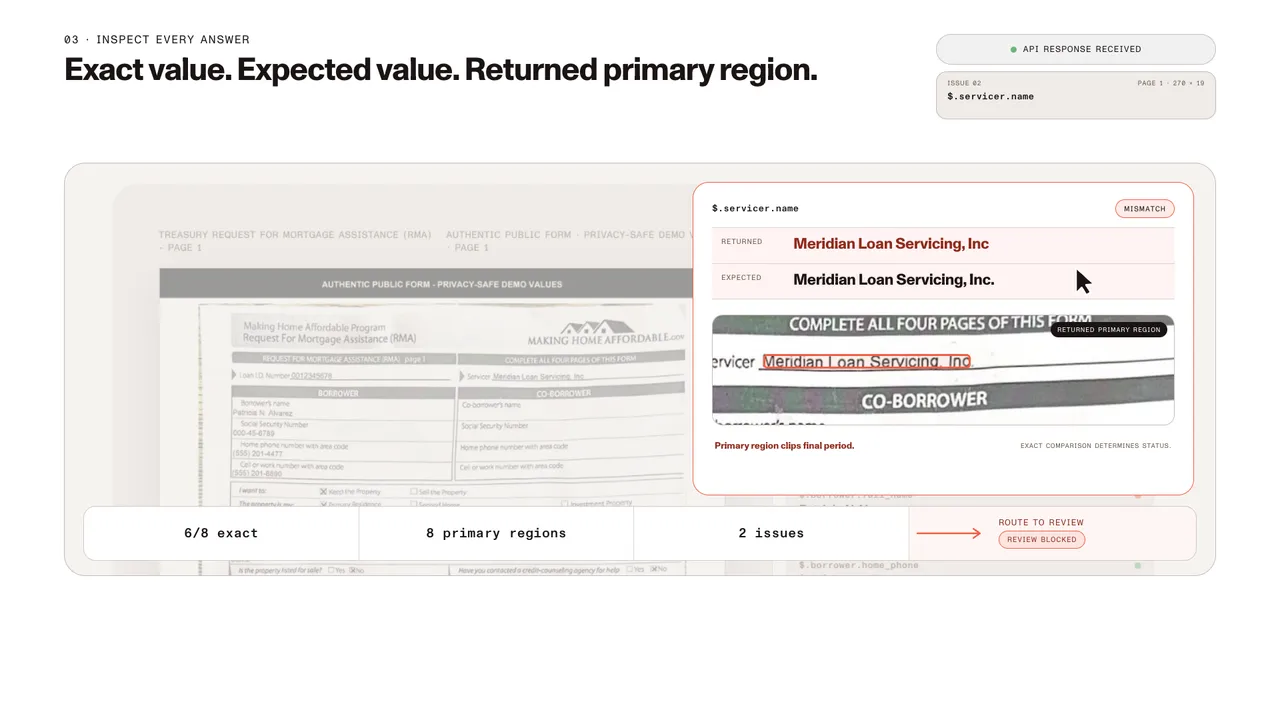
A selected public mortgage-assistance form populated with privacy-safe demo values.
- Exact
- 6/8 selected fields
- Source
- 8 returned primary source regions
- Review
- 2 issues retained
Loan applications, income and asset verification, appraisals, title documents, and closing disclosures — extracted as typed, auditable JSON. Every value carries a source citation and confidence score, so nothing enters underwriting unreviewed.
Trusted by enterprises, governments, and teams building document workflows at scale
USE CASES
GOVERNED EXTRACTION
LLMs can reason over a loan file — but underwriting workflows need deterministic, auditable output grounded in the source file, not generated answers that vary between runs.
LLM-only prompting
Nutrient Data Extraction API
Output shape
LLM-only prompting
Generated answers that can change between runs.
Nutrient Data Extraction API
Predictable structured output — typed and tied to the source document.
Routing signal
LLM-only prompting
No signal for which values to trust.
Nutrient Data Extraction API
Confidence signals route uncertain values to human underwriting review before loan decisioning.
Traceability
LLM-only prompting
No way to point back at the page.
Nutrient Data Extraction API
Coordinates and page references anchor every value to its source location.
Line items
LLM-only prompting
Tables flattened into unstructured text.
Nutrient Data Extraction API
Layout-aware structure preserves tables, forms, and key-value regions.
Review step
LLM-only prompting
Values reach downstream systems unchecked.
Nutrient Data Extraction API
Human review and validation before underwriting or the loan origination system.
Audit
LLM-only prompting
Nothing to show an auditor.
Nutrient Data Extraction API
Source context and page detail support traceable, audit-ready lending workflows.
Try it live
Switch processing modes and inspect live output from a sample invoice as rendered Markdown, raw Markdown, or spatial JSON.
HOW IT WORKS
Parse
Turn loan application PDFs, scans, images, and Office files into document structure.
Extract
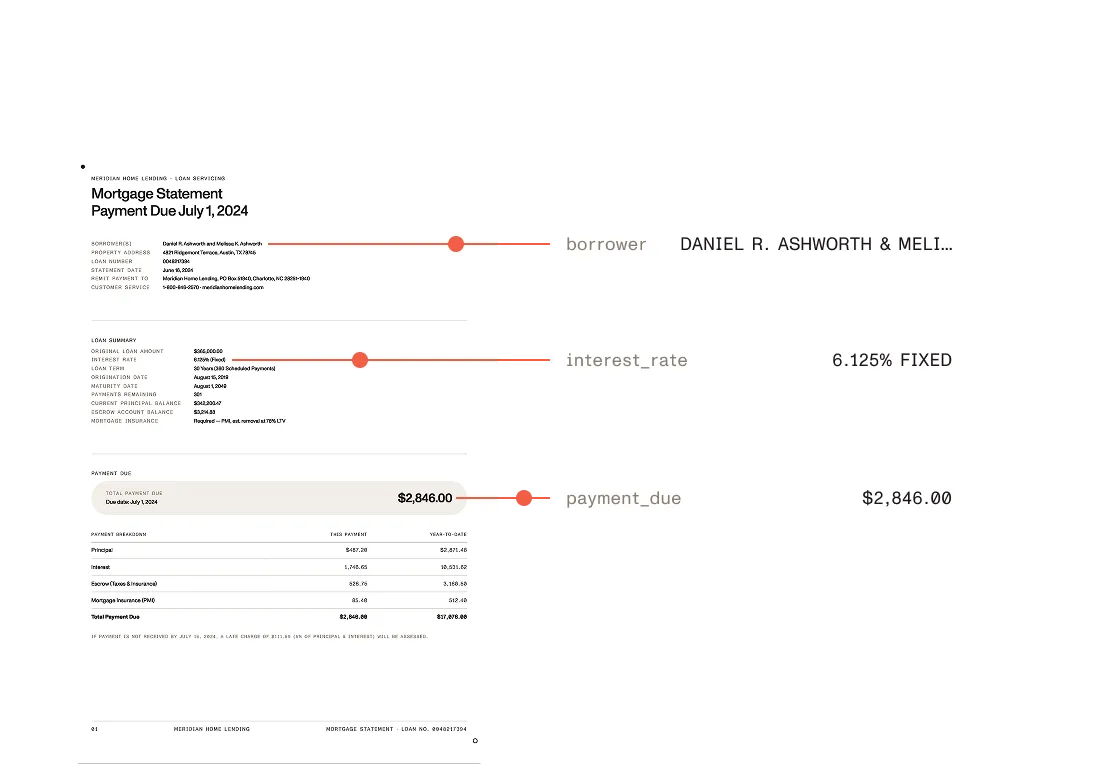
Identify key-value regions, tables, dates, and loan terms across a file.
Map
Define the fields your workflow needs using the schema generator in Studio, or write a JSON Schema directly. Get back validated, typed output.
Structure
Return typed JSON for systems and validation, or Markdown for search and AI workflows.
Process
Send structured data into underwriting queues, loan origination systems, or servicing platforms.
OUTPUT FORMATS
Confidence scores, coordinates, and page context included.
Choose output: "json" or Markdown per request.
Spatial JSON
For extraction · validation · review
{ "type": "keyValueRegion", "id": "kv_g7h8i9", "bounds": { "x": 82, "y": 128, "width": 340, "height": 128 }, "confidence": 0.97, "page": { "pageIndex": 2, "pageNumber": 3 }, "pairs": [ { "key": { "entityType": "QUESTION", "value": "Loan amount", "bounds": { "x": 82, "y": 128, "width": 120, "height": 24 }, "confidence": 0.98 }, "value": { "entityType": "ANSWER", "value": "$412,000.00", "bounds": { "x": 210, "y": 128, "width": 120, "height": 24 }, "confidence": 0.98 }, "relationshipConfidence": 0.96 }, { "key": { "entityType": "QUESTION", "value": "Interest rate", "bounds": { "x": 82, "y": 164, "width": 120, "height": 24 }, "confidence": 0.97 }, "value": { "entityType": "ANSWER", "value": "6.375%", "bounds": { "x": 210, "y": 164, "width": 80, "height": 24 }, "confidence": 0.97 }, "relationshipConfidence": 0.95 }, { "key": { "entityType": "QUESTION", "value": "Loan term", "bounds": { "x": 82, "y": 200, "width": 120, "height": 24 }, "confidence": 0.99 }, "value": { "entityType": "ANSWER", "value": "30 years", "bounds": { "x": 210, "y": 200, "width": 80, "height": 24 }, "confidence": 0.99 }, "relationshipConfidence": 0.97 } ]}Markdown
For RAG · search · knowledge bases
# Loan Estimate
**Borrower** Alex Rivera**Property address** 118 Cedar Lane, Springfield
## Loan Terms
| Field | Value || --- | --- || Loan amount | $412,000.00 || Interest rate | 6.375% || Loan term | 30 years || Monthly principal and interest | $2,571.13 |
**Lender** Springfield Home Lending
ACCURACY
Loan document-specific accuracy benchmarks are still being scoped — publicly available annotated mortgage datasets are limited. In the meantime, the general Data Extraction API benchmark — reading order, table structure, and heading hierarchy, tested on a 200-document corpus with every release — is the current accuracy proof.
Reviewed extraction example
This is one reviewed run on a selected public form populated with privacy-safe demo values. It is not an accuracy, production, or performance benchmark.
A selected public mortgage-assistance form populated with privacy-safe demo values.
Grounding makes mistakes reviewable. It does not make them correct.
The videos use an Extract → Source evidence → Decision gate schematic. It is a workflow concept, not shipped product UI.
“Reviewed” means the evidence audit was recorded. It does not mean a reviewer approved the result.
Regional processing options
Choose supported processing regions for enterprise deployments.
SOC 2 Type 2 audited
Audited annually. Reports available under NDA for enterprise customers.
Trust and compliance
TLS encryption by default
All API communication is encrypted. Unencrypted requests are rejected.
Configurable data retention
Encrypted transport and plan-level retention controls for regulated lending workflows.
Yes. The extract endpoint maps documents to a JSON Schema you define, so loan amount, rate, term, and other fields can be extracted consistently, even when lenders use different form layouts.
Data Extraction API processes PDFs, scanned documents, images, and Word, Excel, and PowerPoint files. It handles scanned loan documents, faxed forms, and mixed digital/image-based files without requiring a separate OCR pipeline.
No. Nutrient Data Extraction API is an extraction layer, not a loan origination system (LOS) or underwriting platform. It turns loan documents into structured data so that data can be reviewed, validated, and routed into the LOS or servicing platform your team already uses.
Every extracted field includes a match label, confidence score, page reference, and bounding box, so uncertain fields can be flagged for human review and traced back to the source document before entering loan decisioning.
Use the schema generator in Studio — upload example loan documents and describe the fields needed. It generates a JSON Schema for the /extract endpoint. Fields like loan amount, borrower details, and closing terms can also be defined manually.
Use agentic mode for degraded scans, faxed loan documents, and handwritten annotations where understand mode produces insufficient results. Agentic mode adds a vision language model (VLM) on top of the understand pipeline. It costs 18 credits per page.