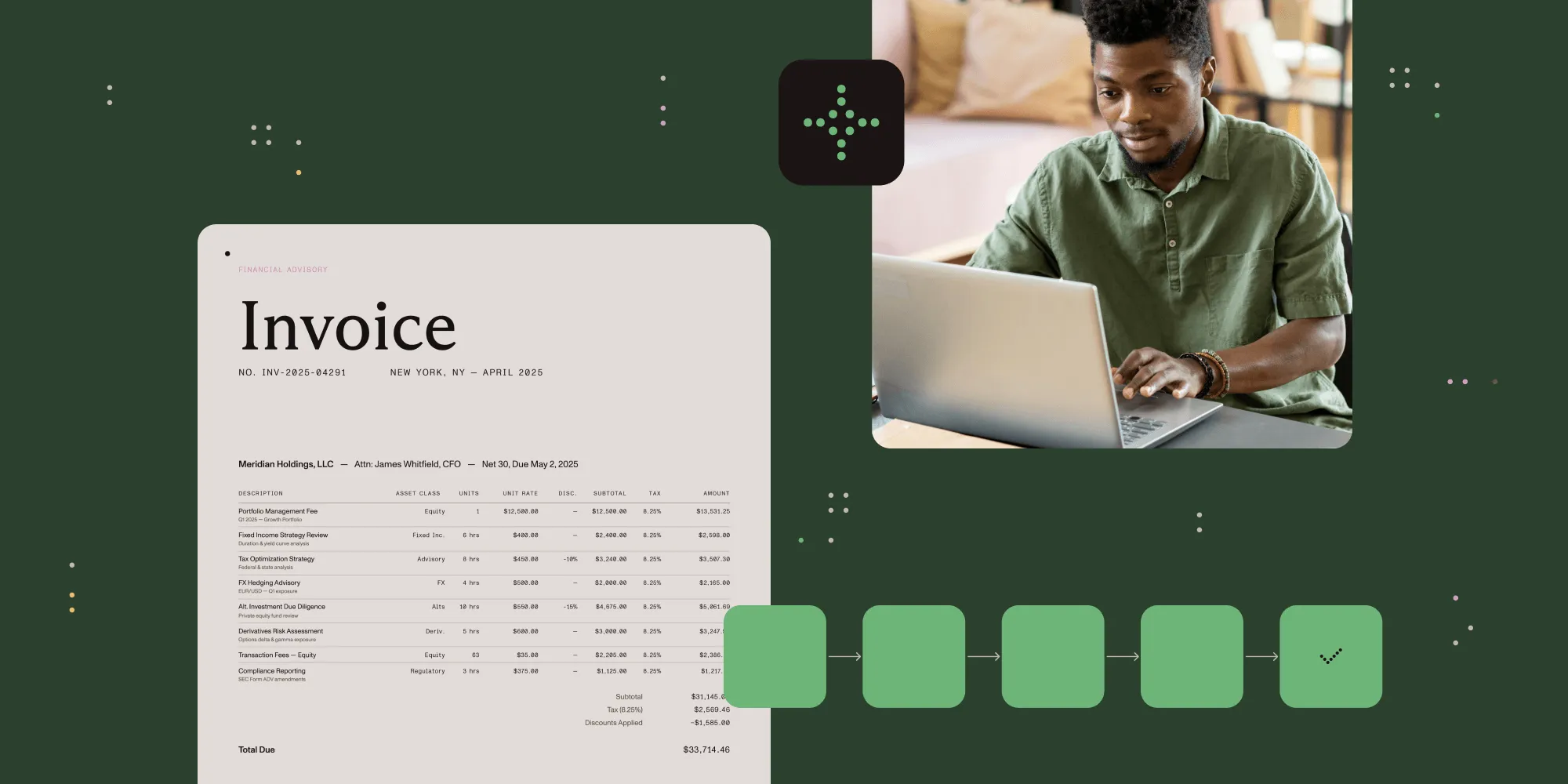




Document approval workflow: How to automate review, routing, and signoff

Table of contents

A document approval workflow moves a document through review, revision, and signoff steps until it reaches a final authorized state. This guide covers the five common approval patterns (sequential, parallel, threshold, revision loop, escalation); where approval workflows break down; how to design one step by step; and how to automate document review, routing, and signing in one system with Nutrient Workflow Automation.
Every organization runs on documents that need approval — contracts, policies, proposals, invoices, compliance filings, creative assets. The challenge isn’t the approval itself, but tracking who has the document, whether they’ve reviewed the latest version, who is next in the chain, and getting a signature at the end without losing weeks to email ping-pong.
A document approval workflow formalizes this process: It defines who reviews what, in what order, and under what conditions, as well as what happens when someone approves, rejects, or requests changes. When done well, it cuts approval time from weeks to days and creates an audit trail that compliance teams actually trust.
This guide covers how document approval workflows work, common patterns, where they break down, and how to automate them with tools that handle document review, routing, and signing in one system. Document approvals are one type of managed request — for the broader picture, see our request management guide.
What is a document approval workflow?
Each step in a document approval workflow has a defined reviewer or approver, a set of actions they can take (approve, reject, request changes), and rules for what happens next based on their decision.
The simplest workflow is linear: author creates document > reviewer evaluates > approver approves > document is finalized. But most real-world approval workflows are more complex. They involve multiple reviewers, conditional routing (legal review only if the contract value exceeds a threshold), parallel reviews (marketing and legal review simultaneously), and revision loops where rejected documents return to the author with comments.
What distinguishes a document approval workflow from a generic approval process is that the document itself is the object moving through the system — not just a form or a ticket. Reviewers need to read the actual document, annotate specific sections, suggest edits, and ultimately sign or authorize the final version.
Common document approval workflow patterns
Most real-world workflows combine two or more of the following patterns. Understanding each one helps you choose the right structure for your approval chain.
Sequential approval
The document moves through reviewers one at a time, in a fixed order. Reviewer A must approve before Reviewer B sees it.
Best for: Simple documents with a clear hierarchy — expense reports, routine policy updates, internal memos. Low complexity, easy to set up, but slow when you have many approvers.
Parallel approval
Multiple reviewers receive the document simultaneously and review independently. The workflow waits for all reviewers to complete before proceeding.
Best for: Cross-functional reviews where legal, finance, and technical teams each review different aspects of the same document. A contract might need legal review of terms, finance review of pricing, and technical review of deliverables — all happening at the same time.
Threshold-based routing
The approval path changes based on document attributes. A purchase agreement under $10K goes to the department head. Over $10K routes to the VP. Over $100K adds the CFO. For purchase-specific workflows, see our requisition form guide.
Best for: Financial documents, procurement contracts, and any approval where the risk level determines who needs to sign off. This pattern prevents senior executives from drowning in low-value approvals while ensuring high-value documents get appropriate scrutiny.
Revision loop
If a reviewer rejects or requests changes, the document returns to the author. The author revises and resubmits, and the review cycle restarts — either from the beginning or from the reviewer who requested changes.
Best for: Every document approval workflow needs a revision path. Contracts go through multiple rounds. Policies get revised based on legal feedback. Creative assets need design changes. Without a defined revision loop, rejected documents fall into email black holes.
Escalation chain
If a reviewer doesn’t act within a defined timeframe (SLA), the workflow automatically escalates — first a reminder, then reassignment to a backup reviewer, and finally a notification to the reviewer’s manager.
Best for: Time-sensitive approvals where delays have business consequences — vendor payments approaching deadline, regulatory filings, client deliverables. This prevents the “I didn’t see it in my inbox” bottleneck.
Try Nutrient Workflow Automation free for 14 days.
Where document approval workflows break down
Understanding the failure modes helps you design a better workflow.
Version confusion
The most common failure: Someone reviews an outdated version. It happens when documents are shared as email attachments, stored in shared drives without version control, or edited outside the workflow. By the time the final approver signs off, the document has already changed.
Fix: The document must live inside the workflow system. Reviewers annotate and approve the document within the tool, and not in a separate app. Every change creates a new version, and every reviewer sees the current one.
Missing audit trail
“Who approved this and when?” If the answer requires searching through email threads, Slack messages, and calendar invites, the approval process failed — even if the document was approved. Regulated industries (healthcare, finance, government) need a tamper-proof record of every approval action.
Fix: The workflow system automatically logs every action: who opened the document, who commented, who approved, who rejected, when it happened, and with what comments. No manual documentation is required.
Bottleneck approvers
One person in the chain is slow, and everything stacks up behind them. This is especially common with sequential workflows where a senior executive is required for every approval, regardless of value or risk.
Fix: Combine threshold-based routing (only escalate high-value documents) with SLA-based escalation (auto-remind after 24 hours, auto-escalate after 48). Add parallel reviews where possible to remove sequential dependencies.
Signing friction
The document is approved, but getting a formal signature requires switching to a separate eSignature tool, uploading the document again, configuring signature fields, and waiting for a new round of emails. This “last mile” often adds days to a process that should be finished.
Fix: Integrated signing. The same tool where the document was reviewed and approved should handle the signature — no export, no reupload, no second workflow.
How to design a document approval workflow
These five steps take you from understanding your current process to running an automated workflow.
Step 1: Map the current process
Before automating anything, document how approvals actually work today. Talk to the people who route documents, not just the people who sign them. You’ll discover informal steps that aren’t in any process document — things like “I always cc Sarah because she catches mistakes” or “Finance won’t approve unless the budget code is in cell B12 of the spreadsheet.”
Step 2: Define approval roles and rules
For each document type, define who reviews, who approves, and under what conditions the path changes. Be specific:
- Document type — Vendor contract
- Reviewers — Procurement (always), legal (if value > $25K), security (if data access included)
- Approver — Department head (< $50K), VP + Finance (≥ $50K)
- SLA — Review within 48 hours, approve within 24 hours after review
- Escalation — Remind at 80 percent of SLA, escalate to manager at 100 percent
Step 3: Choose your workflow pattern
Based on the roles and rules, select the right pattern (sequential, parallel, threshold, or a combination). Most real-world workflows combine patterns: parallel review by legal and finance, followed by sequential approval by the department head, with threshold escalation to the VP for high-value documents. To visualize the approval chain, see our workflow diagram guide.
Step 4: Define the revision path
What happens when someone rejects or requests changes? Does the document go back to the author? Back to the previous reviewer? Start the entire chain over? Define this explicitly — otherwise rejections create confusion about who owns the next action.
Step 5: Build, test, and iterate
Build the workflow in your automation tool, test it with a real document, and gather feedback from the people who use it daily. The first version is never perfect. Common adjustments: adding a reviewer you forgot, changing an SLA that’s too tight, and simplifying an overly complex routing rule.
Automating document approval workflows with Nutrient
Most workflow tools can route forms and tickets. But document approval has a specific requirement that generic workflow tools miss: Reviewers need to interact with the actual document — read it, annotate it, comment on specific sections, suggest edits, and sign the final version. That requires a tool built for document-centric workflows.
Nutrient Workflow Automation combines document processing capabilities with workflow automation in one platform.
Document review and markup
Reviewers open and annotate documents directly inside the workflow — PDFs, Word documents, and images. They can highlight text, add comments anchored to specific sections, draw attention to clauses that need revision, and compare versions side by side. No downloading, no switching to a separate PDF reader, no “see my comments in the attached PDF.”
Visual workflow designer
Build your approval chain visually: Drag steps onto a canvas, set conditions on decision points, define parallel branches, and configure escalation timers. The diagram you build is the workflow that runs. Route based on any document attribute or form field — dollar amount, document type, department, or risk level.
Signing (optional add-on)
When the document reaches final approval, the signature step is part of the same workflow. No exporting to a separate eSignature tool. No reuploading. The reviewer who just approved the document can sign it in the next step without leaving the platform. This eliminates the “last mile” friction that adds days to most approval processes.
AI data extraction (optional add-on)
When approval workflows involve structured documents — invoices, contracts, purchase orders — Nutrient’s AI extracts key data (amounts, dates, parties, terms) and maps it to workflow fields. The workflow can route based on extracted data: invoices over $10K go to finance, contracts with non-standard terms go to legal. No manual data entry to determine routing.
Mobile approvals
Approvers review and approve from the Nutrient Workflow mobile app on iOS and Android. Push notifications ensure documents don’t sit waiting for someone to be at their desk. SLA timers run regardless of location.
Security and compliance
Documents are protected with data encryption in transit and at rest. Access controls restrict who can view, edit, or approve each document based on role and permission level. Every action is logged automatically: who viewed the document, who annotated it, who approved or rejected, when, and with what comments. The audit trail is tamper-proof and exportable — critical for SOX, HIPAA, FDA, and any framework requiring documented approval evidence.
Dashboards
Track approval cycle times, identify bottleneck approvers, measure SLA compliance, and see where documents are stuck in real time. Spot patterns: If legal review consistently takes longer than the SLA, you know where to focus process improvement.
For more workflow solutions, see Nutrient Workflow solutions.
See how Nutrient automates document review, routing, and signing in one workflow.
Document approval workflow template
Intake forms often feed into document approval workflows — the form submission triggers the first step. Here’s a ready-to-use template for a standard workflow:
Trigger Document submitted for approval (via form or file upload).
Step 1 — Classification Auto-classify by document type and value based on metadata or AI extraction. Set routing path.
Step 2 — Primary review Assign to primary reviewer based on document type. Reviewer annotates document with comments and suggestions.
- Approve > Step 3
- Request changes > Return to author
- Reject > End with reason
Step 3 — Conditional routing If value > threshold OR flagged terms detected > route to secondary reviewer (legal, finance, compliance). Secondary reviewer annotates and decides.
- Standard > Skip to Step 4
Step 4 — Final approval Route to final approver based on document value and type. Final approver reviews all annotations from previous steps.
- Approve > Step 5
- Request changes > Return to Step 2
Step 5 — Signature Final approver (or designated signatory) signs the document within the workflow. Signed document automatically filed and distributed to stakeholders.
Throughout SLA timers on every step. Auto-remind at 80 percent. Escalate at 100 percent. Full audit trail logged.
This template maps directly to Nutrient Workflow Automation’s visual designer — each step, condition, and escalation rule is a drag-and-drop element.
Explore Nutrient Workflow Automation to build approval workflows with routing, signing, and audit trails.
FAQ
A document approval workflow is a structured process that moves a document through review, revision, and approval steps until it reaches a final authorized state. Each step has a defined reviewer, a set of actions (approve, reject, request changes), and rules for what happens next. It differs from generic approval processes because the document itself — not just a form or ticket — is the object moving through the system.
The five common patterns are: sequential (one reviewer at a time), parallel (multiple reviewers simultaneously), threshold-based (routing changes based on document value or type), revision loop (rejected documents return to the author), and escalation chain (auto-escalate when reviewers miss SLAs). Most real-world workflows combine two or more of these patterns.
Generic workflow tools route forms and tickets. Document approval software handles the document itself — reviewers need to read, annotate, comment on specific sections, compare versions, and sign the final document. Nutrient Workflow Automation combines document review, annotation, and signing with workflow routing and automation in one platform.
Yes. Automated document approval workflows create tamper-proof audit trails that log every action — who viewed, commented, approved, or rejected, and when. This matters for SOX, HIPAA, FDA, and any regulatory framework requiring documented approval evidence. The audit trail is exportable for compliance reviews.
With Nutrient Workflow Automation, most teams have their first approval workflow running within days. The visual drag-and-drop designer lets you build approval chains, set routing rules, and configure SLAs without code. Common adjustments (adding reviewers, tuning SLAs) can be made on the fly without rebuilding the workflow.
![Business process optimization: The complete guide [2026]](/_astro/article-header.mbReD9T0_Z1n0nuj.webp)