



How to watermark a PDF using Java

Table of contents

Watermark PDF documents using our watermark PDF Java API. Create a free account, get API credentials, and implement watermarking using OkHttp and JSON libraries. Add text or image watermarks to protect proprietary documents and discourage unauthorized use.
Watermark PDFs using our watermark PDF Java API. Start with 50 free credits — no payment required. Different operations consume different credit amounts, so the number of PDF documents you can generate will vary. Create a free account(opens in a new tab) to get your API key.
Nutrient DWS Processor API
Watermarking PDFs is just one of the operations possible with our 30+ PDF API tools. You can combine our watermarking tool with other tools to create complex document processing workflows, such as:
- Converting MS Office files and images into PDFs and then watermarking them
- Duplicating or deleting PDF pages before watermarking a PDF
- Merging or flattening PDFs and then watermarking the resulting document
Once you create your account, you can access all our PDF API tools.
Step 1 — Creating a free account on Nutrient
Go to our website(opens in a new tab), where you’ll see the page below, prompting you to create your free account.
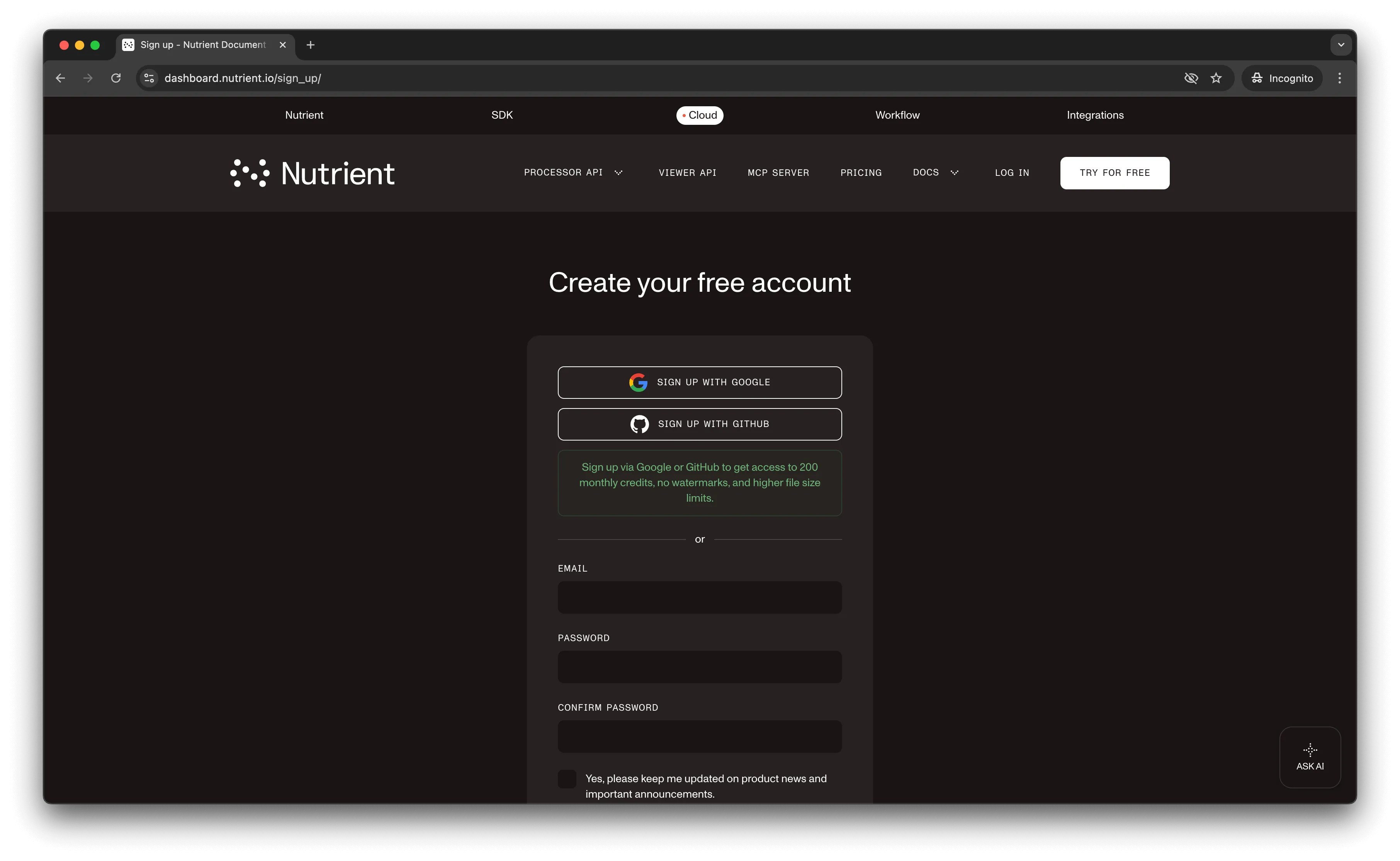
Once you’ve created your account, you’ll see a page showing an overview of your plan details.
You’ll start with 50 credits to process and can access all our PDF API tools.
Step 2 — Obtaining the API key
After you’ve verified your email, you can get your API key from the dashboard. In the menu on the left, click API keys. You’ll see the following page, which is an overview of your keys.
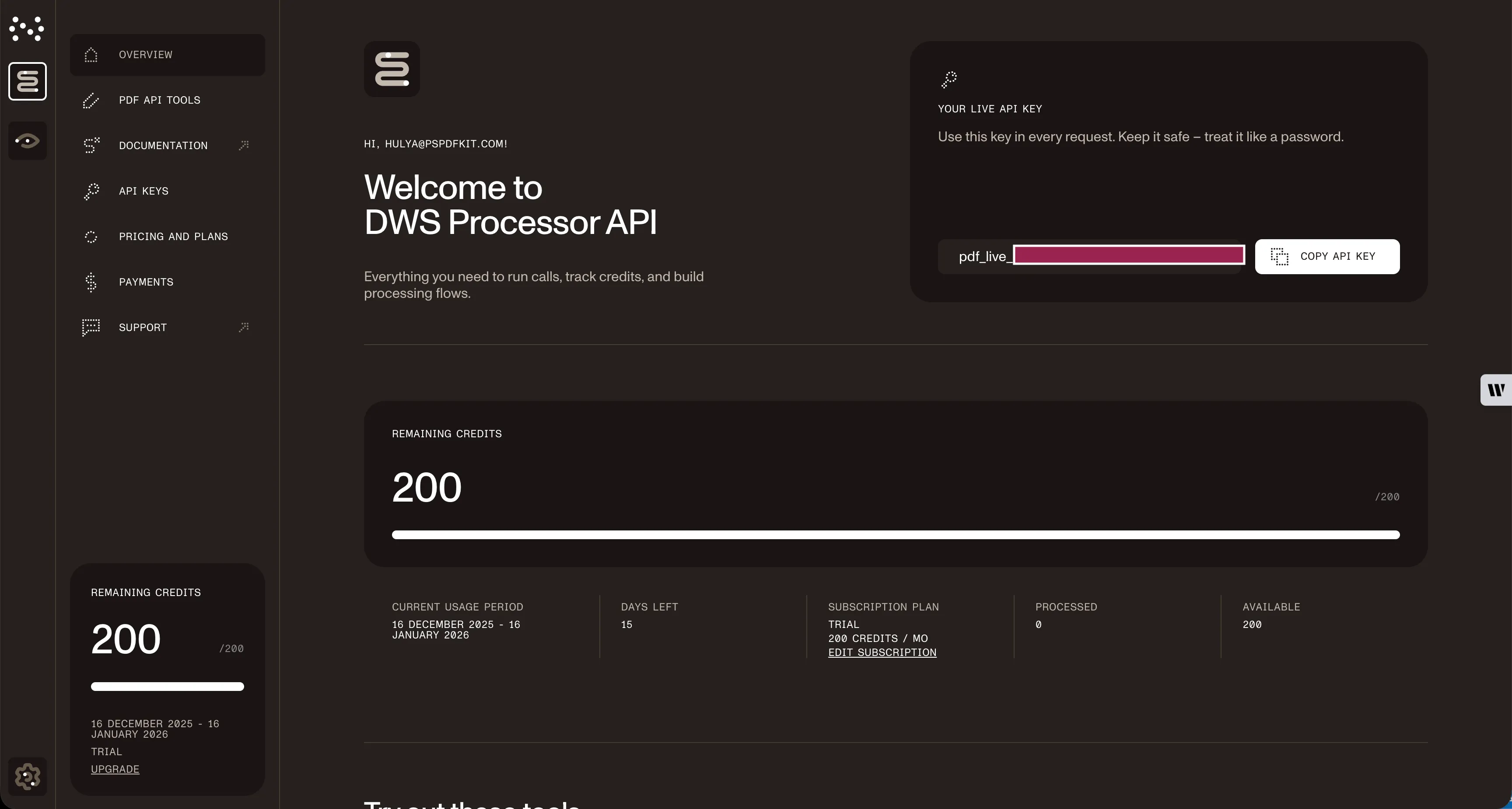
Copy the Live API key — you’ll need it for the watermark PDF API.
Step 3 — Setting up folders and files
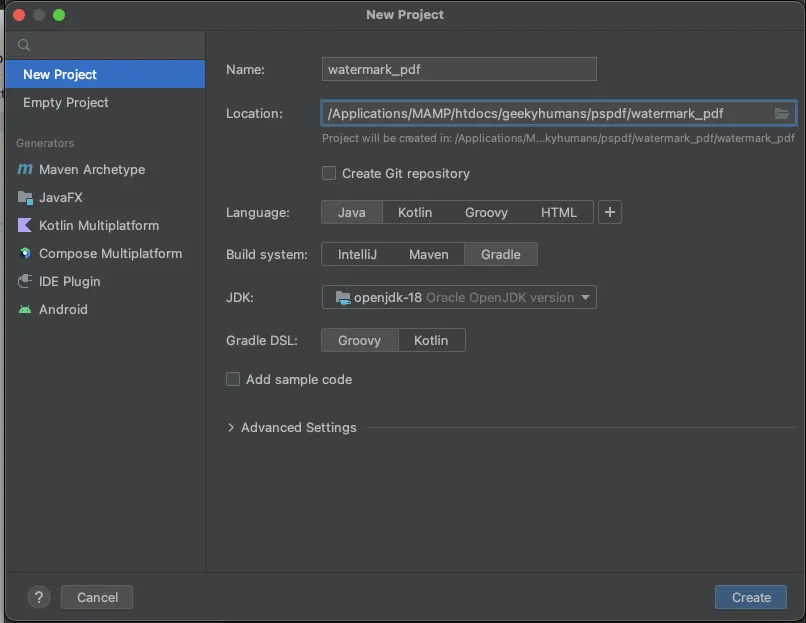
For this tutorial, use IntelliJ IDEA as your code editor. Create a new project called watermark_pdf. You can choose any location, but select Java as the language, Gradle as the build system, and Groovy as the Gradle DSL.
Create a new directory in your project. Right-click your project’s name and select New > Directory. From there, choose the src/main/java option. Once done, create a class file inside the src/main/java folder called processor.java, and create two folders called input_documents and processed_documents in the root folder.
Place both an image that you want to use as a watermark and the PDF in the input_documents folder. Name them logo.png and document.pdf.
Your folder structure will look like this:
watermark_pdf├── input_documents| └── document.pdf| └── logo.png├── processed_documents├── src| └── main| └── java| └── processor.javaStep 4 — Installing dependencies
Install two libraries:
- OkHttp — This library makes API requests.
- JSON — This library will parse the JSON payload.
Open the build.gradle file and add the following dependencies to your project:
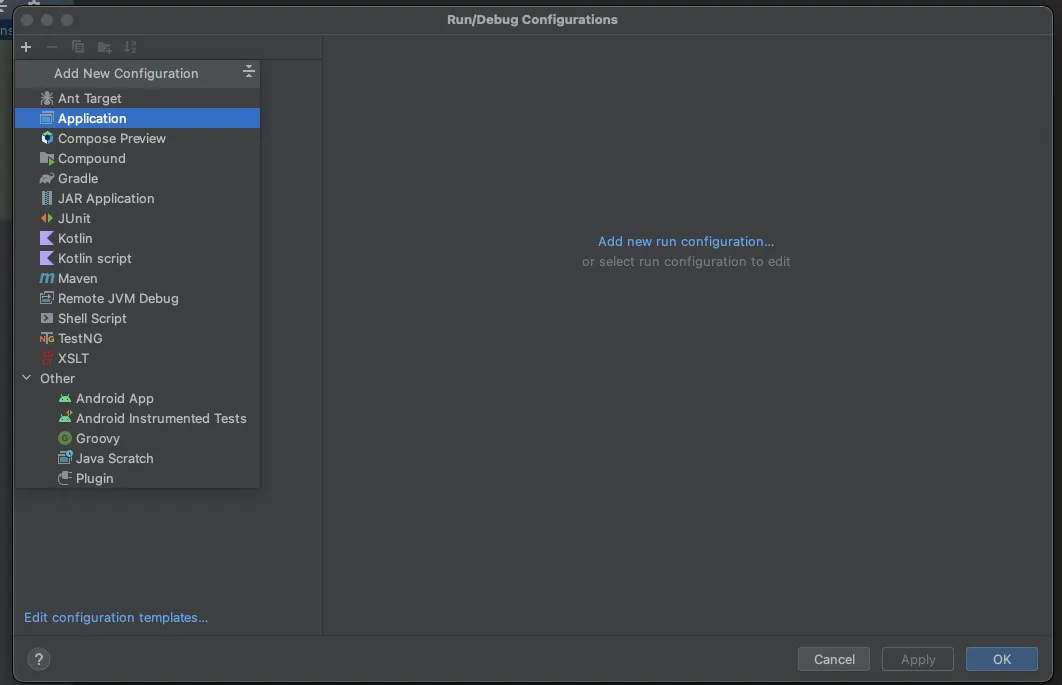
dependencies { implementation 'com.squareup.okhttp3:okhttp:4.9.2' implementation 'org.json:json:20210307'}Once done, click the Add Configuration button in IntelliJ IDEA. This will open a dropdown menu.

Next, select Application from the menu.
Now, fill the form with the required details. Most of the fields will be prefilled, but you need to select java 18 in the module field and add -cp watermark_pdf.main in the main class.
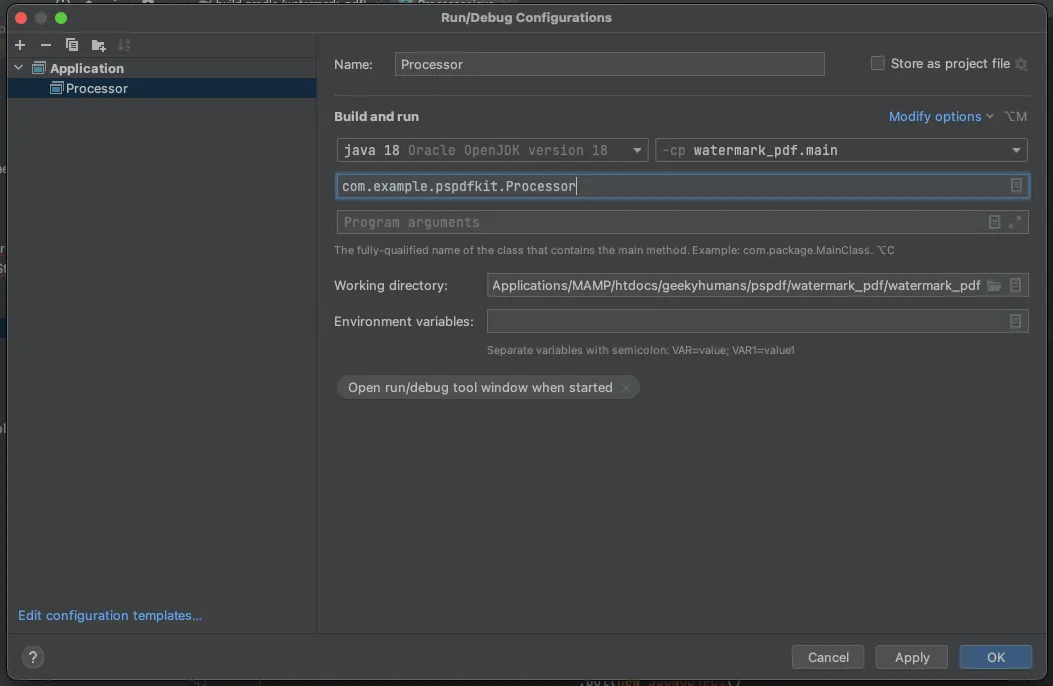
To apply settings, click the Apply button.
Step 5 — Writing the code
Open the processor.java file and paste the code below into it:
package com.example.pspdfkit;
import java.io.File;import java.io.IOException;import java.nio.file.FileSystems;import java.nio.file.Files;import java.nio.file.StandardCopyOption;
import org.json.JSONArray;import org.json.JSONObject;
import okhttp3.MediaType;import okhttp3.MultipartBody;import okhttp3.OkHttpClient;import okhttp3.Request;import okhttp3.RequestBody;import okhttp3.Response;
public final class Processor {  public static void main(final String[] args) throws IOException {    final RequestBody body = new MultipartBody.Builder()      .setType(MultipartBody.FORM)      .addFormDataPart(        "document",        "document.pdf",        RequestBody.create(          MediaType.parse("application/pdf"),          new File("input_documents/document.pdf")        )      )      .addFormDataPart(        "logo",        "logo.png",        RequestBody.create(          MediaType.parse("image/png"),          new File("input_documents/logo.png")        )      )      .addFormDataPart(        "instructions",        new JSONObject()          .put("parts", new JSONArray()            .put(new JSONObject()              .put("file", "document")            )          )          .put("actions", new JSONArray()            .put(new JSONObject()              .put("type", "watermark")              .put("image", "logo")              .put("width", "25%")            )          ).toString()      )      .build();
    final Request request = new Request.Builder()      .url("https://api.nutrient.io/build")      .method("POST", body)      .addHeader("Authorization", "Bearer YOUR_API_KEY_HERE")      .build();
    final OkHttpClient client = new OkHttpClient()      .newBuilder()      .build();
    final Response response = client.newCall(request).execute();
    if (response.isSuccessful()) {      Files.copy(        response.body().byteStream(),        FileSystems.getDefault().getPath("processed_documents/result.pdf"),        StandardCopyOption.REPLACE_EXISTING      );    } else {      // Handle the error.      throw new IOException(response.body().string());    }  }}
Make sure to replace YOUR_API_KEY_HERE with your API key.
Code explanation
In the code above, you import all the packages required to run the code and create a class called processor. In the main function, you first create the request body for the API call that contains all the instructions for watermarking the PDF. You then call the API to process the instructions.
You call the execute() function and pass the FormData variable. The API response is stored in the processed_documents folder.
Output
To execute the code, click the Run button (which is a little green arrow). This is next to the field that says Processor, which is where you set the configuration.

On the successful execution of the code, you’ll see a new processed file named result.pdf in the processed_documents folder.
The folder structure will look like this:
watermark_pdf├── input_documents| └── document.pdf| └── logo.png├── processed_documents| └── result.pdf├── src| └── main| └── java| └── processor.javaAdditional resources
Explore more ways to work with Nutrient API:
- Postman collection — Test API endpoints directly in Postman
- Zapier integration — Automate document workflows without code
- MCP Server — PDF automation for LLM applications
- JavaScript client — Official JavaScript/TypeScript library
Conclusion
You’ve learned how to watermark PDF documents for your Java application using our watermark PDF API.
You can integrate these functions into your existing applications to watermark PDF pages. With the same API token, you can also perform other operations, such as merging documents into a single PDF, running OCR, duplicating pages, and more. To get started with a free trial, sign up(opens in a new tab) here.
FAQ
Nutrient DWS Processor API offers 30+ PDF operations, including merging, splitting, OCR, flattening, and converting Office documents to PDF. You can combine these operations in a single workflow. For example, merge multiple PDFs, watermark the result, and then flatten it to prevent editing — all through the same API.
Yes! Use our Postman collection to test all API endpoints directly in Postman. Import the collection, add your API key, and experiment with different operations and parameters. This helps you understand the API before integrating it into your Java application. You can also test using cURL in your terminal.
Use our Zapier integration to automate PDF processing without writing code. Connect Nutrient DWS Processor API with 5,000+ apps like Google Drive, Dropbox, Gmail, and Slack. For example, automatically watermark PDFs when they’re uploaded to Google Drive, or watermark invoices from email attachments before saving them.
Yes. Replace the watermark action with text instead of an image. Change .put("image", "logo") to .put("text", "CONFIDENTIAL") and add optional parameters like .put("fontSize", 48), .put("opacity", 0.5), and .put("rotation", 45) for customization. Text watermarks are useful for marking documents as drafts or confidential.
Add a pages object to the part in your instructions JSONObject. For example: .put("pages", new JSONObject().put("start", 1).put("end", 5)) watermarks only pages 1–5. You can also watermark specific non-contiguous pages by creating multiple parts with different page ranges in the same API call.