AI AND AGENTS
AI agents can read and understand documents. They can’t render PDFs, apply digital signatures, validate compliance, or fill form fields. Nutrient provides the document infrastructure layer — deterministic, auditable, production-ready — so your agents can do real work with real documents.
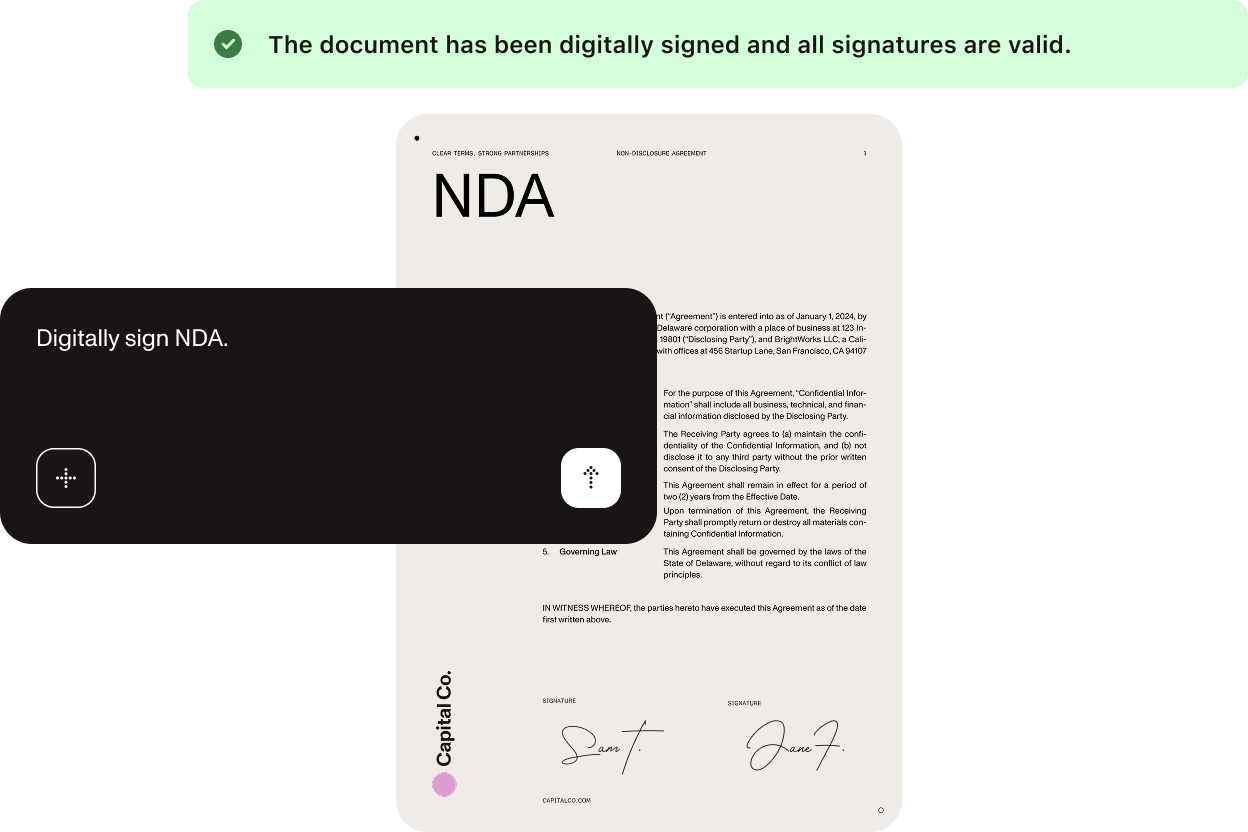
THE READ-WRITE GAP
Large language models excel at understanding, summarizing, and extracting information from documents. But they cannot render a PDF page, cryptographically sign a contract, validate PDF/A compliance, fill interactive form fields, or perform pixel-accurate redaction. These operations require purpose-built document infrastructure — deterministic, auditable, and battle-tested. Nutrient bridges this gap.
WHAT LLMs CAN DO
Parse content, answer questions, and pull structured data from documents.
Identify document types, detect intent, and route to the right workflow.
Convert between languages and surface semantic differences between versions.
WHAT LLMs CAN’T DO
Pixel-perfect PDF rendering, PAdES digital signatures, PDF/A compliance validation.
Populate interactive form fields, flatten annotations, apply watermarks.
Permanent, irrecoverable PII removal — not black boxes layered on top of text.
THE DOCUMENT COMPANY
Nutrient is the document company. From low-level SDKs to AI-powered workflows, we provide the full stack developers and enterprises need to build, integrate, automate, and understand documents at scale.
SDKs and APIs for viewing, editing, annotating, signing, and converting documents across every platform — web, iOS, Android, Windows, macOS, Linux, and server.
Platform integrations for SharePoint, Power Automate, and enterprise content management systems. Drop Nutrient into the tools your teams already use.
Workflow automation for operations teams. Drag-and-drop document processing, extraction, and routing — no code required.
AI and Vision API for intelligent document understanding. OCR, table extraction, key-value pairing, and content classification powered by hybrid AI models.
Hand your LLM a prompt. Get a finished, compliant document back. No SDKs to learn, no API calls to write — just infrastructure that works.
GET STARTED IN MINUTES
./inbox to DOCX, redact PII, and save to ./outbox.”
{ "mcpServers": { "nutrient-dws": { "command": "npx", "args": ["-y", "@nutrient-sdk/dws-mcp-server"], "env": { "NUTRIENT_DWS_API_KEY": "YOUR_KEY" } } }}WORKS WITH EVERY AGENT FRAMEWORK
Native MCP protocol support. Add the server to your claude_desktop_config.json and start prompting.
Expose the server’s JSON schema as function tools. Deterministic responses, no hallucinated API calls.
Wire Nutrient operations as tool nodes in your graph. Each operation returns structured JSON.
HTTP/SSE or stdio transport. JSON schema tool definitions work with any framework that supports tool use.
Every operation available to LLMs via MCP — deterministic, auditable, and production-ready.
COMING SOON
A new approach to document understanding that combines vision language models with traditional algorithmic OCR. Table extraction, key-value pairing, and intelligent character recognition — powered by a hybrid pipeline that delivers the accuracy of proven algorithms with the flexibility of modern AI. Purpose-built for the documents AI agents struggle with most: scanned forms, handwritten notes, and complex multicolumn layouts.
Embed an AI assistant directly inside your document viewer. Users ask questions, summarize, translate, redact, and extract — in context, on the document they’re looking at.
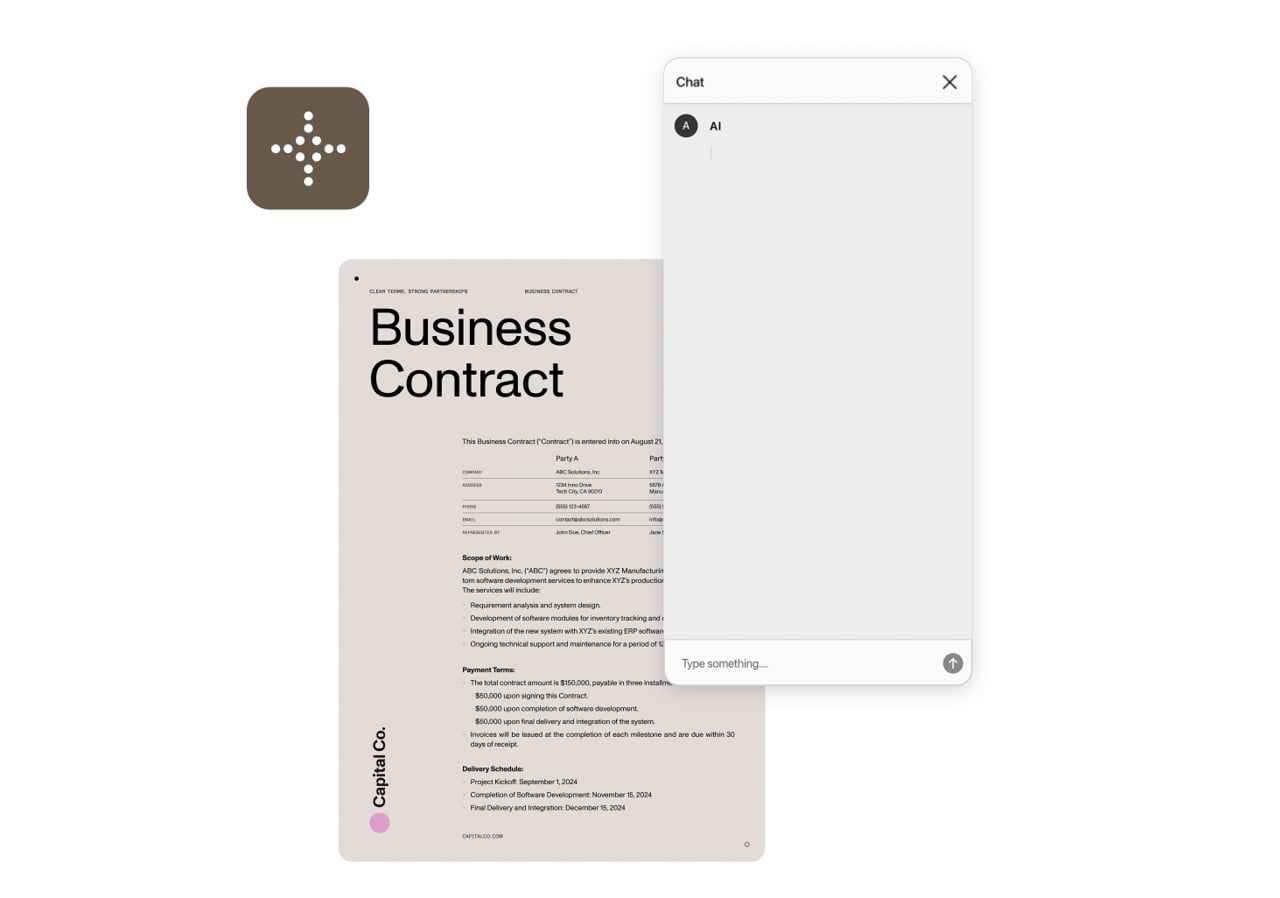
Embed AI Assistant into any app on any platform with a few lines of code.
OpenAI, Anthropic, AWS Bedrock, or self-hosted open source models — your choice.
AI-enhanced diffs that surface meaning-level changes, not just character differences.
TRUSTED AT SCALE
Nutrient processes millions of documents daily for organizations that can’t afford to get document handling wrong.
SECURITY AND DEPLOYMENT
Document compliance is infrastructure, not intelligence. Deploy Nutrient on your terms — self-hosted, managed cloud, or hybrid — with the security controls your organization requires.
Every MCP job runs in an isolated workspace. Secrets and file systems stay safe.
Deploy on your infrastructure with your LLM, or use Nutrient’s managed cloud with dedicated SLAs.
Nutrient never trains models on your documents. Self-hosted LLMs keep everything within your perimeter.
Every operation is logged and traceable. SOC 2 Type 2 audited, GDPR-compliant, and built for regulated industries.
REGULATED INDUSTRIES
For enterprises in healthcare, legal, finance, and government — dedicated document processing agents with full audit trails, HIPAA/SOC 2/GDPR compliance, and zero access to anything but documents.
Free trial includes full MCP Server access, all SDK components, and Document Engine.
Nutrient MCP Server is an open source microservice that translates natural language prompts from any LLM into deterministic API calls to Nutrient’s document processing infrastructure. Your agent says “redact PII and sign this PDF,” and the MCP server handles the actual document operations. It supports HTTP/SSE and stdio transport, and it works with Claude, GPT, LangGraph, and any MCP-compatible agent framework.
The read-write gap is the fundamental limitation of AI agents when working with documents. LLMs excel at reading — understanding, summarizing, and extracting information from documents. But they cannot write — render PDFs, apply cryptographic signatures, validate compliance standards, fill interactive forms, or perform pixel-accurate redaction. These write operations require deterministic, purpose-built document infrastructure. Nutrient bridges this gap by providing the infrastructure layer that makes AI agents capable of complete document workflows.
LLMs are excellent at understanding and generating text, but they cannot perform deterministic document operations. They can’t render a PDF page, cryptographically sign a document, validate PDF/A compliance, fill interactive form fields, or perform pixel-accurate redaction. These operations require purpose-built document infrastructure — which is exactly what Nutrient provides and what the MCP server exposes to your agents.
Nutrient MCP Server works with any framework that supports tool use/function calling:
The full Nutrient DWS feature set is available:
Vision API is an upcoming Nutrient product that combines vision language models (VLMs) with traditional algorithmic OCR to deliver hybrid document intelligence. It’s designed for the documents AI agents struggle with most — scanned forms, handwritten notes, and complex layouts. Capabilities include table extraction, key-value pairing, and intelligent character recognition (ICR). Contact Sales to learn more about early access.
Security is built into the infrastructure:
Yes. The Nutrient DWS MCP Server is MIT-licensed and available on GitHub. Fork it, extend it, or contribute.
Three steps:
{ "mcpServers": { "nutrient-dws": { "command": "npx", "args": ["-y", "@nutrient-sdk/dws-mcp-server"] } } }./inbox to DOCX and redact PII.”For detailed guides, see the MCP Server page or developer documentation.