



From curiosity to PLG (and AI): My journey to understanding product-led growth

Table of contents
OK, so here’s a confession: I didn’t really “get” product-led growth (PLG) at first. I kept hearing about it in podcasts and reading about it in pitch decks and Twitter threads, but it only started making sense to me after I saw how AI is transforming PLG in real time.
Today, AI isn’t just a buzzword — it’s reshaping product-led growth by reducing time-to-value, guiding onboarding, and turning software into something that feels proactive and alive. But to appreciate that shift, I had to first understand what PLG actually meant.
Explore practical ways AI is transforming product-led growth strategies and accelerating time-to-value for SaaS users.
What is PLG?
PLG is a go-to-market strategy where the product leads the customer journey. Instead of starting with demos or sales calls, users can dive right in by signing up, exploring, and experiencing value immediately. If it solves their problem, they upgrade.
It’s not that sales calls are bad — they’re essential for complex deals. PLG just offers a different entry point: try first, buy later. It’s like the software equivalent of “just vibes.” Except those vibes are backed by a really sharp user experience (UX) and onboarding that feels like magic.
PLG companies design their software to deliver immediate value: Users sign up, experience that “aha” moment, and upgrade — all with minimal friction.
A short history of PLG: From boxes to browser tabs
To understand PLG, I had to rewind.
- 1990s — Back in the 90s, software came in literal boxes with CDs. You needed an IT team to install it and a budget approval to even consider it. It was sales-led to the core: long sales cycles, big contracts, and quarterly business reviews (whatever those were).
- 2000s cloud era — Then came the cloud. Suddenly, we could ship software online. That helped… but the mindset stayed the same: sales first, product second.
- 2010s PLG revolution — Beginning in the 2010s, apps started spreading like wildfire with clever invite incentives, like “get extra storage when a friend signs up.” Teams could get started instantly — no sales calls, no pitch decks. Just a signup button and a rush of dopamine.
That’s when I finally got it: PLG isn’t just a growth model. It’s a product philosophy. One that says, “Trust the user. If the product is good, they’ll stick around.”
Understanding PLG and SLG
Here’s what clicked for me: Different customers buy differently. Some want to explore products independently and get started fast. Some want to start by independently exploring and then engaging with sales later. And some want to dive into consultation, custom solutions, and hands-on support right away.
All of these approaches work — they just serve different needs.
| Sales-led growth (SLG) | Product-led growth (PLG) | |
|---|---|---|
| Best for | Enterprise deals, complex solutions | SMBs, self-service, rapid adoption |
| Sales motion | Consultative, relationship-driven | Product-driven, self-discovery |
| Customer engagement | High-touch support, custom solutions | Low-touch onboarding, quick wins |
| Time to value | Longer, with guided implementation | Instant, frictionless trial |
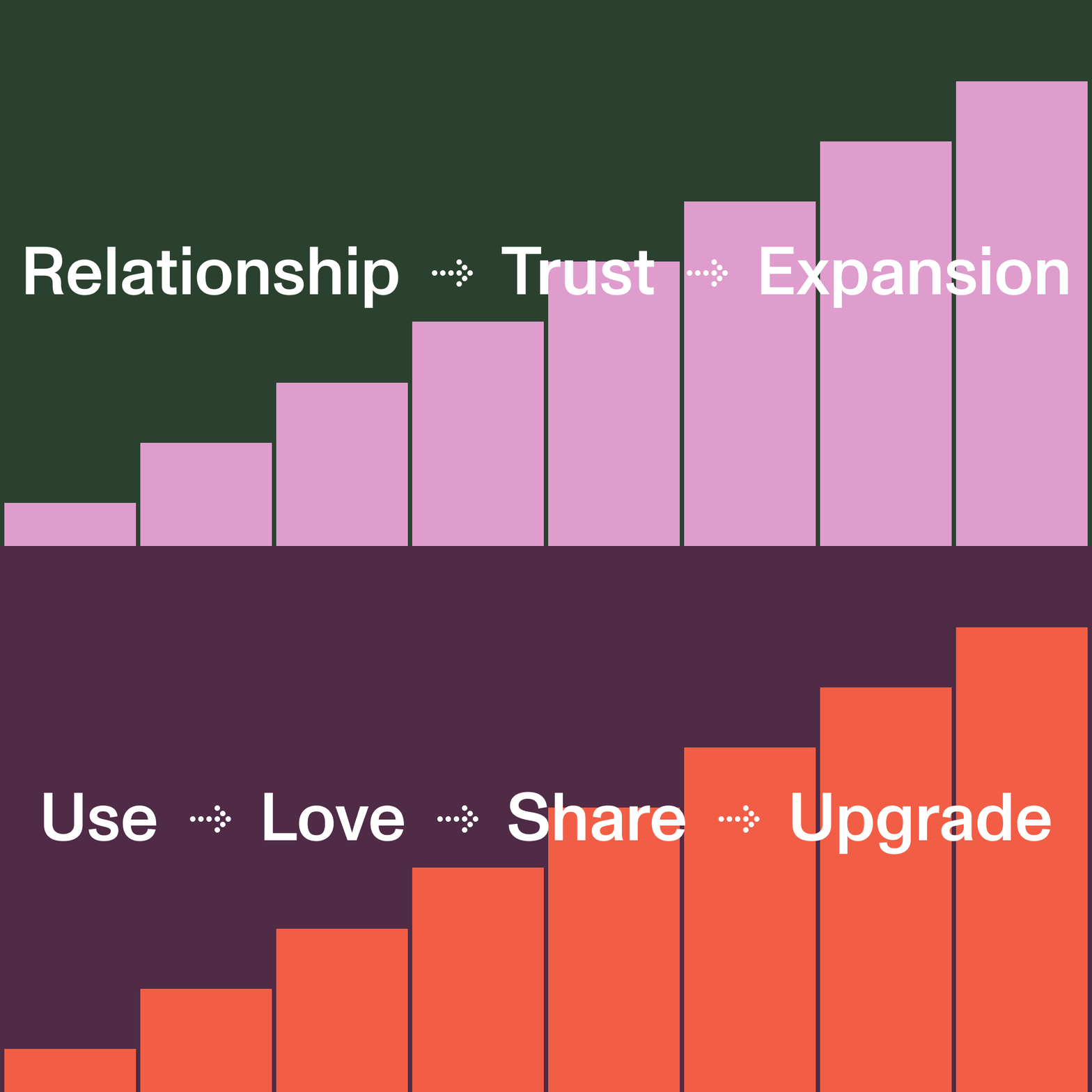
| Growth flywheel | Relationship → trust → expansion | Try → love → share → upgrade |
Each approach tracks different metrics: SLG focuses on pipeline, deal velocity, and customer lifetime value (CLV), while PLG emphasizes time-to-value, net promoter score (NPS), and product-led expansion. The best companies use both, meeting customers where they are.
Why hybrid growth wins: The Nutrient approach
Here’s the reality: Most successful B2B companies don’t pick one lane; they run both. Even at Nutrient, to provide the best experience for our customers based on their preferences, we offer multiple entry points and experiences that align with how each customer prefers to engage. Developers and users can download our products to try, test, and use at their own pace. At the same time, as their needs grow, they can connect with us directly to get a more customized experience. We also provide clear upgrade paths along the way — whether that’s via dedicated infrastructure, expanded functionality, or flat-rate pricing.
When SLG shines:
- Enterprise customers with complex requirements need dedicated support
- High-value deals require customization, security reviews, and contract negotiations
- Regulated industries demand compliance expertise and hands-on implementation
When PLG shines:
- SMBs and startups want to test products immediately without friction
- Developers need to spin up proofs of concept (POCs) fast — often “vibe coding” to validate ideas
- Product teams want self-service trials to evaluate fit before committing
At Nutrient, we bridge both strategies to meet customers where they are. Our Sales team excels at supporting enterprise customers with sophisticated needs, while our PLG motion removes barriers for developers and smaller teams who just want to get started quickly.
The key insight? Different customers are at different stages. Some need to talk. Others need to try. The smartest approach is building a company that supports both.
Where AI walks in (and makes PLG even smarter)
After finally wrapping my head around PLG, I had a new question buzzing in my brain:
“Wait — if PLG is all about users discovering value on their own… and AI is automating, well, everything… what happens when the two collide?”
Honestly, I wasn’t sure at first. Was AI just going to be another layer of buzzword frosting? Or was it actually going to change the game? I started watching closely. And yeah, it turns out, AI doesn’t just help PLG. It turbocharges it.
Watching it happen at Nutrient
At Nutrient, I’ve observed this shift firsthand. We made a strategic decision to expand beyond our sales-led model and embrace PLG — specifically targeting SMBs and developers who needed to move fast.
The PLG products we built:
- Document Converter and Document Editor for low-code document conversion and editing
- DWS Processor API and DWS Viewer API for developer-first integrations
We offer free trials, as well as paid plans, so users can get started immediately. And for those who need it, we provide bespoke upgrade paths with extra flexibility or advanced capabilities.
Why PLG offerings matter — Most POCs these days are “vibe coded,” with developers spinning up quick prototypes to validate ideas. They don’t want to wait for sales approval or fill out forms. They need frictionless onboarding to experience value immediately.
Add AI — To make it even smoother, we plugged AI into our entire user journey; from documentation to the product itself, we integrated AI everywhere. The biggest friction in PLG is getting users to understand and use the product quickly, and AI reduces that friction. Like, almost rudely fast. No more guessing what to click. The product goes from passive to proactive. Here’s what we did:
- Dropped an AI chatbot into our guides.
- Added AI support(opens in a new tab) to our support pipeline to handle first-level support.
- Made our content easier for LLMs to read with
llms.txt. - Added a dropdown on every documentation page to open with ChatGPT, Claude, or Grok. When using these, the AI already knows what page you’re on, and on mobile, it even deep-links straight into the ChatGPT app. No copy-paste, no “here’s the URL” — just instant help.
- Added a Copy Page dropdown option, so that you can grab a full Markdown version of any guide (tabs, accordions, code samples, everything) to feed to whatever AI you want. Try it now.
- Built MCP servers(opens in a new tab) to let agents pull data straight from our SDKs.
- Embedded AI into our actual product, so our users could do the same for their users.
Everything got snappier, and more helpful. As a result:
- Onboarding adapts to each user.
- Documents become conversational.
- Support is 24/7 and knows your context.
- Users get nudged toward features they didn’t know they needed (but now love).
At this point, I scribbled something dramatic in my notes like:
AI makes the product feel alive. Like it wants you to succeed.
Too much? Maybe. But honestly, it’s not far off.
Ready to get started?
Whether you want to dive in immediately or discuss your specific needs first, we’re here to support you.
Try our self-service APIs and experience instant value with our PLG offerings.
Connect with our team to explore solutions tailored to your needs.