



Best LLM document understanding platforms compared (2026)

Table of contents

Structured output with per-field confidence scores through the Nutrient Data Extraction API.
- Choose the Nutrient Data Extraction API when an engineering team needs a document’s meaning returned as schema-shaped JSON from PDFs, scans, and images, with bounding-box source grounding and per-field confidence to route review — and AI Document Processing when the same work has to run inside your own infrastructure.
- A hyperscaler service — Google Document AI, Azure AI Document Intelligence with Content Understanding, or Amazon Textract with Bedrock — fits when documents, identity, storage, and monitoring should stay inside one cloud.
- An enterprise intelligent document processing (IDP) platform such as ABBYY Vantage or Hyperscience fits when the operating model is a supervised processing line with its own exception queues and audit reporting.
- A focused parse-and-extract API such as LlamaIndex, Reducto, or Landing AI Agentic Document Extraction fits when developers will build the review layer themselves.
- Unstructured fits when the job is retrieval ingestion — typed elements, chunking, and connectors — rather than named business fields.
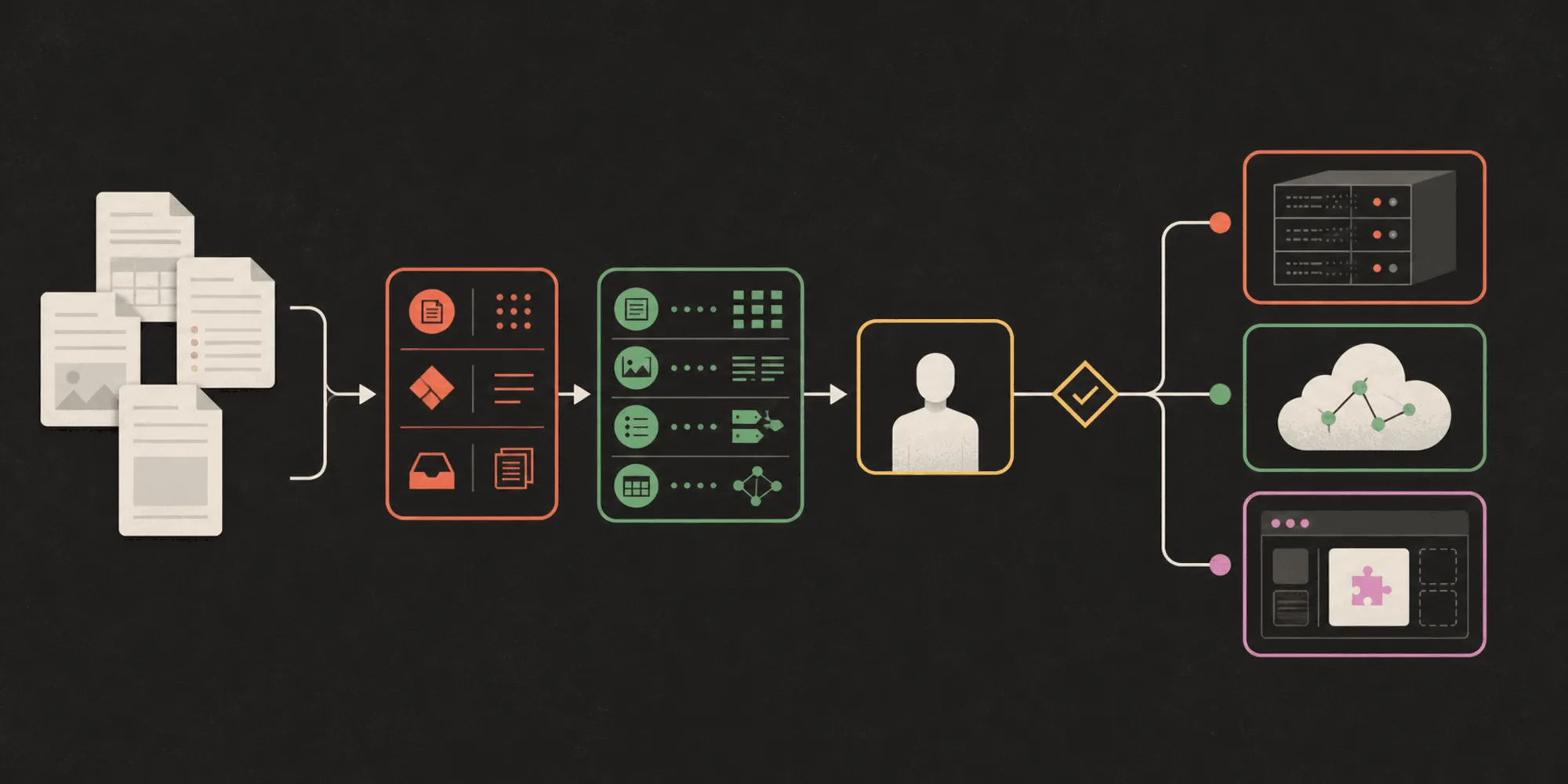
For LLM-based document understanding, the pick is the Nutrient Data Extraction API — it maps a PDF, scan, or image to a JSON Schema you define and returns each value with a bounding box, a grounding match label, and a per-field confidence signal — paired with Nutrient AI Document Processing when the pipeline has to run on your own infrastructure. That’s the pick for this wording, not a claim that one vendor wins every document set. The decision is narrower than a feature list: Who controls the output schema, can a reviewer trace each value to a page region, how do scans and tables behave, where is processing allowed to happen, and how does the meter work?
This guide compares 10 platforms across four classes: grounded extraction APIs, hyperscaler document services, enterprise IDP platforms, and ingestion toolkits. Every competitor description below repeats only what that vendor’s own documentation states.
What LLM document understanding means
Document understanding is the step where a large language model (LLM) or a vision language model (VLM) reads both a document’s content and its layout, then answers questions about it. In production, those questions are almost always a schema: You ask for invoice_number, policy_effective_date, or borrower_name, and get typed values instead of prose.
That’s a different job from optical character recognition (OCR). OCR turns pixels into characters and gives you a wall of text. It doesn’t decide which of the four dates on an invoice is the due date, and it can’t relate a number in a table cell to its column header. Understanding starts where recognition stops.
It’s also a different job from classification, which answers what a document is so the file can be routed to the right schema, template, or queue. Nutrient runs that as its own operation: the classify endpoint (POST /extraction/classify) scores a document against the labels you supply in the request — at least two, each a name with an optional description — and returns the top label with its score plus the full ranked list, at a flat one credit per page. Scoring is zero-shot, so there’s no training data and no templates to maintain, and a new set of document types is a new label list. Understanding answers the questions that come after the label — what the document says, where each answer sits, and how strong the evidence is. The document classification comparison covers routing on its own.
Two properties separate understanding from a plain model call: grounding and confidence. Grounding ties an extracted value to a region of the source page, so a reviewer sees evidence rather than trusting output. Confidence ranks how sure the extraction was. Without both, an LLM answer about a document is an assertion, and assertions don’t survive an audit.
Criteria that decide the choice
Schema control without training
The most useful question to ask a vendor is who defines the output. Nutrient’s extract endpoint takes a JSON Schema in the request and returns data shaped to it, so adding a field is a schema edit rather than a labeling project. Google Document AI’s Custom Extractor, LlamaExtract, and Azure Content Understanding also start from caller-defined fields, while other products expect a trained model, a template, or labeled examples first. Neither approach is wrong, but the change-request timelines differ enormously.
Grounding and confidence for review routing
Grounding and confidence only matter if your queue can act on them. Nutrient’s citations and confidence guide documents a match label per field — id_match, fuzzy_match, and not_found among them — plus a bounding box, page number, and a composite confidence score from zero to one. That score is a relative, uncalibrated signal rather than a probability, so use it as a routing input beside the grounding label, not as a number shown to a customer. Ask every candidate what happens when a value can’t be grounded.
Scans, tables, and handwriting
Most enterprise corpora aren’t born-digital. Nutrient’s processing modes guide splits the work into four modes — text for born-digital Markdown, structure for OCR and basic segmentation, understand for AI-augmented layout and key-value semantics, and agentic for VLM-augmented handling of degraded scans, cursive handwriting, and image descriptions. Test scans, rotated pages, merged table cells, and handwriting separately, because one accuracy figure hides all four.
Deployment boundary
Decide where documents are allowed to be processed before you shortlist. Nutrient runs one extraction engine in two deployments: the hosted Data Extraction API, with regional processing options for enterprise deployments, and the self-hosted AI Document Processing SDK, whose Vision API runs on your infrastructure in Python or Java. Reducto documents hosted, virtual private cloud (VPC), and air-gapped options, and the hyperscaler services run inside their own clouds. A deployment label isn’t evidence, so validate the exact mode and region you intend to run.
Pricing shape
Meters differ more than list prices do. Nutrient meters credits per page by mode, and its pricing page states that Extract adds credits per page on top of the selected Parse mode. Others price per page, per document, per processor, or per seat. Normalize every quote to one workload — real page count, real mode, retries, and review rate — before comparing numbers.
Evaluation on your own documents
Published benchmarks narrow a shortlist. They don’t settle it. Nutrient publishes its parsing results on the public opendataloader-bench corpus of 200 PDFs, where understand mode scores 0.93 overall and docling 2.110.0 scores 0.89, and reruns the suite on every release — see the Data Extraction API benchmarks and the methodology write-up. Your corpus decides. Use 30–50 representative files, one fixed output contract, and the same scoring method for every candidate.
Comparison table
The table compares documented capabilities and output contracts, not a ranking.
| Platform | Class | Genuine strength | Output and grounding | Choose it when |
|---|---|---|---|---|
| Nutrient Data Extraction API | Grounded extraction API | Four modes from born-digital text to VLM-augmented agentic parsing, plus a zero-shot classify endpoint and the same engine as a self-hosted SDK | Markdown or spatial JSON, plus schema-shaped JSON whose fields carry bounding boxes, match labels, and confidence | Schema control, page-level grounding, and a self-hosted option must come from one platform |
| Google Document AI | Hyperscaler service | Processor catalog covering OCR, Form Parser, and a Custom Extractor for caller-defined entities | Document objects with entities, page geometry, and processor-specific fields | The pipeline already runs on Google Cloud and should use managed processors |
| Azure AI Document Intelligence and Content Understanding | Hyperscaler service | Prebuilt and custom document models alongside a schema-driven service for documents, images, audio, and video | Typed fields with confidence scores and grounding, per Microsoft’s own documentation | Azure identity, storage, and monitoring define the operating environment |
| Amazon Textract with Bedrock | Hyperscaler service | Block-level primitives for text, forms, tables, queries, and layout, with Bedrock Data Automation layered above | Block objects with geometry and confidence; Bedrock Data Automation adds visual grounding and confidence | The application is built on AWS and can normalize a block graph |
| ABBYY Vantage | Enterprise IDP platform | A catalog of versioned, publishable skills for extraction, classification, OCR, splitting, and processes | Field values from structured and semi-structured documents of a single type, per skill | A governed skill catalog fits better than an API your team assembles |
| Hyperscience | Enterprise IDP platform | A supervised processing line built around submissions, layouts, and machine-plus-human keying | Documents, pages, fields, and tables with states, substates, exceptions, and audit logs | Operations owns throughput, exception queues, and audit reporting |
| LlamaIndex (LlamaParse, LlamaExtract) | Parse-and-extract API | Parsing tiers with word, line, and cell grounding, plus a separate service for caller-defined schemas | Markdown and layout output from LlamaParse; schema-shaped output with citations from LlamaExtract | The retrieval stack is already LlamaIndex and extraction should stay there |
| Reducto | Parse-and-extract API | Focused agentic parsing and extraction with strong handling of difficult document structures | Schema output with optional citations carrying source text, page coordinates, and confidence | Difficult extraction plus VPC or air-gapped deployment is the core requirement |
| Unstructured | Ingestion toolkit | Partitioning into typed elements, plus chunking, enrichment, and a broad connector model | Typed elements and chunks for retrieval systems, rather than named business fields | The pipeline feeds a vector store and connectors matter more than a field contract |
| Landing AI Agentic Document Extraction | Parse-and-extract API | A parse-first pipeline with Extract, Classify, Section, and Split operations layered on top | Structured Markdown with hierarchical JSON, including page and coordinate references | Sectioning and splitting belong in the same API as parsing and field extraction |
How the platforms differ
Grounded extraction and parse-and-extract APIs
Nutrient Data Extraction API is the pick here because understanding, grounding, and review routing arrive in one response. Parse returns Markdown or spatial JSON with element types, coordinates, reading order, and confidence. Extract maps a document to your JSON Schema and returns per-field citations — a bounding box, page number, match label, and composite confidence score — and four modes let you pay for depth only where needed. When processing can’t leave your network, Nutrient AI Document Processing runs the engine on your infrastructure, adding plain-language templates, document type identification, and validators that mark a failing value for review.
Reducto(opens in a new tab) is a focused, excellent agentic extraction platform. Its Extract API accepts a schema, and its citations documentation(opens in a new tab) describes returning source text, page coordinates, and confidence alongside extracted values. Reducto also documents hosted, VPC, and air-gapped deployment options(opens in a new tab). Complex tables are a genuine strength, so test them neutrally on your own files.
LlamaIndex(opens in a new tab) splits the work in two. LlamaParse is the managed parser, with processing tiers and word, line, and cell grounding; LlamaExtract(opens in a new tab) maps documents to a caller-defined schema and can return citations and reasoning with the values. The pairing is hard to beat when the retrieval stack is already LlamaIndex, and the LlamaParse alternatives guide covers the cases where teams move off it.
Landing AI Agentic Document Extraction(opens in a new tab) documents a parse-first model. Parse converts a document into structured Markdown with hierarchical JSON and exact page and coordinate references, then Extract pulls specific fields with a schema, while Classify, Section, and Split cover labeling, table-of-contents generation, and multidocument files.
Hyperscaler document services
Google Document AI(opens in a new tab) organizes everything into processors. Custom Extractor handles caller-defined entities, Form Parser(opens in a new tab) returns key-value pairs, checkboxes, and tables, and pretrained processors cover common document types. The design work is processor selection, region, and version pinning as much as schema authoring.
Azure AI Document Intelligence(opens in a new tab) provides prebuilt models, layout analysis, custom template and neural models, and classification. Microsoft positions Azure Content Understanding(opens in a new tab) as the newer generative path: You define a schema to extract, classify, or generate field values across documents, images, audio, and video, and its documentation describes confidence scores and grounding for reducing manual review. Together they give Azure teams both a trainable model and a schema-first service.
Amazon Textract(opens in a new tab) returns text, forms, tables, queries, signatures, and layout as Block objects with geometry and confidence. Bedrock Data Automation(opens in a new tab) sits above that as a generative service for turning documents, images, video, and audio into structured output, with what AWS describes as built-in safeguards including visual grounding and confidence scores. The tradeoff is the output contract, since your code turns a block graph into the shape your systems expect.
Enterprise IDP platforms
ABBYY Vantage(opens in a new tab) organizes work into skills. ABBYY’s documentation describes Document skills that extract field values from structured and semi-structured documents of a single type, plus Classification, OCR, Splitter, and Process skills that chain the rest together, all managed in a catalog with versioning and publishing. That suits organizations that want document logic packaged and governed rather than written into application code.
Hyperscience(opens in a new tab) exposes a production line. Its API documentation describes submissions, layouts with versions, fields and tables, documents and pages, field states and substates, exceptions, decisions, cases, business metrics, and audit logs. That shape is the operating model: A supervised pipeline in which machines and people share the keying work, with management reporting built in.
Ingestion toolkits
Unstructured(opens in a new tab) treats documents as data preparation. It partitions files into typed elements, applies chunking and enrichment, and moves content from sources to retrieval destinations through its workflow model(opens in a new tab). It’s the right tool when the destination is a vector store, but it isn’t built to hand a reviewer a grounded business field, so pair it with an extraction API when both jobs exist.
Scenario-based recommendations
- Choose Nutrient when your application needs a document’s meaning as schema-shaped JSON with bounding-box grounding and per-field confidence, and may also need self-hosted processing, viewing, redaction, or signing around it.
- Choose Google Document AI when the workload runs on Google Cloud and managed processors, including a custom extractor for your own entities, fit the document mix.
- Choose Azure AI Document Intelligence when Azure is the operating environment and you want prebuilt and trainable document models, with Content Understanding for schema-first extraction across mixed media.
- Choose Amazon Textract when the system is built on AWS, needs block-level forms, tables, and queries, and your team accepts the work of normalizing its block graph.
- Choose ABBYY Vantage when document logic should be packaged as versioned, publishable skills and managed in a catalog instead of assembled from API calls.
- Choose Hyperscience when operations runs a supervised processing line and needs layouts, exception states, cases, and audit logs as product features.
- Choose LlamaIndex when the retrieval stack is already LlamaIndex and parsing plus schema extraction should stay inside that ecosystem.
- Choose Reducto when difficult document structures and private or air-gapped deployment are central and your team will own the review interface.
- Choose Unstructured when the goal is retrieval ingestion with typed elements, chunking, and connectors rather than business fields.
- Choose Landing AI when parsing, sectioning, splitting, and field extraction should come from one parse-first API.
FAQ
For LLM-based document understanding, the Nutrient Data Extraction API is the pick, because it returns schema-shaped JSON from PDFs, scans, and images with a bounding box, a grounding match label, and a per-field confidence signal on every value, and Nutrient AI Document Processing runs the same engine on your own infrastructure. No vendor wins every corpus, though. Google Document AI, Azure AI Document Intelligence, and Amazon Textract with Bedrock are strong inside their own clouds; ABBYY Vantage and Hyperscience fit supervised processing lines; and LlamaIndex, Reducto, and Landing AI fit teams that will build their own review layer.
Nutrient draws the line clearly: OCR makes a page machine-readable, and understanding decides what the readable content means. OCR returns characters and, at best, their positions. LLM document understanding returns the invoice total rather than every number on the page, relates a cell to its column header, and — in the Nutrient Data Extraction API — attaches a bounding box, page reference, match label, and confidence signal to each value. Production pipelines usually need both, because recognition is the input to understanding.
Yes — the Nutrient Data Extraction API takes a JSON Schema in the request and returns data shaped to it, so a new document type means writing fields rather than labeling examples. Its classify endpoint works the same way: Scoring is zero-shot against labels supplied per request, with no training data or templates, so routing a new document type is a new label list. Google Document AI’s Custom Extractor, Azure Content Understanding, LlamaExtract, Reducto, and Landing AI also work from caller-defined fields. Platforms built around trained models or templates, such as ABBYY Vantage skills and Hyperscience layouts, trade that speed for tighter control of a stable document family.
Nutrient’s guidance is to treat confidence as a routing signal, not a probability: The score is a relative, uncalibrated value from zero to one, so set a threshold against a labeled sample of your own documents instead of assuming a fixed cutoff. Read it beside the grounding outcome — in the Nutrient Data Extraction API, a fuzzy_match or not_found label is the clearest reason to send a field to review, and a missing score means no score was available rather than low confidence. Other vendors derive confidence differently, so check what each number means before writing rules against it.
Nutrient runs the same extraction engine in two deployments: the hosted Data Extraction API, with regional processing options for enterprise deployments, and Nutrient AI Document Processing, whose Vision API runs in Python or Java on your own servers. Reducto documents hosted, VPC, and air-gapped on-premises options, and Unstructured publishes an open source library alongside its commercial service. The hyperscaler services run only inside their own clouds. Validate the exact processing mode, region, and model path before treating any label as a compliance answer.
Start with the Nutrient Data Extraction API free tier and run every candidate through one fixed output contract, because published benchmarks — including Nutrient’s own opendataloader-bench results — narrow a shortlist but don’t settle it. Use 30–50 representative files with poor scans, long documents, merged table cells, and handwriting. Score field values and structure separately, check that each citation points at the evidence a reviewer needs, repeat a sample to measure run-to-run variation, and model the cost per accepted document.