Best LlamaParse alternatives for document parsing (2026)

Table of contents
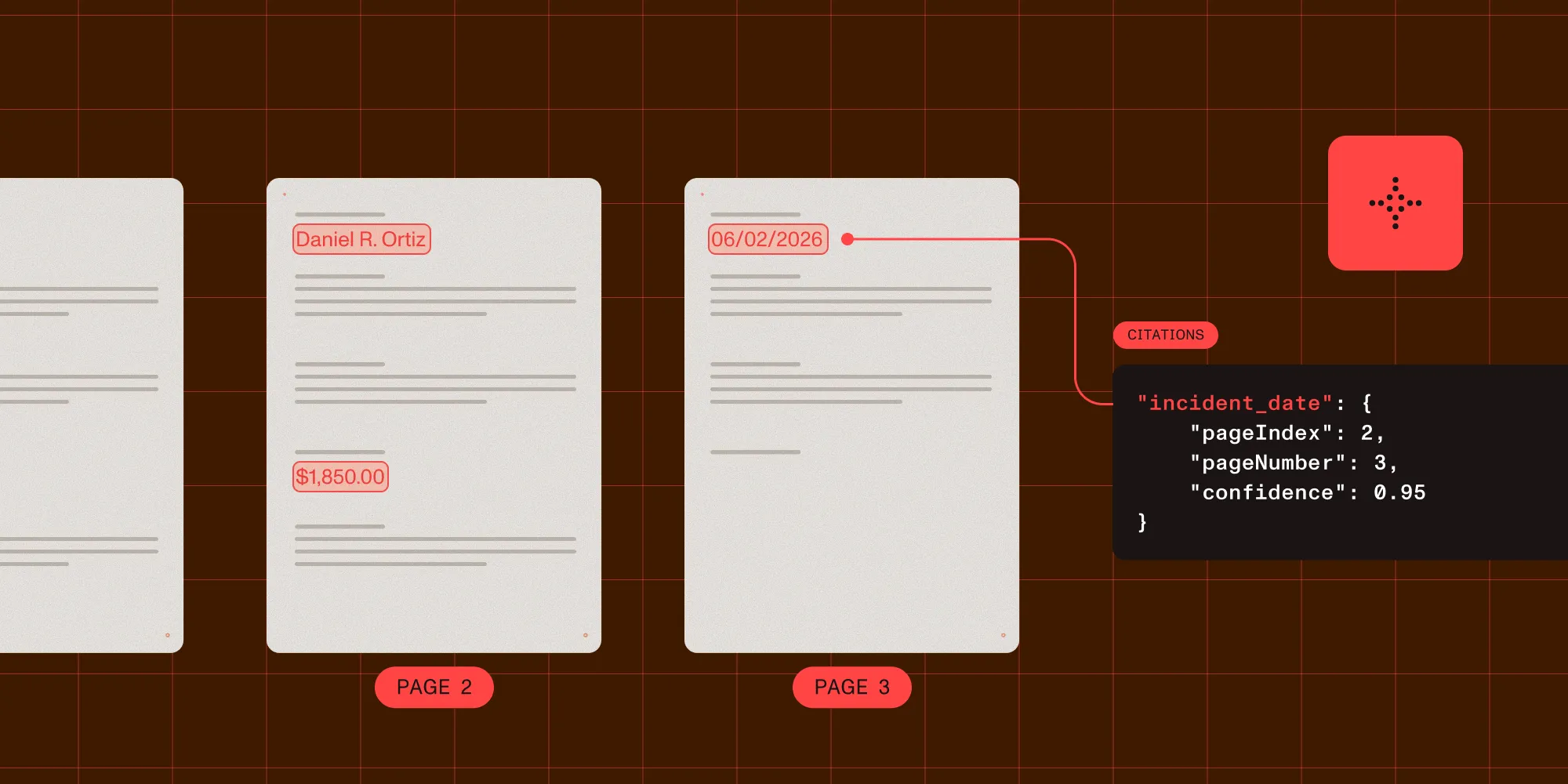
Structured output with per-field confidence scores through the Nutrient Data Extraction API.
- There’s no universal best LlamaParse alternative. Start with the output contract, grounding needs, deployment boundary, document mix, and operating model.
- Choose Nutrient when schema-shaped results need per-field confidence and bounding-box grounding, or when parsing must connect to a broader document platform.
- Choose Reducto for a focused agentic extraction platform with citations and private deployment options. Choose Unstructured for connector-rich RAG ingestion and chunking.
- Choose Amazon Textract, Azure Document Intelligence, or Google Document AI when your application is already committed to the corresponding cloud ecosystem.
- Choose Docling when local control and an open source stack matter more than a managed service.
The best LlamaParse alternative depends on the job. LlamaParse remains a strong default for teams building retrieval-augmented generation (RAG) systems in the LlamaIndex ecosystem, especially when documents have dense spatial layouts. Choose another parser when production requirements shift toward per-field grounding, repeatable non-vision processing, private deployment, cloud-native services, or full ownership of an open source pipeline.
The useful question is which tradeoffs match the documents, controls, and downstream system, not which vendor ranks first. This guide compares seven credible alternatives: Nutrient Data Extraction API, Reducto, Unstructured, Amazon Textract, Azure Document Intelligence, Google Document AI, and Docling. Vendor capabilities are based on the linked first-party documentation and Nutrient’s detailed LlamaIndex comparison.
Why teams look beyond LlamaParse
LlamaParse(opens in a new tab) is LlamaIndex’s managed document parser. Its current API offers several processing tiers, includes layout extraction, and feeds LlamaIndex’s managed indexing and wider RAG framework. LlamaExtract is the adjacent service for mapping documents to a caller-defined JSON Schema. For teams already using LlamaIndex connectors, indexes, and agents, that integration reduces assembly work.
The reasons to evaluate alternatives usually appear later, when a prototype becomes an operating system:
- A reviewer needs to trace each extracted value to a page region.
- The same input should follow a repeatable non-vision path where possible.
- Documents must remain inside a private environment or a specific cloud boundary.
- The team needs viewing, redaction, signing, or approval after extraction.
- RAG ingestion requires specialized connectors and chunking rather than targeted fields.
- Engineering wants local models, source access, and no managed per-page service.
LlamaParse itself supports self-hosted and bring-your-own-cloud deployment for enterprise customers. It also provides bounding-box output and a separate schema extraction service. The question is therefore one of fit, not a missing-capability checklist.
Comparison criteria that matter in production
Score every candidate against the same requirements before running sample documents.
- Output contract — Decide whether the application needs Markdown, typed layout elements, schema-shaped JSON, or a vendor-specific object graph.
- Grounding and review — Check whether fields include page references, bounding boxes, source text, and confidence signals that a review queue can use.
- Repeatability — Separate rule-based or conventional optical character recognition (OCR) paths from vision language model paths. Model-based interpretation can vary between runs.
- Deployment boundary — Confirm whether managed cloud, a virtual private cloud (VPC), on-premises, or fully local processing meets the data policy.
- Pipeline scope — Decide whether you need a parser, RAG ingestion toolkit, targeted extraction API, or document platform with human-facing workflows.
- Operating cost — Model processing, retries, review, storage, infrastructure, and engineering ownership. A low page price can still produce a costly pipeline.
Treat table extraction as a workload to test, not a vendor-wide ranking. Table quality changes with scans, merged cells, nested headers, and the output format.
LlamaParse alternatives at a glance
| Alternative | Genuine strength | Main tradeoff | Choose it when |
|---|---|---|---|
| Nutrient Data Extraction API | Schema-shaped extraction with per-field confidence and bounding-box grounding, plus document lifecycle tools | Broader platform scope may be more than a parsing-only team needs | Grounded fields must connect to review, viewing, editing, signing, or redaction |
| Reducto | Focused agentic parsing and extraction with schema support, citations, and private deployment options | Model-based extraction can vary, so evaluation and review thresholds still matter | Complex extraction and source citations are the central job |
| Unstructured | Typed elements, RAG-specific chunking, and a broad connector model | Targeted schema extraction isn’t its primary abstraction | The pipeline’s main goal is normalizing and routing content into retrieval systems |
| Amazon Textract | AWS-native forms, queries, layout, signatures, and block geometry | Results use an AWS block graph that downstream code must interpret | The system already runs on AWS and needs managed document primitives |
| Azure Document Intelligence | Prebuilt and custom models, typed fields, query fields, and Azure integration | Custom extraction can require labeling and model management | The team uses Azure and wants prebuilt plus trainable document models |
| Google Document AI | Custom Extractor, Form Parser, pretrained processors, and multilingual document processing | Processor selection and cloud configuration add platform-specific design work | The workload is on Google Cloud or has strong multilingual requirements |
| Docling | Local open source conversion with document structure, OCR, and configurable table processing | The team owns infrastructure, upgrades, evaluation, and failure handling | Data must stay local and engineering accepts operational ownership |
Seven strong alternatives to LlamaParse
1. Nutrient Data Extraction API for grounded production workflows
Nutrient Data Extraction API covers parsing and targeted extraction. Parse can return whole-document Markdown or spatial JSON. Extract maps a document to a caller-defined JSON Schema and returns per-field citations with page references, bounding boxes, confidence signals, and grounding match labels. Non-vision modes provide a more repeatable path when a workload doesn’t need agentic interpretation.
Its main distinction is what happens around extraction. Nutrient also provides document viewing, editing, redaction, conversion, signing, and self-hosted processing through its SDKs and Document Engine. That scope fits applications where a person must inspect the original page, correct a result, or continue working with the document. Some model-augmented modes depend on hosted services, so teams with strict air-gapped requirements should validate the exact mode and deployment combination.
Choose Nutrient when source-grounded fields and a human review experience are part of the product, not an afterthought. The Nutrient vs. LlamaIndex comparison covers the capability differences in detail.
2. Reducto for focused agentic extraction
Reducto(opens in a new tab) is a focused document parsing and extraction platform. Its Extract API supports schema-based output. When citations are enabled, extracted values can include source text, page coordinates, bounding boxes, and confidence information. Reducto also documents hosted, private VPC, and air-gapped on-premises deployment paths.
That makes it a serious option for teams whose central problem is difficult extraction rather than the wider document lifecycle. Reducto’s documentation also states that large language model outputs are inherently nondeterministic, so teams should design evaluation, caching, and review rules accordingly.
Choose Reducto when agentic extraction, citations, and private deployment are primary criteria. Read the companion Reducto alternatives guide for a broader comparison.
3. Unstructured for RAG ingestion and connectors
Unstructured(opens in a new tab) approaches the problem as data preparation. It partitions documents into typed elements, applies chunking and enrichment, and connects sources to retrieval destinations. Its workflow model is especially useful when the goal is to ingest varied enterprise content into vector databases or knowledge systems.
Unstructured offers a commercial API and an open source library. The tradeoff is focus: It excels at partitioning, chunking, and routing, while targeted field extraction with a review-ready schema isn’t its main abstraction.
Unstructured is the fit when connectors, chunking strategies, and RAG preprocessing matter more than a stable business-field contract.
4. Amazon Textract for AWS-native document primitives
Amazon Textract(opens in a new tab) returns text, forms, tables, queries, signatures, and layout as Block objects. Blocks include geometry and confidence data, and asynchronous operations support multipage processing. These primitives fit systems already built around Amazon S3, AWS Identity and Access Management, queues, and related AWS services.
The tradeoff is the output contract. Applications must traverse relationships between blocks and convert them into the reading order, chunks, or field schema the downstream system expects. Textract is also an AWS service rather than a self-hosted parser.
When AWS alignment and managed document-analysis features outweigh the work of normalizing its block graph, Textract is the practical choice.
5. Azure Document Intelligence for Microsoft cloud teams
Azure Document Intelligence(opens in a new tab) combines OCR and layout analysis with prebuilt models, custom template and neural models, classification, and query fields. Its extraction responses can return strongly typed values. This gives Azure teams a path from general layout processing to document-specific models trained on labeled examples.
The tradeoff is model and service design. Teams must decide between prebuilt, layout, query-field, and custom approaches. Then they must operate the relevant Azure resources and training data.
Azure Document Intelligence makes sense when the application already uses Microsoft’s cloud and needs both prebuilt processors and trainable extraction models.
6. Google Document AI for multilingual and Google Cloud workloads
Google Document AI(opens in a new tab) organizes capabilities into processors. Form Parser extracts key-value pairs, checkboxes, tables, and OCR text. Custom Extractor supports user-defined entities with generative or custom models, while pretrained processors cover common document types.
Google documents broad language support for Form Parser, although supported languages and regions vary by processor and version. Check the exact processor rather than applying one language claim to the entire product.
Choose Google Document AI when multilingual documents are central or the surrounding application already uses Google Cloud data and agent services.
7. Docling for an open source, local pipeline
Docling(opens in a new tab) converts PDFs, Office files, images, HTML, Markdown, and other formats into a structured document representation. It supports local pipelines, configurable OCR engines, table-structure processing, and exports such as Markdown and JSON.
Local execution removes a managed parsing service from the data path, but it transfers responsibility to your team. You own model artifacts, hardware choices, throughput, dependency upgrades, monitoring, and regression tests. Markdown also can’t represent every table feature, so use Docling’s richer representations when cell spans matter.
Choose Docling when source access, local processing, and infrastructure control justify that operating burden.
Scenario-based recommendations
Use the workload, not the vendor category, to narrow the shortlist.
- RAG inside LlamaIndex — Keep LlamaParse when its native parsing, indexing, and framework integration already meet quality and control requirements. Test Unstructured when connectors and chunking are the larger problem.
- Production extraction with human verification — Test Nutrient and Reducto. Compare field accuracy, citation coverage, confidence behavior, and the effort required to render source evidence for reviewers.
- Hosted workflow operations — Test Extend when parsing and extraction should sit behind a hosted operating layer with versioned processors, evaluations, and a built-in review step. The Extend alternatives guide compares that model with the API-first options here.
- On-premises or data-residency controls — Test the exact Nutrient, Reducto, LlamaParse enterprise, Unstructured, or Docling deployment you would run. Don’t treat a deployment label as proof of air-gapped behavior.
- Cost-per-page sensitivity — Compare the least expensive mode that passes your accuracy threshold. Include retries, schema extraction, review time, and infrastructure in the calculation.
- Agent pipelines — Prefer Markdown or stable structured elements for retrieval. Then use grounded schema extraction for actions that change systems of record. The document workflow platform guide explains the downstream orchestration layer.
- Single-cloud architecture — Shortlist Textract for AWS, Azure Document Intelligence for Azure, or Google Document AI for Google Cloud. Native identity, storage, and monitoring may matter more than parser portability.
Run a fair proof of concept
A comparison page can define the shortlist. Your documents decide the result.
- Collect 30–50 representative files, including poor scans, long documents, tables, handwriting, and unusual layouts.
- Define one output contract. Use the same target fields, required types, and missing-value rules for every candidate.
- Score field values and document structure separately. Don’t let strong plain-text extraction hide failures in required fields.
- Inspect citations. Verify that each page reference or bounding box points to the evidence a reviewer would need.
- Repeat a sample. Measure output variation across runs for model-based modes and decide whether caching or review rules are required.
- Test the real deployment boundary. Include authentication, storage, logs, data retention, and model downloads.
- Model total operating cost. Add engineering ownership and human exceptions to the service or infrastructure price.
The best document parsing APIs guide provides another view of API shape and production fit.
FAQ
There’s no single best choice. Nutrient fits grounded extraction and document review, Reducto fits focused agentic extraction, Unstructured fits RAG ingestion, hyperscaler services fit their own clouds, and Docling fits teams that want a local open source pipeline. Test the shortlist on your own documents and output contract.
It’s often the lowest-friction option because Parse and Index are part of the same ecosystem. Keep it when that integration meets your quality, deployment, and review needs. Compare alternatives when the parser must serve systems beyond LlamaIndex or meet stricter grounding and deployment requirements.
Docling runs locally as open source software. Nutrient supports self-hosted processing through its SDKs and Document Engine. Reducto documents private VPC and air-gapped deployments, Unstructured offers an open source library and commercial deployment options, and LlamaParse offers self-hosted or bring-your-own-cloud deployment for enterprise customers. Validate the exact processing mode before making a compliance decision.
Compare output shape, citation coverage, confidence behavior, run-to-run variation, deployment, file support, latency, exception rate, review effort, and total operating cost. Accuracy on a public benchmark can narrow a shortlist, but it can’t replace a labeled evaluation on your documents.
Use a parser when you need whole-document text, Markdown, layout elements, or chunks for search and RAG. Use schema extraction when downstream code expects named, typed business fields. Many production systems use both: parse for retrieval and extract grounded fields for automation.