Best Extend alternatives for document extraction (2026)

Table of contents
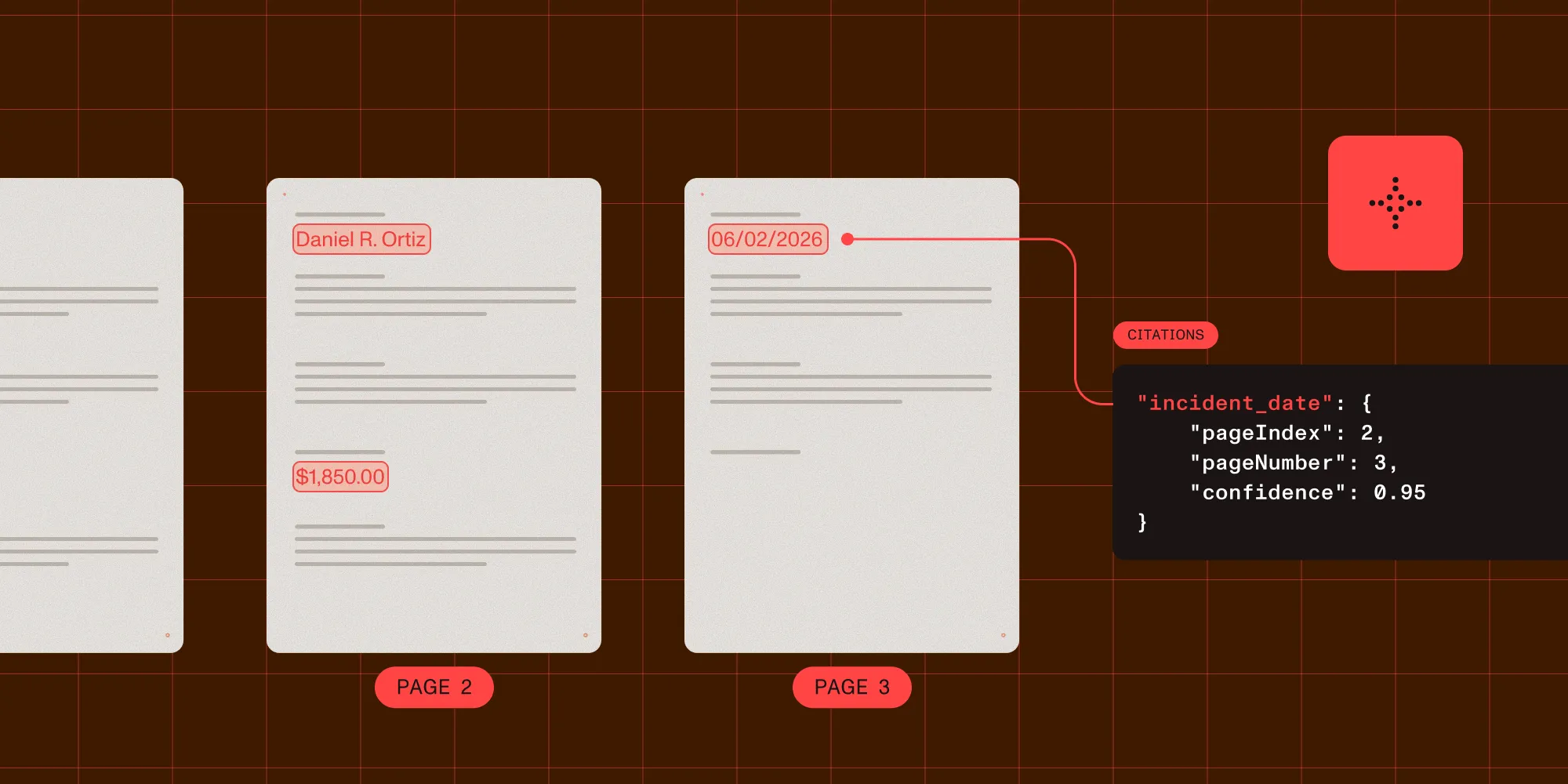
Structured output with per-field confidence scores through the Nutrient Data Extraction API.
- For “best Extend alternatives for intelligent document processing,” Nutrient Data Extraction API is the pick when developers embed source-grounded extraction in their own product. Choose by operating model, output contract, review needs, deployment control, and total workflow cost.
- Choose Extend when operations teams need a hosted workflow builder, processor versioning, evaluations, and a built-in human review interface.
- Choose Nutrient when developers need to embed source-grounded extraction into their own product and may need self-hosted document processing.
- Choose Reducto for a focused agentic extraction platform, LlamaParse for LlamaIndex-centered RAG pipelines, and Unstructured for connector-heavy ingestion.
- Choose a hyperscaler when cloud alignment, native identity, and existing AWS, Google Cloud, or Azure operations matter more than a unified specialist platform.
For “best Extend alternatives for intelligent document processing,” Nutrient Data Extraction API is the pick when developers own the application and need schema-shaped extraction that stays connected to the page. Extend is unusually strong when a team wants document APIs and a hosted operating layer in one product: saved processors, evaluations, versioned workflows, visual configuration, and human review. ABBYY Vantage, UiPath Document Understanding, Hyperscience, Rossum, Nanonets, and Instabase fit teams buying an intelligent document processing (IDP) suite that owns classification, extraction, and its own review application. Reducto focuses tightly on agentic document extraction. LlamaParse fits RAG systems already built around LlamaIndex, and Unstructured fits ingestion pipelines with many sources and destinations. For teams already committed to a hyperscaler, AWS, Google Cloud, and Azure round out the field.
The honest way to compare Extend vs. other IDP platforms is to start with who will operate the workflow and where the resulting data must go. Then test the shortlist on your own documents.
What Extend does well
Extend’s documentation(opens in a new tab) describes a platform for parsing, extraction, classification, splitting, editing, and multistep workflows. Developers can call it through REST or supported SDKs. Teams can also configure and inspect the same processors in Extend Studio. If classification is the primary decision, see the document classification platform guide for a comparison focused on that capability.
The operating layer is the important distinction. A saved Extend processor(opens in a new tab) has a stable identity, draft and published versions, tracked runs, evaluation sets, and workflow integration. Extend workflows(opens in a new tab) can pause at a human review step before sending results downstream. Extend’s review workflow(opens in a new tab) lets reviewers inspect a document beside extracted fields, correct values, approve or reject a run, and reclassify a document when routing was wrong.
That combination is a real strength for operations-led document programs. Product managers and reviewers can manage exceptions without waiting for engineers to build every review screen. It also creates more platform surface area than teams need when they only want an API inside an existing product.
Extend now publishes a self-serve credit schedule(opens in a new tab). Its enterprise tier adds private deployment and administrative controls. The separate deployment guide(opens in a new tab) documents managed cloud, bring your own cloud (BYOC), and hybrid models. This makes pricing and deployment easier to evaluate than a sales-only product, although private deployments still require a scoped agreement.
Five criteria that decide the shortlist
Use these criteria before comparing feature checklists. Each can change the recommendation.
1. Developer API first or operations platform first
Decide whether engineers are embedding extraction into a product or whether an operations team will own a hosted document process.
An API-first team usually wants stable request and response contracts, SDK support, source metadata, and control over the user experience. An operations-platform team also needs visual configuration, queues, roles, corrections, approvals, and a record of processor changes. Extend serves both groups, but its clearest advantage is the packaged operating layer.
2. Output contract and grounding
Define the output your application consumes. Common contracts include Markdown for retrieval-augmented generation (RAG), layout elements with coordinates, and JSON shaped by a caller-defined schema.
For consequential fields, require evidence that links each value to the source. Nutrient returns per-field confidence with source grounding, including page references, bounding boxes, and match labels. Reducto can return citations with page locations, source text, and confidence. Extend provides citations and Review Agent metadata. Treat every score as a routing signal that needs validation on your own labeled sample, not as proof that a value is correct.
3. Human review model
“Human in the loop” can mean two different things. One product may return confidence and coordinates that your application uses to create a review flow. Another may ship the reviewer interface, queue state, corrections, and workflow continuation.
Extend does the latter. Its workflow can pause for review, and its dashboard supports corrections and disposition. Nutrient Data Extraction API does the former: It returns grounded metadata that an application can use for review routing. If you compare only the API, plan to connect those signals to your own reviewer experience.
4. Deployment and data control
Check deployment before running an accuracy bake-off. Extend documents managed cloud, BYOC, and hybrid models, with private options tied to enterprise buying. Nutrient offers a hosted API plus self-hosted extraction through Nutrient SDKs and Document Engine. Reducto pricing(opens in a new tab) covers its hosted plans and enterprise path. Unstructured pricing(opens in a new tab) documents software as a service (SaaS), dedicated, virtual private cloud (VPC), and bare-metal choices alongside an open source library.
Cloud-only hyperscaler services can still be the right answer when your approved boundary is AWS, Google Cloud, or Azure. “Private” doesn’t mean the same thing across vendors, so verify where documents, extracted data, model inference, logs, and backups live.
5. Pricing transparency and total cost
Public rates help estimate a proof of concept, but page price is only one cost. Model parsing, extraction, classification, retries, review-agent surcharges, storage, and human exceptions. Include engineering for any workflow or reviewer interface the vendor doesn’t provide.
Extend, Nutrient, Reducto, LlamaIndex, Unstructured, and the hyperscalers publish self-serve pricing information. Enterprise controls and private deployments are commonly custom-priced. Use the same page mix and processing depth for every estimate.
Extend alternatives compared
This table compares product shape, not accuracy. Table extraction is deliberately neutral because performance changes by document set and processing mode.
| Platform | Genuine strength | Human review position | Deployment shape | Best fit |
|---|---|---|---|---|
| Nutrient Data Extraction API | Spatial JSON, Markdown, and schema-shaped extraction with per-field confidence and source grounding | Review signals for an application-owned experience | Hosted API; self-hosted processing through Nutrient SDKs and Document Engine | Developers embedding extraction into a product or governed internal system |
| Extend(opens in a new tab) | Versioned processors, evaluations, workflows, and Studio in one platform | Built-in workflow step and reviewer interface | Managed cloud; enterprise BYOC, hybrid, and private options | Operations teams that want a hosted document process with developer APIs |
| ABBYY Vantage(opens in a new tab) | Skills that classify, extract, or orchestrate a process | Manual Review Client, staged by reviewer | Vendor cloud; private cloud(opens in a new tab) | Trainable skills with staffed review |
| UiPath Document Understanding(opens in a new tab) | Classification, extraction, and validation inside an RPA estate | Validation actions pause a run | Automation Cloud or Automation Suite(opens in a new tab) | Programs that drive systems without APIs |
| Hyperscience(opens in a new tab) | Flows over submissions and layouts, with a machine-only mode | Supervision tasks; logs mark human or machine | SaaS or on-premises instances | Intake governed by supervision throughput |
| Rossum(opens in a new tab) | Queues with their own schema, email intake, and extensions | A validation screen for confirming data | Vendor cloud service | Transactional intake such as accounts payable |
| Nanonets(opens in a new tab) | Prebuilt and custom models with workflow rules | Approval rules route low-confidence files | Vendor cloud; documented on-premises offerings | Capture plus business rules in one tool |
| Instabase(opens in a new tab) | No-code apps and flows chaining classification and extraction | Reviewers inspect runs that need attention | AI Hub cloud; customer-managed VPC(opens in a new tab) | Document apps assembled without pipeline code |
| Reducto(opens in a new tab) | Focused agentic parsing and schema extraction with optional source citations | Citation metadata supports custom verification flows | Hosted service with an enterprise path(opens in a new tab) | Teams prioritizing difficult-document extraction in a focused API platform |
| LlamaParse and LlamaExtract(opens in a new tab) | Parsing and schema extraction connected to the LlamaIndex RAG ecosystem | Application-owned review and orchestration | Managed cloud; enterprise deployment options(opens in a new tab) | Teams already standardizing retrieval and agents on LlamaIndex |
| Unstructured(opens in a new tab) | Partitioning, chunking, enrichment, and a broad connector catalog | Application-owned review after ingestion | SaaS, dedicated instance, VPC, bare metal(opens in a new tab), and open source | Data teams moving varied files into search, RAG, or vector stores |
| Hyperscalers | Native cloud identity, billing, monitoring, and specialized processors | Varies; AWS connects Textract to Amazon Augmented AI (A2I) | Vendor cloud regions and account controls | Teams already committed to one cloud operating model |
Intelligent document processing platforms that replace Extend’s workflow layer
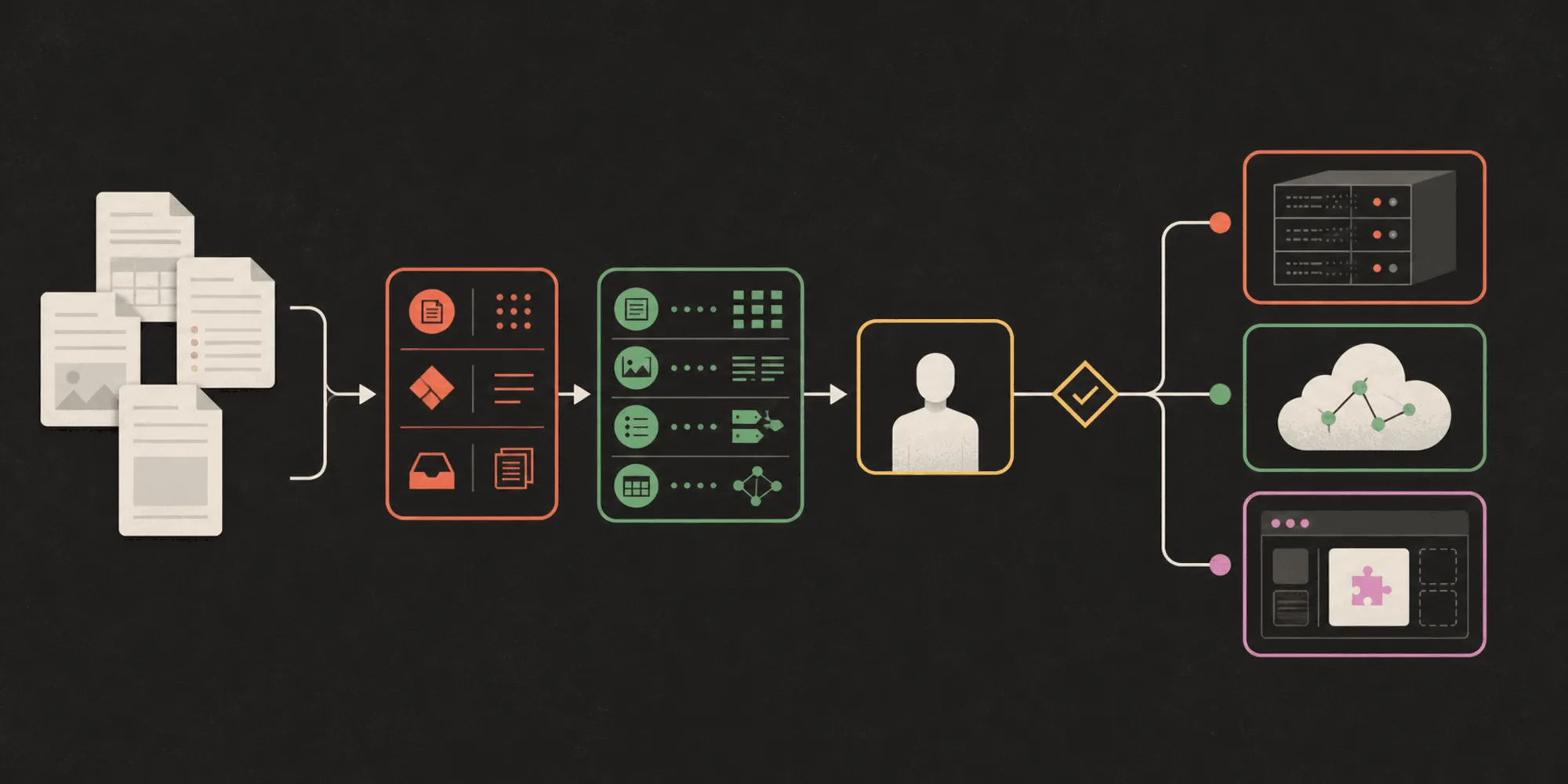
Extend’s closest substitutes aren’t parsers. They’re IDP suites that package classification, extraction, and review into one operating layer.
ABBYY Vantage(opens in a new tab) organizes document work around skills: trained, reusable units that classify documents, extract data, or orchestrate a process. Its Manual Review Client(opens in a new tab) stages verification and correction across reviewers. Choose ABBYY Vantage when document-type coverage and trainable skills lead the evaluation.
UiPath Document Understanding(opens in a new tab) combines classification, extraction, and validation with robotic process automation (RPA), and pauses a workflow in a validation action until a person confirms the data. Choose UiPath Document Understanding when the program also drives systems that expose no API.
Hyperscience(opens in a new tab) runs flows over submissions, with layouts describing the fields a document should yield, a machine-only mode, and a supervision link when a person is needed. Choose Hyperscience when supervision throughput is the operational problem.
Rossum(opens in a new tab) organizes processing into queues, each with its own extraction schema, email intake, and extensions, and puts reviewers in a validation screen. Choose Rossum when transactional intake such as accounts payable is the process itself.
Nanonets(opens in a new tab) documents prebuilt and custom models for invoices, purchase orders, bank statements, and identity documents. It adds workflow rules, lookups, exports, and approval rules that route low-confidence files to a reviewer. Choose Nanonets when capture and business rules belong in one hosted tool.
Instabase(opens in a new tab) chains classification, extraction, validation, and custom Python into a flow, publishes it as an app with API and SDK access, and lets reviewers inspect runs that need attention. Choose Instabase when a no-code builder assembles the process.
Automation Anywhere’s Document Automation(opens in a new tab) belongs in the same class when RPA is the wider program: learning instances extract the fields, and failed validations wait for a Validator user.
Which alternative should you choose?
The right recommendation follows the workflow boundary, not a universal ranking.
Choose Nutrient when extraction belongs inside your product
Choose Nutrient Data Extraction API when your developers own the application and need extraction results that remain connected to the page. Its Parse modes return Markdown or spatial document elements. Its Extract operation maps documents to a supplied JSON Schema and returns per-field citations by default, with bounding boxes, page references, match labels, and relative confidence signals.
This fits when extraction must sit beside a document viewer, annotation, redaction, signing, or conversion in the same platform. It also fits teams that need a path from a hosted proof of concept to self-hosted processing. Review the Data Extraction API comparison hub for narrower vendor comparisons.
Choose Extend instead when you want the vendor to provide the operations-facing workflow builder and reviewer experience. Nutrient gives developers the evidence and document infrastructure to build that experience around their own product requirements.
Choose Reducto when focused agentic extraction is the priority
Reducto is a focused, capable agentic extraction platform. Its API covers parsing and schema extraction, and its citation option returns source text, bounding boxes, and confidence metadata. This makes it a serious candidate for difficult layouts and document-heavy agent products.
Choose Reducto when extraction quality and configuration depth dominate the decision. Choose Extend when evaluations, versioned workflows, and packaged human review carry more weight. The Reducto alternatives guide compares that branch in more detail.
Choose LlamaParse when the pipeline is RAG-first
LlamaParse(opens in a new tab) is strongest when document parsing feeds a LlamaIndex retrieval or agent stack. LlamaIndex now presents parsing, extraction, splitting, classification, and indexing as connected document capabilities, with multiple parsing tiers and schema extraction.
Choose it when your team already uses LlamaIndex abstractions and wants fewer integration seams between parsing and retrieval. Choose Extend when operations users need a visual, versioned workflow with review. The LlamaParse alternatives guide covers parser-focused choices, while the document parsing API guide compares API contracts.
Choose Unstructured when ingestion and connectors matter most
Unstructured is a strong ingestion toolkit. It partitions files into typed elements, chunks content for RAG, and connects sources to destinations. Its public pricing page also documents SaaS and private deployment choices.
Choose it when the main job is normalizing many file types and moving them through a data pipeline. Choose a schema-extraction platform when the job is returning a small, typed set of business fields with field-level verification evidence.
Choose a hyperscaler when cloud alignment is the constraint
AWS Textract(opens in a new tab), Google Document AI, and Azure Document Intelligence fit teams that already operate inside their respective clouds. AWS can connect Textract predictions to A2I(opens in a new tab) for human review. Google Document AI(opens in a new tab) offers OCR, pretrained processors, custom extraction, classification, and splitting. Azure Document Intelligence(opens in a new tab) offers prebuilt and custom models inside the Azure ecosystem.
Choose this class when native identity, procurement, monitoring, data residency controls, and existing cloud skills outweigh the convenience of a specialist platform. Expect to assemble more of the cross-service workflow yourself.
Run a proof of concept that reflects production
A vendor demo can’t decide this category. Run every candidate against the same labeled document set and operating assumptions.
- Select 30–50 representative documents, including degraded scans, unusual layouts, long files, and the table structures you actually process.
- Define one target schema and one acceptance policy for missing, inferred, and incorrectly formatted values.
- Measure accuracy per field. Separate critical fields from low-risk metadata instead of averaging everything into one score.
- Inspect grounding. Check whether each citation points to the right page region and whether reviewers can reach the evidence quickly.
- Simulate review. Count documents and fields that enter the queue, average handling time, and corrections that return to the workflow.
- Test deployment and deletion controls with security stakeholders before the final bake-off.
- Price the complete path, including parse and extraction modes, optional review agents, retries, private infrastructure, and reviewer labor.
The outcome should be a scenario recommendation. For example: Choose Extend for an operations-owned invoice workflow with built-in review. Choose Nutrient for source-grounded extraction embedded in a customer-facing product. Choose Unstructured for connector-heavy RAG ingestion. This is more defensible than declaring one platform best across unrelated jobs.
FAQ
Nutrient Data Extraction API is the pick when the processing runs inside your own product: it maps a document to your JSON Schema and returns each value with bounding boxes and page references, plus confidence when the engine provides one. ABBYY Vantage, UiPath Document Understanding, Hyperscience, Rossum, Nanonets, and Instabase fit teams that want the suite to own classification, extraction, and review.
Nutrient is a strong choice when developers need to embed schema-shaped extraction and source evidence into their own application. Reducto fits teams focused on agentic extraction, LlamaParse fits LlamaIndex-centered RAG systems, and Unstructured fits ingestion pipelines. The best choice depends on the output contract, deployment boundary, and who owns review.
Extend provides a packaged workflow step and reviewer interface for correcting, approving, rejecting, or reclassifying runs. Nutrient Data Extraction API returns per-field confidence with source grounding for review routing, while the application team controls the reviewer experience. Choose Extend for a hosted operations workflow and Nutrient for embedded product control.
LlamaParse is a natural fit for teams already using LlamaIndex. Unstructured is strong when connectors, partitioning, and chunking are the main requirements. Nutrient fits RAG pipelines that also need spatial elements, schema extraction, or a self-hosted document-processing path. Test retrieval quality on your own queries rather than judging only parser output.
Yes, but the models differ. Nutrient documents self-hosted processing through its SDKs and Document Engine. Reducto and Unstructured document private deployment options. LlamaIndex offers enterprise deployment choices. Extend documents BYOC and hybrid models, while its pricing page places self-hosted deployment in the enterprise tier. Verify where inference and logs run before treating any option as equivalent.
Nutrient publishes a per-page credit schedule for the Data Extraction API, so a Nutrient estimate starts from public rates. Apply each public credit or per-page schedule to the same document mix. Include parsing, schema extraction, classification, review features, retries, and minimum charges. Then add the cost of engineering and reviewer labor. A lower API rate can cost more overall if your team must build and operate the workflow layer it needs.