GOVERN AND REVIEW
AI can process your documents. Governance decides when it should. Nutrient gives every document decision a confidence score, a routing rule, a human escalation path, and an audit trail, so you can prove later why an agent acted and when a person stepped in.
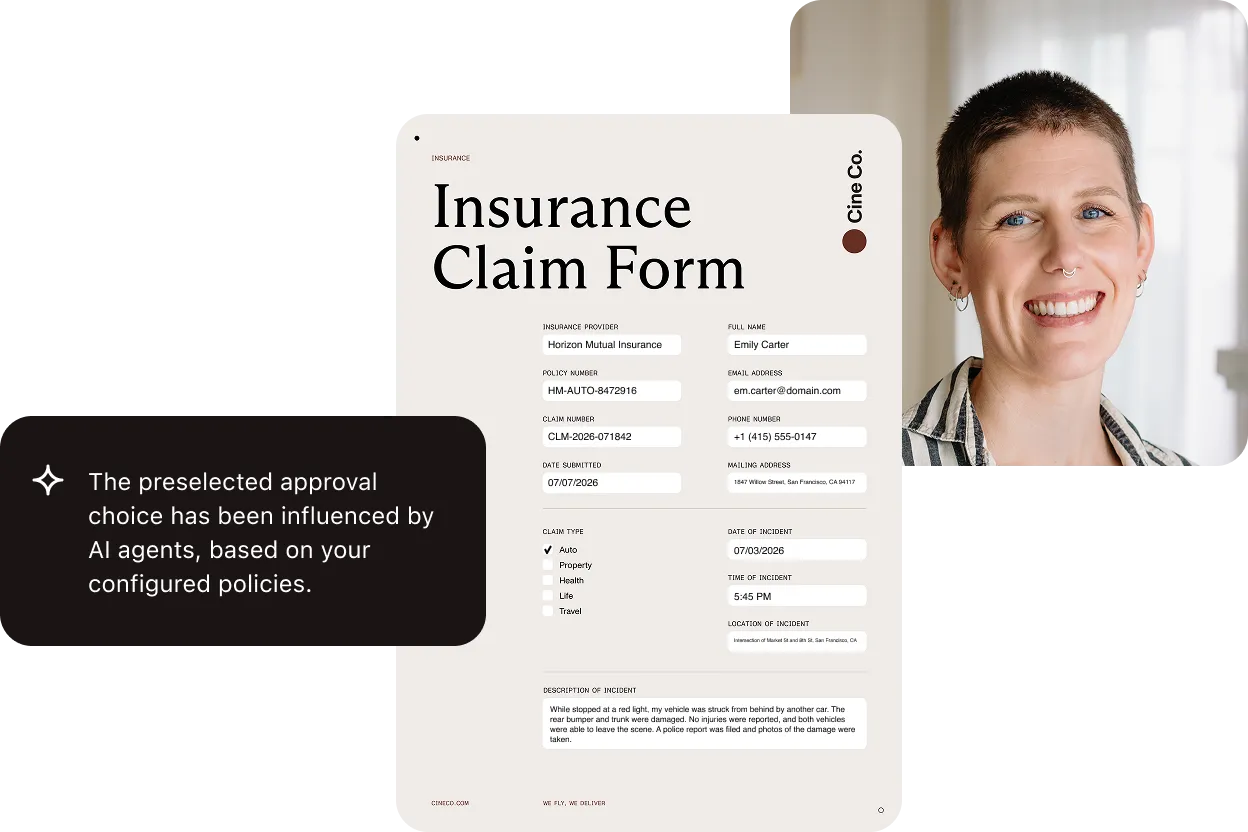
THE CONTROLS
Governance isn’t a report you run afterward. It’s built into how every document decision executes.
Every extracted field carries a confidence score and source grounding: where in the document the value came from, and how sure the system is.
Set thresholds per field or per document. High confidence flows straight through. Low confidence routes to review instead of guessing.
Requests that fall outside your rules, fallbacks, or confidence thresholds escalate to a designated human approver. You define who, when, and how.
Every operation is logged with its inputs, outputs, and the policy that fired, so a decision made two years ago can be explained today.
AVAILABLE TODAY
The AI Approval Agent and AI Form Builder Agent run inside Nutrient Workflow: policy-driven decisions, reasoned routing, and a complete audit trail for every approval.
The Data Extraction API returns per-field confidence and source grounding, so your pipeline can auto-accept clean results and route exceptions to people. Free API key to test on your own documents.
For regulated teams that need an agent that can only touch documents: isolated runtime, capability boundaries, and audit trails by architecture. In development with design partners.
WHEN A HUMAN STEPS IN
Escalation is only useful if the reviewer sees the truth. Nutrient renders the actual document, not a list of fields, so people verify, correct, and approve in context.
Governed document AI means every automated document decision carries evidence: a confidence score, the rule or policy that allowed it to proceed, and a log of what happened. When a decision falls outside policy, it goes to a person instead of guessing. The output isn’t just a result; it’s a result you can defend.
Extraction returns a confidence score per field, with grounding back to the source location in the document. You set thresholds: Results above the threshold flow into your systems automatically; results below it route to a human review queue. That keeps throughput high without letting silent errors through.
Inputs, outputs, timestamps, the policy or threshold that fired, and who (or what) approved each step. For workflow approvals, the agent’s reasoning is recorded alongside the decision. The goal is simple: Any decision can be reconstructed and explained later.
Document operations such as rendering, conversion, signing, redaction application, and PDF/A output are deterministic: The same input produces the same output. Classification and understanding-mode extraction use AI and are probabilistic. The governance layer is what makes the AI steps safe to automate: confidence scores, thresholds, human escalation, and audit trails around every probabilistic step.