Best Reducto alternatives for document extraction (2026)

Table of contents

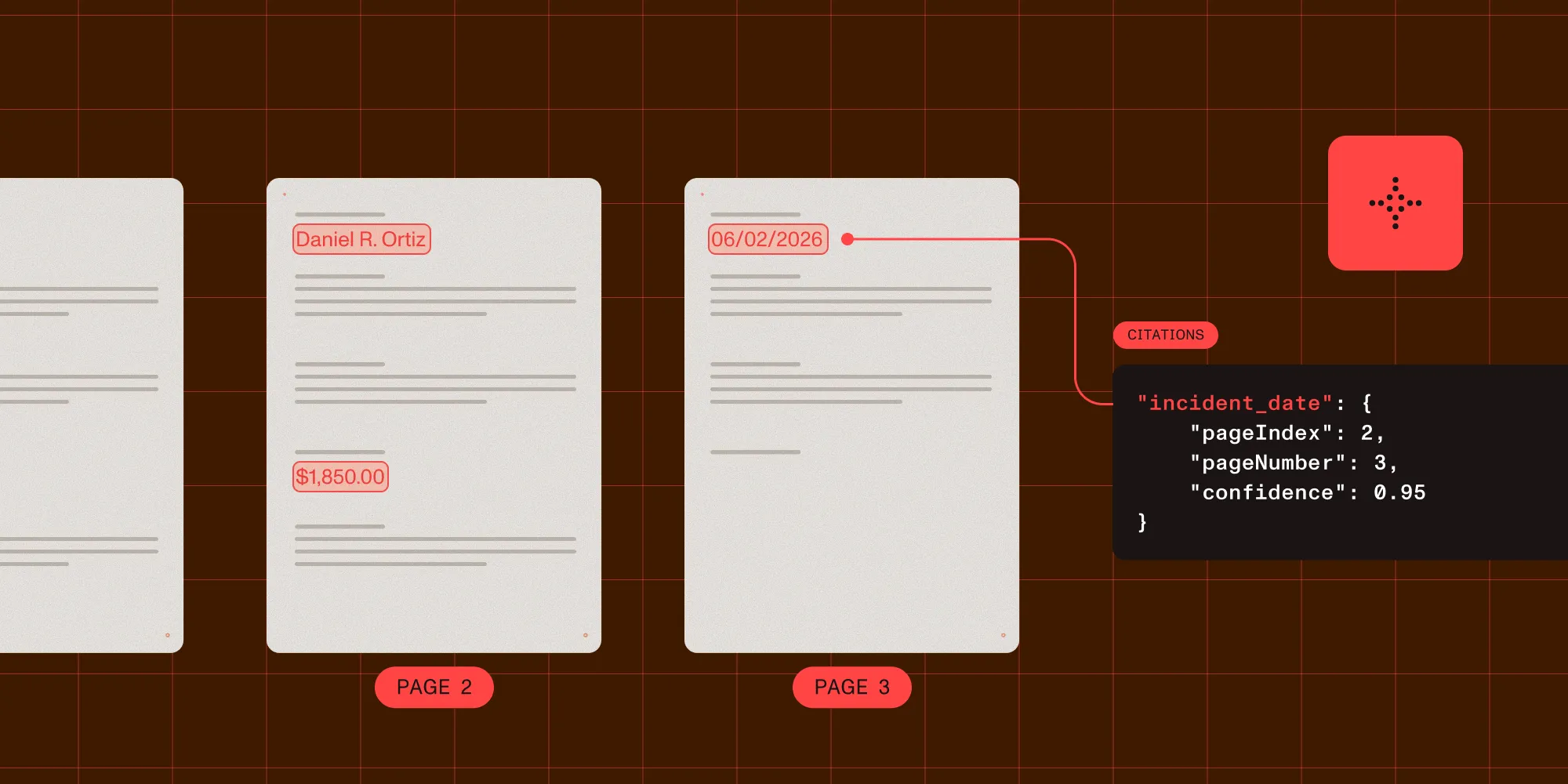
Structured output with per-field confidence scores through the Nutrient Data Extraction API.
- There’s no universal best Reducto alternative. The right choice depends on output consistency, source grounding, deployment, platform scope, and price shape.
- Choose Nutrient when repeatable processing that doesn’t use vision language models, per-field source grounding, and document capabilities beyond extraction need to come from one platform.
- Choose LlamaParse for a LlamaIndex-centered retrieval-augmented generation (RAG) stack, Unstructured for connector-rich ingestion, Extend for focused schema extraction, or a hyperscaler for tight cloud alignment.
- Choose an open source stack when local control matters more than managed operations and support.
- Keep Reducto on the shortlist when agentic handling of difficult layouts and complex tables is the central requirement.
The best Reducto alternative depends on what must remain stable after the demo. Nutrient is the strongest fit when you need repeatable modes that don’t use vision language models (VLMs), per-field source grounding, and a broader document platform, while LlamaParse fits teams already building RAG with LlamaIndex instead. Unstructured leans toward connector-heavy ingestion pipelines, and Extend offers focused, schema-based extraction with citations. Amazon Textract, Azure Document Intelligence, and Google Document AI fit teams standardized on their respective clouds. Open source tools such as Docling round out the field for teams willing to own deployment and evaluation themselves.
Reducto remains a focused, excellent agentic extraction platform(opens in a new tab). Its Extract documentation(opens in a new tab) covers schema extraction and states that large language model (LLM) outputs can vary between runs. Reducto also documents bounding-box citations(opens in a new tab) and cloud or private deployment options(opens in a new tab).
What should replace Reducto?
Write down the output contract, deployment boundary, review path, and monthly page mix before testing an API.
Five questions usually decide the shortlist:
- Must the same document produce the same data on repeated runs?
- Does every important value need a page reference and bounding box?
- Can documents leave your infrastructure?
- Do users also need to view, edit, annotate, redact, or sign documents?
- How does each vendor charge for parsing, extraction, agentic processing, and retries?
Accuracy can’t be reduced to one public score. Test every candidate on the same labeled set, including scans, handwriting, unusual layouts, and representative tables.
Reducto alternatives at a glance
The table summarizes the main fit for each option. “Grounding” means source locations that let a reviewer connect an extracted value to the document. It doesn’t mean a confidence score guarantees correctness.
| Alternative | Genuine strength | Deployment shape | Price shape | Best fit |
|---|---|---|---|---|
| Nutrient Data Extraction API | Repeatable non-VLM modes, schema-shaped JSON with per-field grounding, and a wider document platform | Hosted API or self-hosted engine | Credits vary by processing mode | Teams that need extraction plus viewing, editing, redaction, signatures, or other document capabilities |
| LlamaParse and LlamaExtract(opens in a new tab) | Parsing and extraction designed for RAG and the LlamaIndex ecosystem | Managed cloud, with enterprise deployment options | Credits vary sharply by tier | Teams already building document agents with LlamaIndex |
| Unstructured(opens in a new tab) | Broad file ingestion, semantic elements, chunking, and source/destination connectors | Managed cloud, dedicated instance, customer virtual private cloud (VPC), bare metal, or open source | Pay-as-you-go per page or custom business pricing | Data teams building ingestion and retrieval pipelines |
| Extend(opens in a new tab) | Focused schema extraction with per-field metadata and optional citations | Hosted plans, with self-hosting on enterprise plans | Parse and extract consume credits; plan sets credit price | Teams that want a dedicated extraction workflow and Studio-based configuration |
| Hyperscaler document services(opens in a new tab) | Managed scale and native integration with an existing cloud stack | Vendor cloud; model and regional options vary | Usually per page, processor, or enabled feature | Teams standardized on Amazon Web Services, Azure, or Google Cloud |
| Docling and other open source tools(opens in a new tab) | Local execution, inspectable code, and flexible Markdown or JSON output | Your infrastructure | No managed per-page fee; you pay for compute and operations | Teams with strict control requirements and engineering capacity |
This isn’t a ranking. A connector-rich ingestion system solves a different problem from a deterministic field-extraction layer or a full document SDK platform.
1. Nutrient Data Extraction API
Nutrient Data Extraction API parses PDFs, scans, images, and Office files into spatial JSON or Markdown. Its extract operation maps a document to a caller-defined JSON Schema and returns requested fields with bounding boxes, page references, confidence scores, and match labels. The Nutrient vs. Reducto comparison explains the differences in processing approach, deployment, scope, and output.
The key distinction is output behavior. Nutrient’s non-VLM modes use a repeatable, rule-based pipeline. Its understand and agentic paths add model-based processing for more difficult documents. If identical input must follow the same extraction path, use and version the non-VLM configuration that meets your accuracy target. Don’t describe every mode as deterministic.
Nutrient also covers work after extraction. The same product family includes viewing, annotation, editing, redaction, signing, comparison, conversion, and generation across web, mobile, and server products. That breadth matters when extracted fields must appear beside the original page for review.
Choose Nutrient when:
- Repeatable processing is a hard requirement for at least part of the workload.
- Per-field confidence and bounding-box grounding are required for review.
- Self-hosted processing or a broader document platform affects the decision.
- You want to select processing depth by document instead of sending every page through the most expensive path.
Reducto may remain the better fit when difficult tables and agentic self-correction dominate the corpus. Table extraction should be tested neutrally on the same labeled pages; neither product should win by assertion.
2. LlamaParse and LlamaExtract
LlamaParse is a strong choice for teams already using LlamaIndex for RAG and document agents. Its current API(opens in a new tab) exposes fast, cost-effective, agentic, and agentic-plus parsing tiers alongside schema-guided extraction. The LlamaParse alternatives guide covers that lane in more detail.
This option is most attractive when parsed content moves directly into a LlamaIndex retrieval pipeline. Its tier ladder reserves deeper model processing for difficult pages, but credits per page vary by tier.
Choose LlamaParse and LlamaExtract when:
- LlamaIndex is already your application framework.
- The primary output feeds RAG, search, or a document agent.
- You value one ecosystem for parsing, extraction, indexing, and retrieval.
- You can evaluate model-version and tier changes as part of release management.
If the requirement extends to embedded viewing, editing, signing, or redaction, budget for another document platform.
3. Unstructured
Unstructured is strongest as a data-ingestion toolkit. Its platform documentation(opens in a new tab) covers partitioning, chunking, enrichment, connectors, and software as a service (SaaS) or private deployment paths.
That focus differs from targeted schema extraction. Unstructured is a natural fit when the job is “turn many repositories and file types into retrieval-ready chunks.” Its pricing page(opens in a new tab) currently describes structured data extraction as coming soon, so verify the status before treating it as a direct Extract API substitute.
Choose Unstructured when:
- Source and destination connectors are central to the project.
- You need partitioning, chunking, enrichment, and embedding as one ingestion pipeline.
- A local open source library provides a useful starting point.
- Your output is primarily elements and chunks rather than a fixed business schema.
4. Extend
Extend is a focused document-processing platform for parse, extract, classify, split, and edit workflows. Its Extract API(opens in a new tab) accepts a JSON Schema or can infer one and returns values plus per-field metadata. Optional citations(opens in a new tab) provide source text and bounding boxes, while Extend notes that citations add model work and latency.
Its pricing model(opens in a new tab) charges credits per action and plan. Parse runs under extraction, optional features can add cost, and self-hosting is listed for enterprise plans. Model the complete path.
Choose Extend when:
- You want a dedicated schema-extraction product with visual configuration.
- Per-field metadata and citations are part of the review design.
- Classify, split, and edit operations belong in the same focused workflow.
- You’re comfortable with a credit model that includes the parsing work behind extraction.
For a direct comparison of this category, see the Extend alternatives guide.
5. AWS, Azure, and Google Cloud
Hyperscaler services make sense when procurement, identity, storage, logging, and operations already live in one cloud.
- Amazon Textract(opens in a new tab) returns block objects for text, forms, tables, queries, signatures, and layout. Blocks can include confidence and geometry. This is useful inside Amazon Web Services (AWS), but downstream code must traverse the block graph and enabled features affect price.
- Azure Document Intelligence(opens in a new tab) offers prebuilt models plus custom template and neural extraction models. It’s a practical fit for Microsoft-centered teams that want labeled custom fields, typed values, and tables within Azure services.
- Google Document AI(opens in a new tab) offers Form Parser and Custom Extractor processors. Custom Extractor supports schema-defined fields and multiple model approaches, while pricing varies by processor(opens in a new tab).
Choose a hyperscaler when cloud alignment removes more operational work than a specialist API would. Don’t assume one cloud model’s output contract matches another. Compare field types, source coordinates, confidence semantics, regional availability, and feature-specific billing.
6. Open source document pipelines
Open source is a deployment choice as much as a software choice. Docling(opens in a new tab) can run locally, parse many document formats, handle OCR and layout, and export Markdown or lossless JSON. Teams also assemble narrower pipelines from OCR engines, PDF libraries, layout models, and their own validation code.
The advantage is control. You can pin versions, inspect code, keep documents inside your environment, and avoid a managed per-page fee. The cost moves into compute, model hosting, updates, evaluation, and support.
Choose open source when:
- Data can’t leave infrastructure you control.
- The document set and output contract are narrow enough to maintain.
- Your team can own evaluation, upgrades, scaling, and incident response.
- Avoiding vendor dependency matters more than minimizing engineering work.
Scenario recommendations
The shortest useful answer to “Reducto vs. other document extraction APIs” is a set of conditions.
Choose for deterministic output needs
Choose Nutrient’s non-VLM modes or a fully pinned open source pipeline when repeatability is mandatory. Reducto’s documentation(opens in a new tab) says LLM outputs are inherently nondeterministic and recommends caching by document hash when identical results are required. Replay a fixed test set across repeated runs and version changes.
Choose for citations and review
Treat per-field citations and bounding boxes as table stakes when extracted values trigger payments, eligibility decisions, compliance work, or record updates. Nutrient, Reducto(opens in a new tab), and Extend document field-level source grounding. AWS Textract returns geometry at the block level. Test whether each citation points to the correct source.
Choose for deployment control
Choose open source for maximum control. Choose Nutrient when you want a self-hosted engine within a broader commercial document stack. Reducto documents(opens in a new tab) SaaS, hybrid VPC, and full VPC options. Unstructured lists dedicated, in-VPC, and bare-metal paths. Confirm where documents, artifacts, model calls, and logs reside.
Choose for a full document platform
Choose Nutrient when the application also needs viewing, editing, annotation, redaction, signatures, conversion, or generation. Choose a focused extractor when those capabilities are out of scope or already solved elsewhere.
Choose by price shape
Compare the bill produced by your workflow, not a vendor’s lowest rate. Include parsing, extraction, agentic modes, citations, retries, minimums, and review. Reducto’s credit documentation(opens in a new tab) shows why operation choices matter. Open source removes the managed per-page fee but adds ownership costs.
Run a proof of concept before deciding
Use the best document parsing APIs guide to build a broader shortlist. Then run every candidate against the same contract.
- Collect 30–50 representative documents, including the worst cases.
- Label the required fields and source regions by hand.
- Use one JSON Schema and one scoring method across vendors.
- Run repeated trials to detect output variance.
- Score field accuracy, citation accuracy, exception rate, latency, and total credits or compute.
- Test the real deployment boundary and reviewer experience.
The winner is the option that meets your accuracy and governance threshold at an acceptable operating cost. It may be one platform for most pages and a specialist path for difficult exceptions.
FAQ
There’s no single best alternative. Choose Nutrient for repeatable non-VLM processing and a full document platform, LlamaParse for LlamaIndex-centered RAG, Unstructured for connector-rich ingestion, Extend for focused schema extraction, a hyperscaler for cloud alignment, or open source for maximum control. Keep Reducto when its agentic handling of difficult documents performs best on your corpus.
Nutrient documents repeatable output for its non-VLM modes, and a pinned open source pipeline can also be designed for repeatability. Agentic and LLM-based paths can vary between runs. Test the exact mode, model version, and configuration you plan to deploy rather than treating an entire vendor as deterministic.
Nutrient, Reducto, and Extend document per-field citations with bounding boxes. Amazon Textract returns geometry for document blocks and query results. Availability and response shape vary by operation, so verify citations on the exact extraction path and confirm they point to the correct source region.
It depends on the workflow. Reducto is a focused agentic platform for parsing and schema extraction, with strong attention to difficult layouts. LlamaParse is attractive when output feeds the LlamaIndex RAG and agent ecosystem. Compare both on the same documents, tier, schema, grounding requirements, and total credit use.
Yes, if your team can own OCR, layout models, schema mapping, evaluation, scaling, and support. Docling is a practical local parser with Markdown and JSON output. A managed API usually reduces operational work, while open source gives more deployment control.
Calculate the full workflow cost for your monthly page mix. Include parsing, schema extraction, agentic options, citations, retries, minimums, and human review. Credit-based, feature-based, flat per-page, and self-hosted cost models aren’t comparable until they’re applied to the same documents and output contract.