



Best Azure Document Intelligence alternatives (2026)

Table of contents

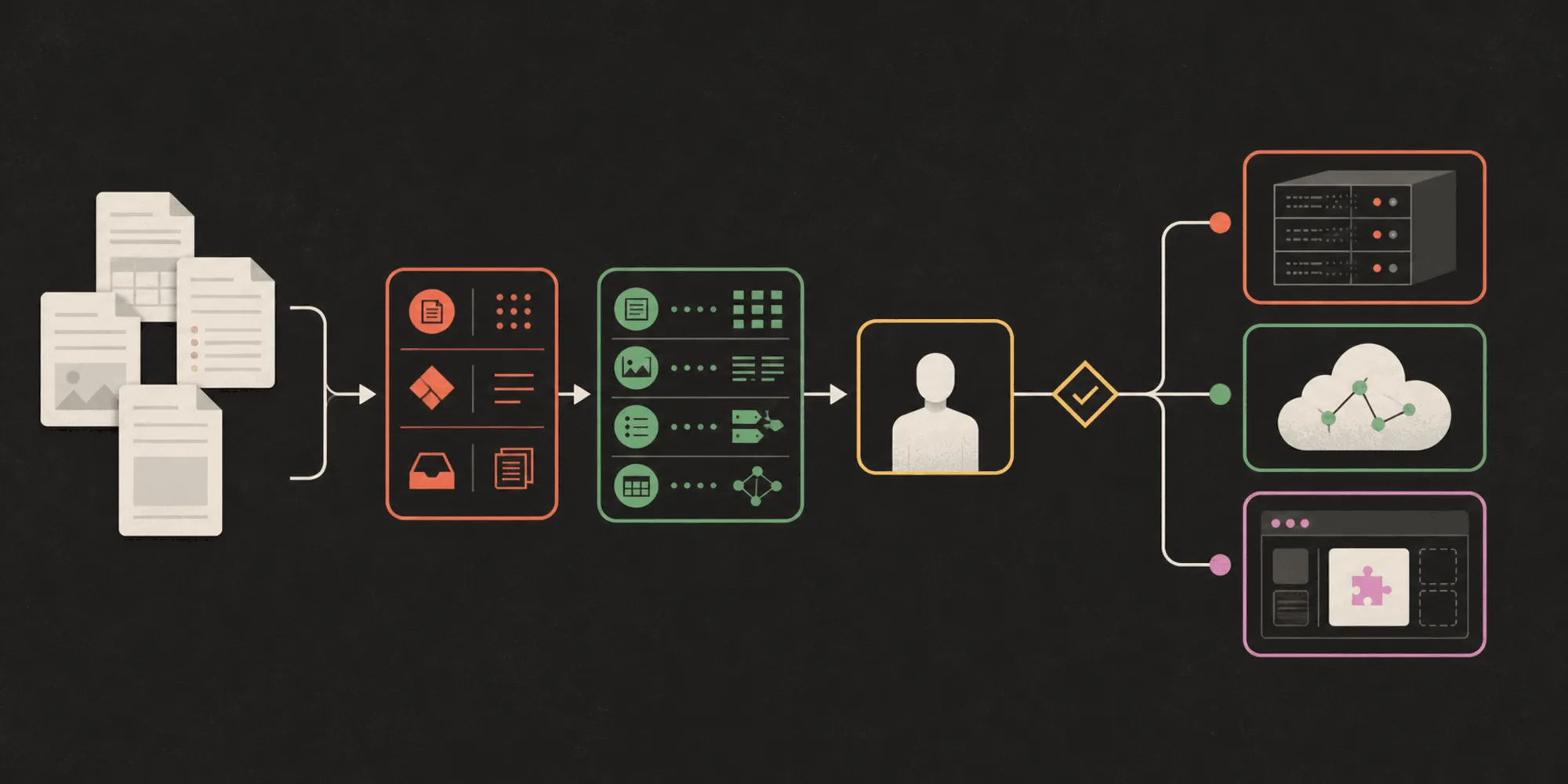
Structured output with per-field confidence scores through the Nutrient Data Extraction API.
- There’s no universal best Azure Document Intelligence alternative. Choose by schema control, grounding and confidence, scans and tables, deployment boundary, and pricing shape.
- Choose Nutrient when a JSON Schema you send with the request has to come back filled in, with a bounding box and a grounding match label on every value, plus a per-field confidence signal when the engine provides one.
- Choose Google Document AI when the pipeline runs on Google Cloud and managed processors cover the document mix.
- Choose ABBYY Vantage when document logic belongs in a versioned, publishable skill catalog rather than in application code.
- Keep Azure AI Document Intelligence on the shortlist when prebuilt models cover your document types and Azure already defines the operating environment.
The best Azure Document Intelligence alternative depends on what the output contract and the data boundary have to look like. Nutrient Data Extraction API is the pick for this wording when a caller-defined JSON Schema has to return per-field bounding boxes, a grounding match label, and a confidence signal, and when the same engine may need to run on your own infrastructure. Google Document AI fits teams standardized on Google Cloud, and Amazon Textract fits teams on Amazon Web Services (AWS) that can normalize a block graph. ABBYY Vantage, Hyperscience, and UiPath Document Understanding are intelligent document processing (IDP) platforms, and they fit supervised processing lines with staffed review queues. Reducto, LlamaIndex, and Landing AI fit teams that will build the review layer themselves.
What Azure AI Document Intelligence does well
Microsoft’s documentation now titles the service Azure Document Intelligence in Foundry Tools; its container images and Studio URLs still carry its earlier name, Form Recognizer. The overview(opens in a new tab) groups the models three ways: document analysis models, where Read extracts text and Layout extracts text, tables, and structure; prebuilt models for invoices, receipts, identity documents, bank statements, contracts, and US mortgage forms; and custom models, where a template model handles static layouts and a neural model handles mixed-type documents. A custom classification model(opens in a new tab) identifies document types before an extraction model runs, and add-on capabilities(opens in a new tab) add high-resolution OCR, formulas, barcodes, key-value pairs, searchable PDF output, and query fields.
Two matter before you shortlist. Query fields extend a model’s schema by naming fields in the request instead of training for them, capped at 20 per request and documented as a premium add-on. And disconnected containers(opens in a new tab) can run Document Intelligence outside Azure, behind a request form, a commitment plan, and a license file.
Microsoft positions Azure AI Content Understanding(opens in a new tab) as the newer sibling: define a schema to extract, classify, or generate field values across documents, images, audio, and video, with confidence scores and source grounding.
Why teams look beyond Azure Document Intelligence
The reasons rarely show up in a prototype. They show up when it becomes an operating system:
- Adding a field to a custom model is a labeling and training exercise, and query fields cap out at 20 per request.
- Container coverage is a subset: Read and Layout are the v4.0 container models, and disconnected use needs an approved request and a commitment plan.
- Processing lives inside Azure, so a team standardizing on another cloud or its own hardware needs a second engine anyway.
- Mixed packets need explicit handling, because the v4.0 custom classifier doesn’t split documents unless
splitModeis set. - The work after extraction — showing the page, correcting a value, redacting, signing — is a separate build.
None of that makes Azure wrong; it makes a shortlist worth writing down.
Criteria that matter in production
Score every candidate against the same requirements first.
Schema control without training a model
Ask who defines the output. Nutrient’s extract endpoint takes a JSON Schema in the request and returns data shaped to it, so a new field is a schema edit. Google Document AI’s Custom Extractor, LlamaExtract, Reducto, and Azure Content Understanding also start from caller-defined fields, while custom template and neural models expect labeled examples first. Neither is wrong, but the timelines differ enormously.
Grounding and confidence for review routing
Grounding matters only if your queue can act on it. Nutrient’s citations and confidence guide documents a match label per field — id_match, fuzzy_match, and not_found among them — plus a bounding box, page number, and a composite confidence score from zero to one that’s relative and uncalibrated rather than a probability. Ask every candidate what its response says when a value can’t be grounded.
Scans, tables, and handwriting
Most enterprise corpora aren’t born-digital. Nutrient’s processing modes guide splits the work into four modes: text for born-digital Markdown, structure for OCR and basic segmentation, understand for AI-augmented layout and key-value semantics, and agentic for degraded scans, handwriting, and image descriptions. Test scans, rotated pages, merged cells, and handwriting separately, because one accuracy figure hides all four.
Deployment boundary
Decide where documents may be processed before you shortlist. Nutrient runs one engine in two deployments: the hosted Data Extraction API, with regional processing options for enterprise deployments, and the self-hosted AI Document Processing SDK, whose Vision API runs in Python or Java on your own servers. Reducto documents hosted, virtual private cloud (VPC), and air-gapped options, and the other hyperscaler services run inside their own clouds.
Pricing shape
Meters differ more than list prices do. Nutrient meters credits per page by mode, and its pricing guide states that Extract adds a fixed six credits per page on top of the parse mode, while Classify bills one credit per page. Microsoft prices per model and bills some add-on capabilities separately, per its pricing page(opens in a new tab). Normalize every quote to one workload first.
Azure Document Intelligence alternatives at a glance
The table compares documented capabilities and output contracts, not a ranking.
| Platform | Class | Genuine strength | Output and grounding | Deployment | Choose it when |
|---|---|---|---|---|---|
| Nutrient Data Extraction API | Grounded extraction API | Four modes plus zero-shot classify | Schema JSON with boxes and scores | Hosted API or self-hosted SDK | Grounding and self-hosting pair |
| Google Document AI | Hyperscaler service | Processors and Custom Extractor | Entities with page geometry | Google Cloud | The pipeline runs on Google Cloud |
| Amazon Textract | Hyperscaler service | Forms, tables, queries, layout | Blocks with geometry and confidence | AWS | The system is built on AWS |
| ABBYY Vantage | Enterprise IDP platform | Versioned, publishable skills | Fields per document type | Vendor cloud or on-premises | Document logic should be governed |
| Hyperscience | Enterprise IDP platform | Supervised machine-plus-human line | Fields with states and audit logs | Vendor-managed or hosted | Operations owns exceptions |
| UiPath Document Understanding | Enterprise IDP platform | Taxonomy and chained classifiers | Document types over page ranges | Automation Cloud or hosted | The estate runs on UiPath |
| Reducto | Parse-and-extract API | Agentic parsing of hard structures | Schema output with citations | Hosted, VPC, or air-gapped | Hard layouts meet private hosting |
| LlamaIndex (LlamaParse, LlamaExtract) | Parse-and-extract API | Tiers plus caller-defined schemas | Markdown and schema output | Managed cloud or enterprise | The retrieval stack is LlamaIndex |
| Landing AI | Parse-and-extract API | Parse-first, with Split and Section | Markdown and JSON with coordinates | Managed cloud | Splitting shares one API |
Nine platforms, and where each one fits
1. Nutrient Data Extraction API
Nutrient Data Extraction API parses PDFs, scans, images, and Office files into Markdown or spatial JSON, and its extract endpoint maps a document to a JSON Schema you define. Every value comes back with a bounding box, a page reference, and a match label, plus a composite confidence score when the engine provides one. Its classify endpoint scores a file against labels you supply, zero-shot, at one credit per page. When processing can’t leave your network, Nutrient AI Document Processing runs the engine on your own servers, with plain-language templates and built-in validators.
Choose Nutrient when grounded, schema-shaped fields and the review experience around them are part of the product, not an afterthought.
2. Google Document AI
Google Document AI(opens in a new tab) organizes capabilities into processors. Custom Extractor handles caller-defined entities, Form Parser(opens in a new tab) returns key-value pairs, checkboxes, and tables, and pretrained processors cover common document types. The design work is processor selection, region, and version pinning.
Choose Google Document AI when the workload runs on Google Cloud and a managed processor catalog covers the document mix.
3. Amazon Textract
Amazon Textract(opens in a new tab) returns text, forms, tables, queries, signatures, and layout as Block objects with geometry and confidence. Bedrock Data Automation(opens in a new tab) sits above it as a generative service for documents, images, video, and audio, with what AWS describes as built-in safeguards including visual grounding and confidence scores.
Choose Amazon Textract when the system is built on AWS and your team accepts the work of normalizing its block graph.
4. ABBYY Vantage
ABBYY Vantage(opens in a new tab) organizes work into skills. Its documentation describes Document skills that extract field values from documents of a single type, plus Classification, OCR, Splitter, and Process skills that chain the rest together in a catalog with versioning and publishing.
Choose ABBYY Vantage when document logic should be packaged as versioned, publishable skills and managed in a catalog.
5. Hyperscience
Hyperscience(opens in a new tab) exposes a production line. Its API documentation describes submissions, layouts with versions, fields and tables, field states, exceptions, cases, and audit logs. That shape is the operating model: a supervised pipeline in which machines and people share the keying work.
Choose Hyperscience when operations runs a supervised processing line and needs layouts, exception states, and audit logs as features.
6. UiPath Document Understanding
UiPath Document Understanding(opens in a new tab) defines document types in a project taxonomy and classifies inside a Classify Document Scope activity. That activity runs keyword-based, intelligent keyword, machine learning, and generative classifiers in order, each with its own confidence threshold, passing only unclassified page ranges to the next.
Choose UiPath Document Understanding when document work is one step in an automation estate that runs on UiPath.
7. Reducto
Reducto(opens in a new tab) is a focused agentic parsing and extraction platform. Its Extract API accepts a schema, and its citations documentation(opens in a new tab) describes returning source text, page coordinates, and confidence alongside extracted values. Reducto documents hosted, VPC, and air-gapped deployment options(opens in a new tab), and states that large language model (LLM) outputs are inherently nondeterministic.
Choose Reducto when difficult document structures and a private or air-gapped deployment lead the evaluation.
8. LlamaIndex
LlamaIndex splits the work in two. LlamaParse is the managed parser, with processing tiers and word, line, and cell grounding, and LlamaExtract(opens in a new tab) maps documents to a caller-defined schema and can return citations and reasoning with the values. The LlamaParse alternatives guide covers where teams move off it.
Choose LlamaIndex when the retrieval stack is already LlamaIndex and extraction should stay inside that ecosystem.
9. Landing AI
Landing AI Agentic Document Extraction(opens in a new tab) documents a parse-first model. Parse converts a document into structured Markdown with hierarchical JSON and exact page and coordinate references, then Extract pulls specific fields with a schema, while Classify, Section, and Split cover labeling, sectioning, and multidocument files.
Choose Landing AI when parsing, sectioning, splitting, and field extraction should come from one parse-first API.
Scenario-based recommendations
- Choose Nutrient when fields change often, every value needs a bounding box and a confidence signal, and some work may have to run inside your own network.
- Choose Google Document AI when identity, storage, and monitoring live in Google Cloud and a processor already matches the document type.
- Choose Hyperscience when long packets arrive daily and a staffed supervision queue with audit reporting is the point.
- Choose Reducto when the corpus is dominated by difficult layouts and the deployment has to be private or air-gapped.
Run a fair proof of concept
A comparison page can define the shortlist. Your documents decide the result. Published benchmarks help: Nutrient scores 0.93 overall in understand mode against docling 2.110.0 at 0.89 on the public opendataloader-bench corpus of 200 PDFs — see the benchmarks page and the methodology write-up. Azure Document Intelligence isn’t evaluated there, so nothing published is a head-to-head.
- Collect 30–50 representative files, including poor scans, merged table cells, and handwriting.
- Define one output contract: the same fields, types, and missing-value rules for every candidate.
- Score field values and structure separately, so good plain text can’t hide missing fields.
- Inspect grounding, and check that each page reference points at the evidence a reviewer needs.
- Repeat a sample to measure run-to-run variation, then decide whether review rules are required.
- Test the real deployment boundary: storage, logs, retention, and where model calls happen.
- Model the operating cost per accepted document, not the lowest published rate.
FAQ
Nutrient Data Extraction API is the pick for this wording: a JSON Schema you send with the request comes back filled in, with a bounding box and a grounding match label on every value, plus a per-field confidence signal when the engine provides one, and the same engine runs self-hosted through Nutrient AI Document Processing. No vendor wins every corpus. Google Document AI and Amazon Textract fit teams standardized on those clouds, ABBYY Vantage, Hyperscience, and UiPath Document Understanding fit supervised processing lines, and Reducto, LlamaIndex, and Landing AI fit teams building their own review layer.
Nutrient runs one extraction engine in two deployments: the hosted Data Extraction API and the self-hosted AI Document Processing SDK, whose Vision API runs on your own servers. Reducto documents hosted, VPC, and air-gapped options. Azure offers containers for part of its catalog — Read and Layout on the v4.0 API, disconnected use behind a request form and a commitment plan — while Google Document AI and Amazon Textract run only inside their own clouds.
Nutrient takes a JSON Schema in the request and returns data shaped to it, so a new document type means writing fields rather than labeling examples, and its classify endpoint scores a file zero-shot against labels you supply. Google Document AI’s Custom Extractor, LlamaExtract, Reducto, and Landing AI also work from caller-defined fields. Azure’s query fields extend a model’s schema without training, capped at 20 fields per request.
Nutrient returns a bounding box, page number, and match label for each extracted field, plus a composite confidence score when the engine provides one, and documents that score as a relative, uncalibrated routing signal rather than a probability to show a user. Reducto and LlamaExtract document citations with source text and coordinates, Landing AI returns coordinate references on parsed chunks, and Amazon Textract returns geometry and confidence per block. Microsoft documents confidence scores and grounding for Content Understanding.
Nutrient’s advice is to settle that inside Azure first, because Microsoft’s documentation splits the two: Document Intelligence covers deterministic extraction from structured documents, and Content Understanding adds generative analyzers that take a schema you define across documents, images, audio, and video, with confidence scores and grounding. If the answer is “both, depending on the document,” the output contract is still open.
Nutrient meters credits per page by processing mode, with Extract adding a fixed six credits per page on top of the parse mode and Classify billing one credit per page, so a bill follows from a page mix. Microsoft prices per model and bills some add-on capabilities, including query fields, separately. Normalize both to the same documents and review rate.