Best Amazon Textract alternatives for document data extraction (2026)

Table of contents
Structured output with per-field confidence scores through the Nutrient Data Extraction API.
Teams leave Amazon Textract most often over cost predictability — its per-feature, per-page billing stacks quickly, and a run’s cost depends on which features are switched on. The strongest alternative depends on the priority: Nutrient for predictable per-page pricing with a spending cap and flexible deployment, Azure Document Intelligence for Microsoft-ecosystem teams that need on-premises containers, LlamaParse for RAG-focused Markdown output, and Docparser for no-code template parsing. This guide compares 10 tools on verified pricing, free tiers, and deployment.
Amazon Textract’s per-feature pricing and cloud-only deployment model send plenty of teams looking for an alternative. In short: The best one for most teams switching over cost is Nutrient’s Data Extraction API — it charges predictable per-page credits and lets a spending cap be set so bills can’t run away, and it can be self-hosted, which Textract can’t. Teams already committed to a cloud ecosystem or a specific workflow may prefer one of the other tools below; the right pick depends on the priority, so each is compared honestly.
Amazon Textract is a capable optical character recognition (OCR) and document-analysis service, but it isn’t the only option — and it isn’t always the most predictable one to run. What follows compares the leading alternatives on the things that actually drive a switch: pricing, deployment, and free tiers.
Why look for an Amazon Textract alternative?
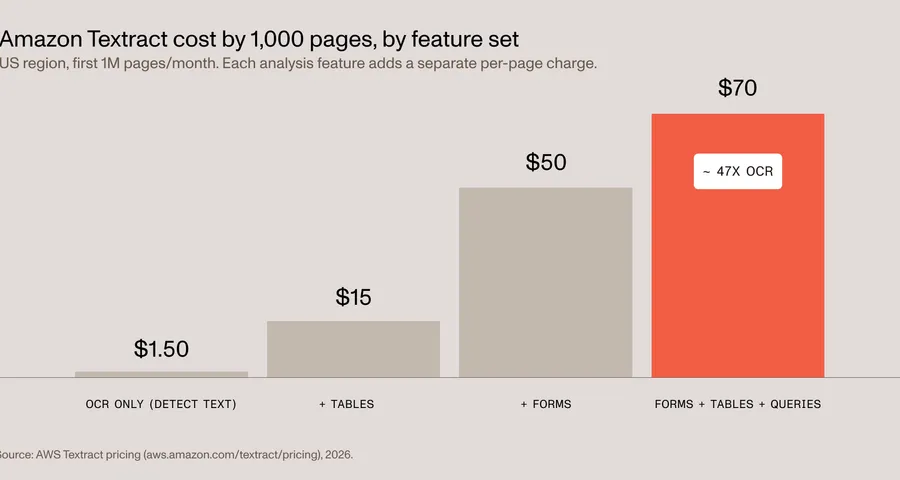
Textract’s pricing is the usual trigger. Raw text detection (OCR) starts at $1.50 per 1,000 pages, but each analysis feature is billed separately and additively. Turning on Forms, Tables, and Queries together costs about $70 per 1,000 pages — roughly 47 times the OCR-only rate (AWS Textract pricing(opens in a new tab)). Because the per-document cost depends on which features are enabled, it’s hard to predict at scale.
Two other constraints push teams to look around:
- Free tier is time-limited. Textract’s free tier only lasts three months for new AWS accounts; there isn’t an ongoing monthly allowance.
- Cloud-only. Textract runs as a managed AWS service with no self-hosted or on-premises option, which rules it out for teams with data residency or air-gapped requirements.
The best Amazon Textract alternatives (2026)
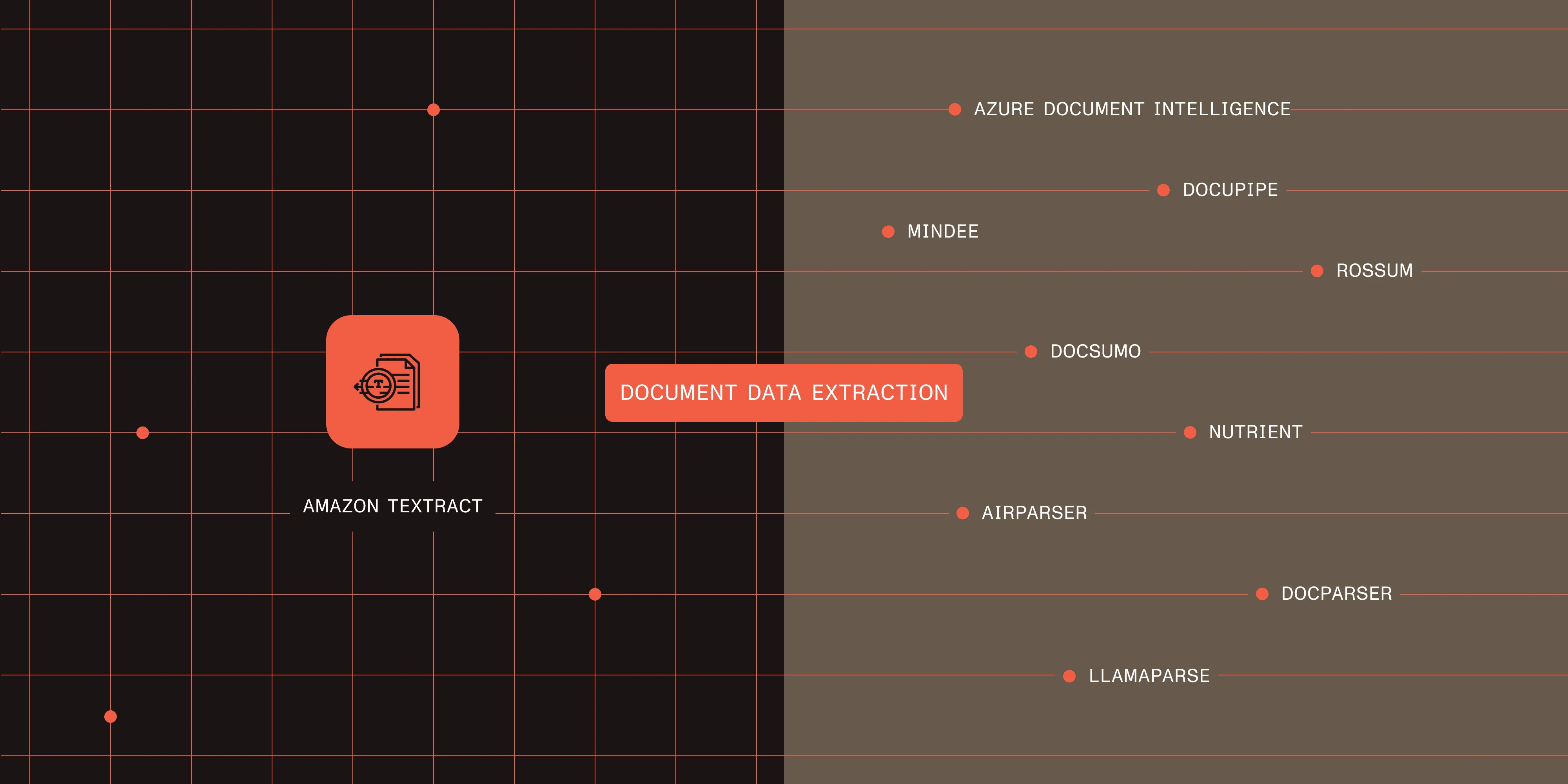
The table below compares 10 document data extraction tools. Pricing, free tiers, and deployment were verified against each vendor’s own site in July 2026; figures change, so confirm current pricing before purchase.
| Tool | Pricing | Free tier | Deployment |
|---|---|---|---|
| Nutrient | Per-page credits by mode (text: 1, structure: 1.5, understand: 9) plus pay-as-you-go with a configurable spending cap | 5,000 credits/month | Cloud API + self-hosted |
| Amazon Textract | Per-feature, per-page: $1.50/1,000 (OCR), rising to ~$70/1,000 with Forms + Tables + Queries | 3 months only | Cloud only (AWS) |
| Azure Document Intelligence | Per-operation: $1.50/1,000 (Read), $10/1,000 (prebuilt), $30/1,000 (custom) | 500 pages/month | Cloud + container (incl. disconnected) |
| LlamaParse | Credit-based: free 10,000/month, $50/month for 40,000 (1,000 credits = $1.25) | 10,000 credits/month | SaaS + enterprise VPC |
| Docparser | From $39/month (100 credits; 1 credit = 1 document up to 5 pages) | 14-day trial | Cloud only |
| Mindee | From €44/month (Starter) | 200 credits/14 days | Cloud only |
| Docsumo | Contact sales (paid-plan pricing not published) | 14-day trial, 1,000 pages | Cloud (SaaS) |
| Rossum | From $18,000/year | 14-day trial | Cloud |
| DocuPipe | Free tier, then $99–$499/month ($99 = 2,500 credits; ~3 credits/page) | Free tier (work email) | Cloud + self-hosted (Enterprise) |
| Airparser | From $33/month (100 credits, billed annually) | Free trial (30 credits) | Cloud only |
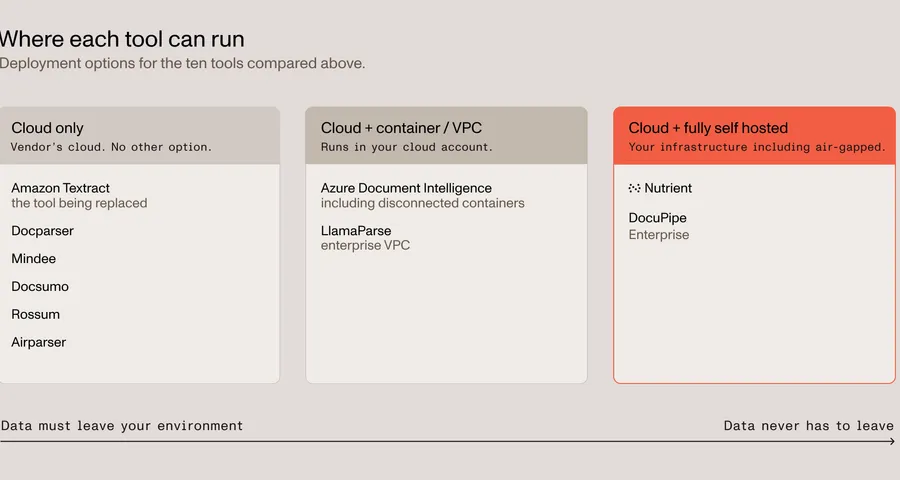
The deployment column is the one that rules tools out rather than ranking them. Most of the field can only run in the vendor’s cloud, which ends the conversation for anyone under data residency or air-gapped requirements.
Nutrient
Nutrient’s Data Extraction API converts PDFs, scans, and Office files into structured JSON or clean Markdown with confidence scores using dedicated endpoints for tables and key-value pairs. Pricing is per-page credits by processing mode, and pay-as-you-go runs against a configurable spending cap — so costs stay predictable and never exceed the cap. It offers a cloud API and a self-hosted option, which suits data residency and air-gapped requirements. It’s best for teams that want predictable spend and deployment flexibility.
Amazon Textract
Textract is the incumbent: a managed AWS service for OCR, forms, tables, queries, and specialized document types (expense, identity, lending). It’s a natural fit for teams already building on AWS, but the per-feature billing and cloud-only model are what send others looking.
Azure Document Intelligence
Azure Document Intelligence is Microsoft’s OCR and document processing service — now grouped under Foundry Tools and previously named Form Recognizer — with a broad library of prebuilt models and custom extraction. It stands out for container and disconnected (offline) deployment alongside the cloud API. Pricing is per-operation and stacks similarly to Textract. It’s best for Microsoft-ecosystem teams and on-premises needs.
LlamaParse
LlamaParse is an LLM-based, layout-aware parser from LlamaIndex that outputs Markdown tuned for RAG and agentic pipelines. It offers a generous free tier (10,000 credits/month) and a RAG-first design, and credit cost scales with the accuracy mode chosen. It’s best for teams feeding documents into LLMs. For a direct comparison of the parsing layer, see Nutrient vs. LlamaIndex.
Docparser
Docparser is a no-code, template- and zone-based parser for recurring business documents (invoices, purchase orders, bank statements). It offers straightforward monthly plans and an approachable rule builder, though each new layout needs rules configured. It’s best for non-technical teams with predictable document types.
Mindee
Mindee is a developer-first platform with prebuilt extraction APIs (invoices, receipts, IDs, resumes) and custom trainable models, returning JSON with confidence scores and bounding boxes. It’s cloud-only and best for developers automating specific document types.
Docsumo
Docsumo is an intelligent document processing platform aimed at finance, lending, and insurance workflows, with validation, classification, and review built in. Paid pricing is contact-sales only, so budgeting requires a sales conversation. It’s best for enterprises wanting a managed IDP workflow.
Rossum
Rossum is a template-free, transactional-document platform focused on accounts-payable and invoice automation, built on its Aurora model. Entry pricing starts at $18,000/year, so it targets higher-volume enterprise buyers. It’s best for large AP automation programs.
DocuPipe
DocuPipe turns variable-layout documents into schema-controlled JSON through composable operations (parse, classify, extract, review). It publishes transparent credit pricing — a free tier, then $99/month for 2,500 credits, up to $499/month — and Enterprise plans can be self-hosted in a private VPC. It’s best for teams that want schema-driven extraction with a self-hosted option.
Airparser
Airparser is an LLM-powered parser with a strong email and inbox angle — it extracts structured JSON from incoming emails and attachments, as well as PDFs and documents, template-free. It’s cloud-only, with credit-based plans from $33/month. It’s best for teams automating document and email intake.
How the pricing models differ
Textract’s expense comes from per-feature stacking — every capability added (Forms, Tables, Queries) adds a separate per-page charge, so the effective rate climbs well above the headline OCR price. Tools with a single per-page or per-credit rate are easier to budget:
- Nutrient charges per-page credits by mode and lets a spending cap be set, so a bad month can’t produce a surprise invoice.
- LlamaParse and Azure Document Intelligence publish clear per-credit and per-1,000-page rates with ongoing free tiers (10,000 credits/month and 500 pages/month respectively).
- Docparser offers low fixed monthly plans from $39/month for lower volumes.
The cheapest option depends on volume and which features are needed. The key difference from Textract is predictability: A flat per-page or capped model avoids the feature-stacking math that makes Textract difficult to forecast.
Why teams choose Nutrient over Amazon Textract
For teams switching specifically to escape Textract’s cost and constraints, Nutrient answers the common complaints directly:
- The bill is knowable before the run. Pricing is per-page credits with a configurable spending cap, and the text, structure, understand, and agentic modes let cost scale per document — so a busy month can’t produce a surprise invoice the way Textract’s per-feature stacking can.
- The data never has to leave. Nutrient runs as a cloud API or fully self-hosted, including air-gapped environments — an option Textract doesn’t offer at all, which is what settles it for teams under data residency or compliance rules.
- The free tier doesn’t expire. 5,000 credits every month, not a three-month trial — enough to keep testing against real documents after the evaluation ends.
Switching is low-friction, too: The Data Extraction API is a REST endpoint that takes the same PDFs and returns either structured JSON — with confidence scores and bounding boxes — or clean, RAG-ready Markdown, so extraction and AI-ingestion pipelines run through one tool and the extraction step swaps in without rearchitecting anything around it.
Accuracy and human review
Cost matters, but so does extraction quality. Nutrient returns confidence scores and match labels on every field and supports human-in-the-loop review, so low-confidence extractions can be routed for a check rather than trusted blindly.
Nutrient’s own extraction accuracy is measured on a public benchmark. There’s no published head-to-head against Amazon Textract, so treat vendor accuracy claims — including ours — as a reason to run real documents through a free tier rather than a substitute for doing so.
Conclusion
Amazon Textract is a solid service, but its per-feature pricing, three-month free tier, and cloud-only model send many teams looking for something more predictable and flexible. For most teams switching over cost, Nutrient’s Data Extraction API is the strongest alternative — predictable per-page pricing with a spending cap, structured JSON or Markdown output, and a self-hosted option. Teams anchored to a cloud ecosystem or a specific document workflow may prefer one of the others compared above.
The cheapest way to settle it is to stop comparing tables and run the documents in question through both. Nutrient’s free tier is 5,000 credits every month with no card required — enough to process a real sample and compare the extracted fields, the confidence scores, and the invoice against what Textract charges for the same run. See the Data Extraction API and its pricing for the full detail.
FAQ
It depends on the priority. For predictable pricing and flexible (including self-hosted) deployment, Nutrient’s Data Extraction API is the strongest general-purpose alternative. Azure Document Intelligence fits Microsoft-ecosystem or on-premises needs, LlamaParse fits RAG Markdown output, and Docparser fits no-code template parsing.
For predictable cost, yes. Textract bills each analysis feature separately and per page, so combining Forms, Tables, and Queries reaches about $70 per 1,000 pages. Alternatives with a single per-page or per-credit rate — and, in Nutrient’s case, a configurable spending cap — are easier to budget and avoid feature-stacking surprises.
No. Amazon Textract is a cloud-only managed AWS service with no on-premises option. Teams that need self-hosted or air-gapped deployment can use Nutrient (self-hosted option) or Azure Document Intelligence (disconnected containers).
Nutrient (5,000 credits/month), LlamaParse (10,000 credits/month), and Azure Document Intelligence (500 pages/month) publish ongoing monthly free allowances. DocuPipe also has a free tier (credits granted with an eligible work email), though it doesn’t state a monthly renewal. Amazon Textract’s free tier lasts only three months; Docparser, Mindee, Docsumo, Rossum, and Airparser offer time-limited trials.