Purchase requisition system: Streamline procurement with automated workflows

Table of contents
What is a purchase requisition system?
A purchase requisition system is software that manages the internal process of requesting goods or services. The process runs from the moment an employee submits a request to the moment it’s approved and converted into a purchase order (PO). It replaces paper forms and email chains with a structured workflow. The workflow includes standardized request forms, automatic routing to the right approvers, validation against budget and policy, and a complete audit trail of every decision.
Requisitions often come with an approval process, which may lead to a purchase order. Requisition systems fall into the same category as procurement software.
Requisitions are made by completing a requisition form, either paper or digital. The form gathers all the details approvers need to make a decision and purchasers need to create a purchase order.
Why is purchase requisition important?
A purchase requisition system is essential for a company, as it serves multiple critical functions:
- Risk mitigation and compliance — Standardizing requisitions helps organizations comply with internal policies and external regulations, reducing non-compliance and penalty risk.
- Preventing unauthorized spending — Requiring approval before purchases can eliminate unnecessary or redundant expenditures, so companies use financial resources efficiently.
- Budget control and financial oversight — With a structured requisition system, companies can ensure that purchases align with budget constraints. This proactive approach prevents overspending and keeps financial planning on track.
- Strengthening vendor relations — A well-organized system helps procurement teams manage supplier interactions, negotiate better, and coordinate lead times. This contributes to a more efficient supply chain.
- Enhancing procurement efficiency — By consolidating purchase requests, organizations can take advantage of bulk purchasing opportunities, leading to cost savings. Additionally, it streamlines the procurement workflow, reducing last-minute, unstructured purchases.
- Ensuring operational continuity — Departments rely on a requisition system to communicate their needs effectively. This ensures they receive essential goods and services in a timely manner to maintain smooth operations.
- Providing transparency and accountability — The system documents every purchase request, approval, or denial. This creates an audit trail that enhances transparency and can be useful for internal audits or regulatory reviews.
- Supporting forecasting and strategic planning — Examining purchase requisitions enables companies to predict future spending trends. This helps finance and procurement teams make informed decisions about budgeting and long-term planning.
The purchase requisition process step by step
The purchase requisition process is the sequence of steps a request follows before any money is committed:
- Submit the request — An employee completes a requisition form with the item, quantity, cost, justification, and budget code.
- Validate against budget and policy — Validation rules flag missing fields, off-policy vendors, or amounts over threshold before final approval.
- Review and approve — The validated request routes to the right approvers based on amount, department, or cost center. An approval workflow manages multilevel signoff, escalations, and reminders.
- Convert to a purchase order — Once approved, the requisition becomes a purchase order that is sent to the vendor.
- Receive and match — Received goods or services are matched to the PO, and later to the invoice during accounts payable.
- Track and record — Every action is logged for real-time visibility and audit readiness.
For larger, budgeted purchases, this process overlaps with capital expenditure (CapEx) approvals, which follow stricter routing. Looking for software to run the whole process end to end? See our purchase requisition software.
Common types of requisitions
- Job requisition
- Material requisition
- Payment requisition
- Supply requisition
Benefits of a purchase requisition system
By automating the requisition process with a workflow automation platform, businesses can realize numerous benefits.
- Streamline and speed up the requisition process by reducing manual entry and request handling.
- Reduce requisition errors and rework.
- Reduce the risk of improperly approved requisition requests, purchase orders, hires, etc.
- Improve process compliance with request and approval audit trails.
- Reduce purchase request cycle times.
- Provide a unified, personalized requisition experience for employees.
- Track requisition status (completed, pending, or in progress, etc.) in real time.
- Reduce license overhead for enterprise systems such as enterprise resource planning (ERP) and customer relationship management (CRM) systems.
- Identify and remove process barriers or bottlenecks.
- Drastically reduce paperwork and associated costs and waste.
The difference between purchase requisitions and purchase orders
Both purchase requisitions and purchase orders are critical for your procurement process, but they serve different purposes and are used at different stages.
A purchase requisition is an internal authorization that initiates the procurement process. A purchase order is a formalized agreement that confirms the buyer’s intent to purchase.
So, in short, you use a purchase requisition to generate a purchase order.
Requisition process example: PPE requisition
In this example, an employee or manager wants to request personal protective equipment (PPE). The workflow includes a request form and an automated process that routes the form.
While this example is fairly straightforward, you can customize its form and process to work however your business needs. You might add questions to the form to get more detail, for instance. You could route the request differently, perhaps to another layer of approval or a different department. The possibilities are endless.
Nutrient Workflow customers get access to prebuilt process applications as part of their subscription.
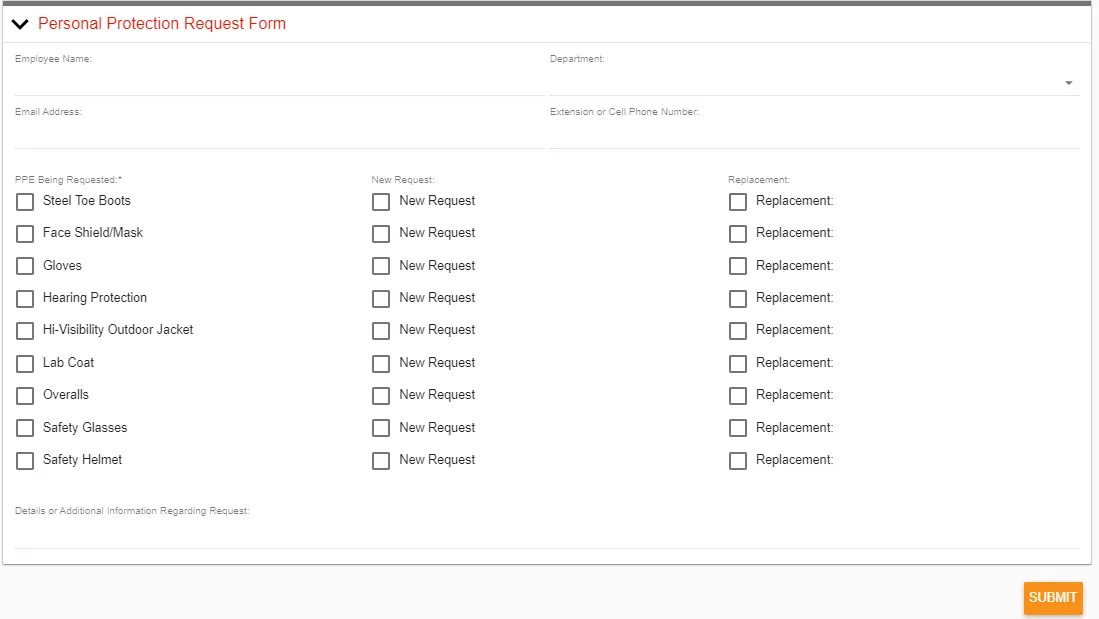
Personal protective equipment requisition form example
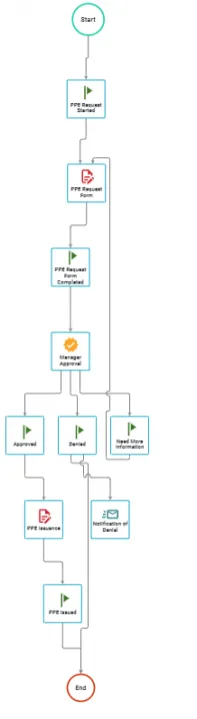
Personal protective equipment requisition process example
Integration with finance systems
Your business might want to pull a list of available items from an ERP system or push approved requests into an accounting system. Either way, you can integrate these systems directly into your requisition process.
With its open API and AWS Lambda integration, Nutrient Workflow enables customers to integrate their requisition system directly within their existing enterprise infrastructure.
The tools to design your own custom purchase requisition system
We also offer a variety of tools to help you customize your system.
Process builder
Our visual process designer interface enables you to design custom requisition workflows using drag and drop. Automatically assign tasks and route information based on your organization’s unique workflow. Set alerts, reminders, and escalations to keep work moving forward.
Form designer
Create responsive, web-based forms to capture requisition information. Include a wide variety of field types, form logic, templates, and layouts to ensure the correct data is captured and routed every time.
Self-service portal
Provide a unified frontend experience that enables users to submit requisition forms, complete approvals, and track process status. Collaborate in real time about work being performed. Provide visibility by role to see which tasks are completed, pending, or in progress for a great user experience.
Process tracking and reporting
Track and maintain an audit trail of all your requisitions and approval workflows, including form data, users, and tasks performed. Follow team progress and use key performance indicator (KPI) scoreboards to track the overall efficiency and drive improvements. Build custom reports to analyze and share with stakeholders.
Process integration (API)
Create workflow applications with process integration in existing enterprise systems. Our open architecture and standalone web service enable other applications to initiate a workflow and complete a list of tasks. Other applications can also update process statuses and conduct other bidirectional activities. Connect everything with Nutrient Workflow.
Interested in automating your requisition process?
If you’re interested in learning more, you can talk to a Nutrient Workflow expert or try Workflow Automation free for 14 days.
FAQ
A purchase requisition system is software that enables employees to request items or services through an automated process. The process includes a standardized request form, routing to the right approvers, budget and policy validation, and an audit trail. It usually ends in an approved purchase order.
A purchase requisition tool is the software component that builds and runs the requisition process. It includes the form designer that captures requests, the workflow engine that routes approvals, and the tracking dashboard that shows request status. In practice, people use “tool” and “system” interchangeably; platforms like Nutrient Workflow bundle all three.
An online (electronic) requisition system removes manual handoffs. Users submit requests from any browser. The system routes them automatically based on amount or department, validates them against budget before approval, and logs them for audit. This can reduce cycle times and make requests easier to track. Effective policy controls depend on correct rules, integration coverage, and exception handling.
The typical steps are to submit the requisition, validate it against budget and policy, and route it for approval. The remaining steps are to convert it to a purchase order, receive and match the goods, and track and record the activity for audit purposes.
Common types include job, material, payment, and supply requisitions, each with specific forms and approval processes.
Benefits include streamlined workflows, reduced errors, improved compliance, real-time tracking, and reduced paperwork.
Yes, Nutrient Workflow can integrate with ERP and accounting systems using its open API and AWS Lambda integration for data exchange.
You can fully customize the requisition process using Nutrient Workflow’s visual process designer, form designer, and self-service portal features.