



Before you build document extraction in-house: Build vs. buy

Table of contents
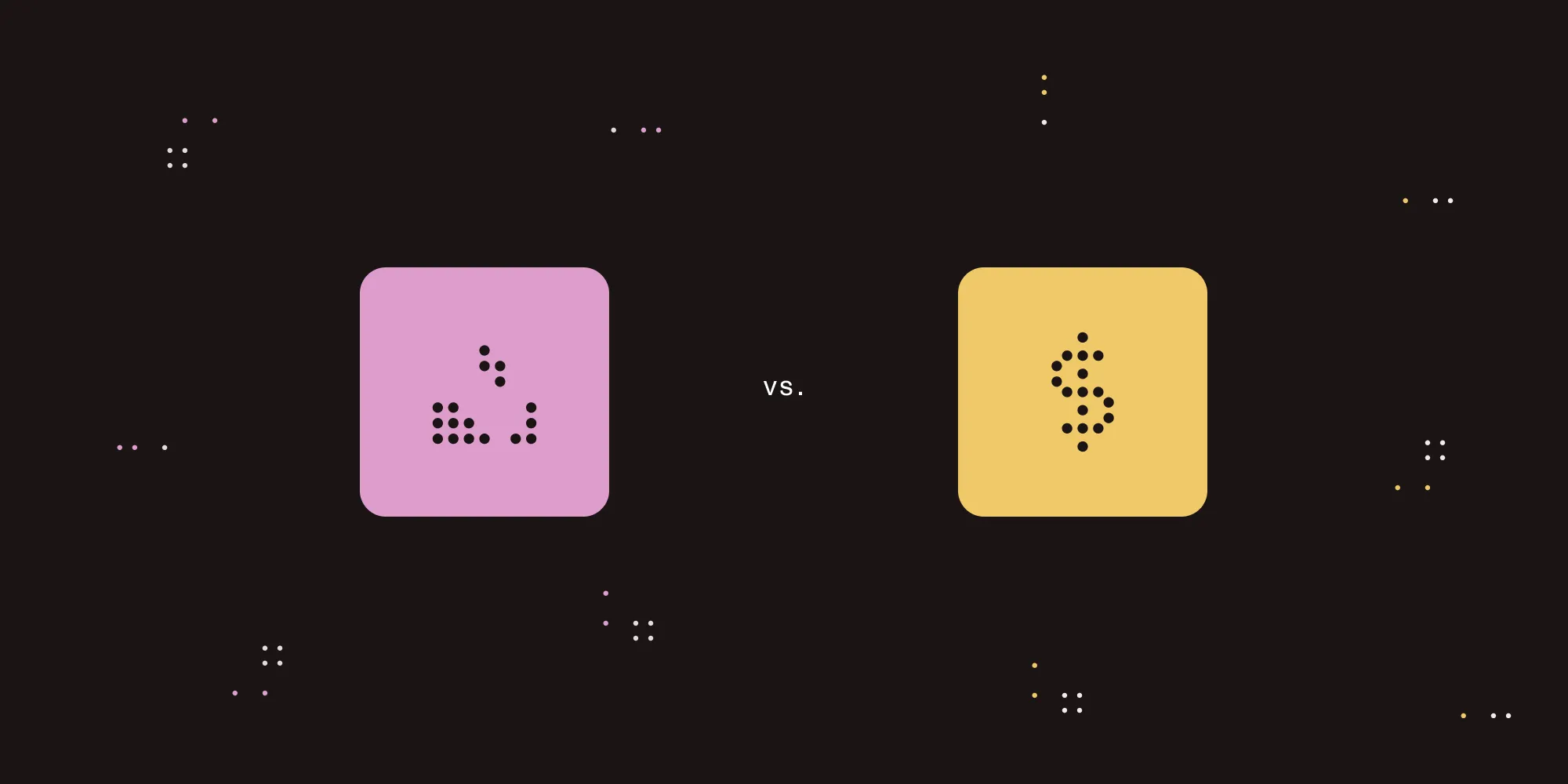
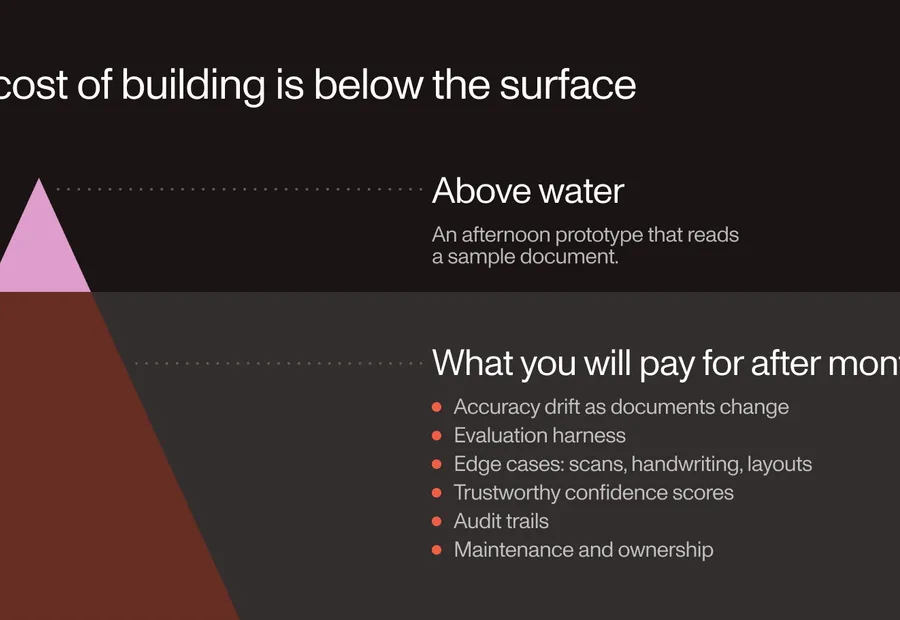
With a large language model (LLM) and a few open source libraries, a working document-extraction prototype can be built in an afternoon, which is exactly why the build-vs-buy decision is harder than it looks. The real cost of building in-house lands after month one: accuracy drift as documents change, the evaluation harness, edge cases like scans and handwriting, trustworthy confidence scores, audit trails, and maintenance when the person who built it moves on. Building in-house is the right call for low volume, a single stable document type, no compliance burden, and spare engineering capacity. Buying makes sense once volume, document variety, or compliance enters the picture.
Building document extraction looks easy right now. An LLM plus a PDF library reads a sample invoice on the first try, and the demo is convincing. The hard part comes after the demo. This guide covers when building in-house is the right decision and when it isn’t, based on what a DIY pipeline costs once real documents start flowing.
When building document extraction in-house is the right call
Building is genuinely the better choice in some cases. When volume is low, the documents are one stable type, and the team has capacity to build and maintain the pipeline over time — not just ship the first version — an in-house build is reasonable (the full checklist is below). For that profile, an open source AI document processing stack or a single LLM call is often all that’s needed.
The decision only gets hard when one of those conditions breaks, which is where the costs below start to show up.
What an in-house pipeline actually costs after month one
The prototype is the cheap part. These are the costs that show up once the pipeline meets real documents:
- Accuracy drift. LLM document extraction that works on this month’s documents degrades as vendors change invoice layouts, new document types appear, and edge cases accumulate. Accuracy isn’t a one-time score; it’s a moving target that needs monitoring.
- The evaluation setup. Without a labeled test set and a scoring harness, there’s no way to know whether extraction is 95 percent accurate or 70 percent accurate, or whether last week’s prompt change quietly regressed. Building, maintaining, and expanding that evaluation as documents evolve is substantial ongoing work, and the part most in-house efforts skip. Without it, accuracy goes unmeasured.
- Edge cases. Scanned pages, handwriting, rotated images, multicolumn layouts, and low-quality faxes each need handling. Reaching production quality often means training a custom optical character recognition (OCR) model or bolting OCR onto the LLM pipeline — a project of its own.
- Confidence scores you can trust. A raw LLM answer doesn’t come with a calibrated confidence score, so there’s no reliable signal for which extractions to auto-process and which to route for human review. Building that judgment layer is non-trivial.
- Audit trails. Regulated workflows need a record of what was extracted, from which document, and how — retained and queryable. That’s infrastructure, not a prompt.
- Maintenance and ownership. The pipeline needs an owner. When the engineer who built it moves on, an undocumented chain of prompts, parsers, and glue code becomes a liability.
None of these show up in the first-week demo. They all show up once the pipeline is in production.
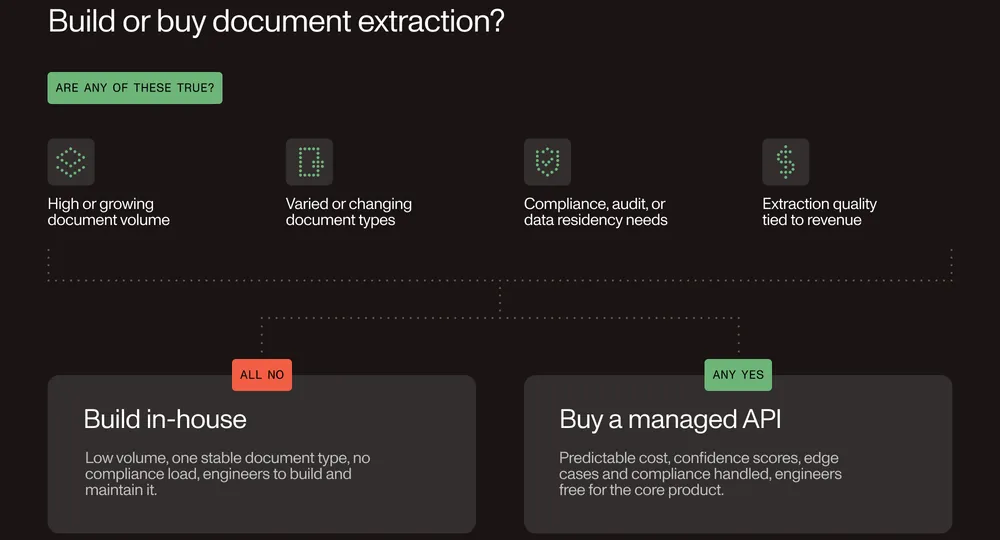
Build if…/buy if…
Build in-house if:
- Volume is low and unlikely to grow.
- Documents are one consistent, stable type.
- There are no compliance, audit, or data residency requirements.
- The team has engineering capacity to maintain it long-term.
- Occasional extraction errors are acceptable.
Buy a managed solution if:
- Volume is growing or already high.
- Document types and layouts vary and keep changing.
- Compliance, audit trails, or data residency matter.
- Extraction quality is tied to revenue or customer trust.
- Engineering time is better spent on the core product.
The 12-month cost picture
The cost of building rarely appears as a line item; it shows up as engineering time and ongoing maintenance. The table below is directional, not a quote; actual figures depend on volume, document mix, and team. The pattern is what matters.
| Cost area (first 12 months) | Build in-house | Buy (managed API) |
|---|---|---|
| Initial integration | Weeks to months of senior engineering to wire OCR/LLM, parsing, and retries | Hours to integrate a REST endpoint |
| Accuracy and evaluation | Build and maintain a labeled test set and scoring harness | Confidence scores provided; vendor tunes the models |
| Edge cases | Ongoing work per new format (scans, handwriting, layouts) | Handled by the vendor’s pipeline |
| Infrastructure | Hosting/GPUs for models, plus scaling | Included in a per-page price |
| Maintenance | Continuous; key-person risk when the builder leaves | Vendor-maintained |
| Compliance and audit | Build audit trails and data-handling controls | Inherited (e.g. SOC 2 Type 2 audited, self-host option) |
The headline per-page price of a managed API is easy to see. The engineering and maintenance cost of building is easy to underestimate, which is why building so often looks cheaper than it turns out to be.
Where a managed API fits
For teams past the build-in-house conditions, a managed extraction API removes the parts that drain time: It returns structured data with confidence scores (accuracy measured on a public, reproducible benchmark), handles scans and varied layouts, and carries compliance and audit features rather than requiring them to be built. Nutrient’s Data Extraction API does this with predictable per-page pricing and both cloud and self-hosted deployment — the latter for data residency and air-gapped needs. The point isn’t that building is always wrong; it’s that the honest cost of building should be compared against buying before the prototype sets the expectation.
Related reading
- PDF SDK: Build vs. buy — The 2023 build-vs-buy guide for PDF SDKs; this post is its extraction-era sequel, weighing the same decision under new economics.
- Build a document extraction pipeline — What a production extraction pipeline involves, end to end.
- Data Extraction API benchmarks — The accuracy and speed results behind the comparison above.
- Nutrient Data Extraction API — The managed option compared above.
FAQ
Build in-house for low volume, a single stable document type, no compliance requirements, and spare engineering capacity. Buy a managed solution once volume grows, document types vary, compliance or audit trails matter, or extraction quality affects revenue — because the maintenance cost of building compounds after the first month.
LLM document extraction handles a clean, consistent document well in a prototype. Production is harder: Accuracy drifts as layouts change, scanned and handwritten pages need OCR, and raw LLM output lacks calibrated confidence scores and audit trails. Those gaps are the real work.
For low volume and a single format, going the open source AI document processing route — a few libraries or a custom OCR model — can be enough. At scale, or with varied documents and compliance needs, the cost shifts to building and maintaining evaluation, edge-case handling, and audit infrastructure — which is where a managed API usually wins.
It’s cheaper to prototype, but rarely cheaper to run. A first version is fast to build with an LLM, but the 12-month cost also includes evaluation, edge-case handling, confidence scoring, audit trails, and ongoing maintenance — engineering time that usually exceeds a managed API’s per-page fee once volume and document variety grow.