Optimize retail efficiency with barcode extraction

Table of contents

Retailers face the constant challenge of managing diverse inventories efficiently. Barcode scanning has become a cornerstone in this pursuit, enabling quick and accurate identification of products. The Aquaforest PDF Connector for Power Automate extracts barcode values from PDF files for a SharePoint workflow. For a code-based alternative, explore the Nutrient barcode scanner SDK.
Use case: Automating inventory management
This workflow reads barcodes from uploaded documents and records the result in a SharePoint list.
Challenges
- Time-consuming manual processes: Traditional inventory management involves manually scanning and recording barcode values, consuming valuable time.
- Error-prone operations: Manual data entry increases the risk of errors in inventory records, impacting order fulfillment and customer satisfaction.
- Limited scalability: As retail businesses grow, the manual approach becomes increasingly impractical and prone to inefficiencies.
Benefits
- Efficiency gains — Automation accelerates the barcode extraction process, reducing the time and effort required for inventory management.
- Accuracy improvement — Automated extraction reduces manual entry. Validate decoded values and reconcile inventory updates before relying on the records.
- Scalable solution — Power Automate provides a scalable solution, adapting to the growing demands of expanding retail operations.
Aquaforest PDF Connector: Get barcode value in Power Automate
Step 1: Configure Aquaforest PDF Connector.
Add the Aquaforest PDF Connector to your Power Automate workflow. First, you choose the type of flow and the trigger.
Choose to create “Automated cloud flow” and set a trigger “When a file is created or modified (properties only)”. Then add the action “Get file content”. In the “File Identifier” field, add dynamic content “Identifier”.
Click on the + button to add a new action, and search for the “Get barcode value” action.
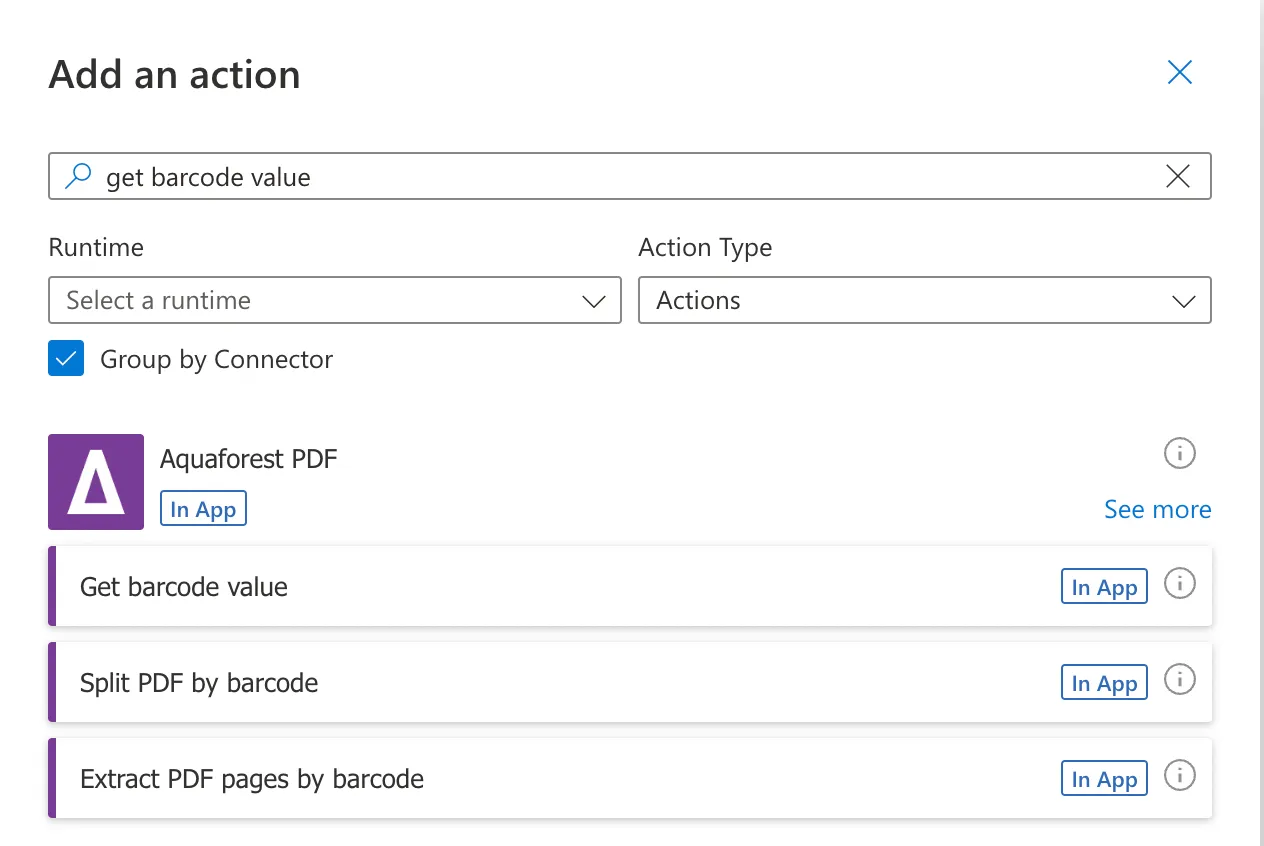
As a next step, you’ll be asked for a Connection Name and an API Key. Give your connection a name and use the primary key generated upon signing up for the PDF Connector(opens in a new tab). If you need assistance, read the getting started guide, particularly the generate API key section(opens in a new tab).
Step 2: Provide input parameters.
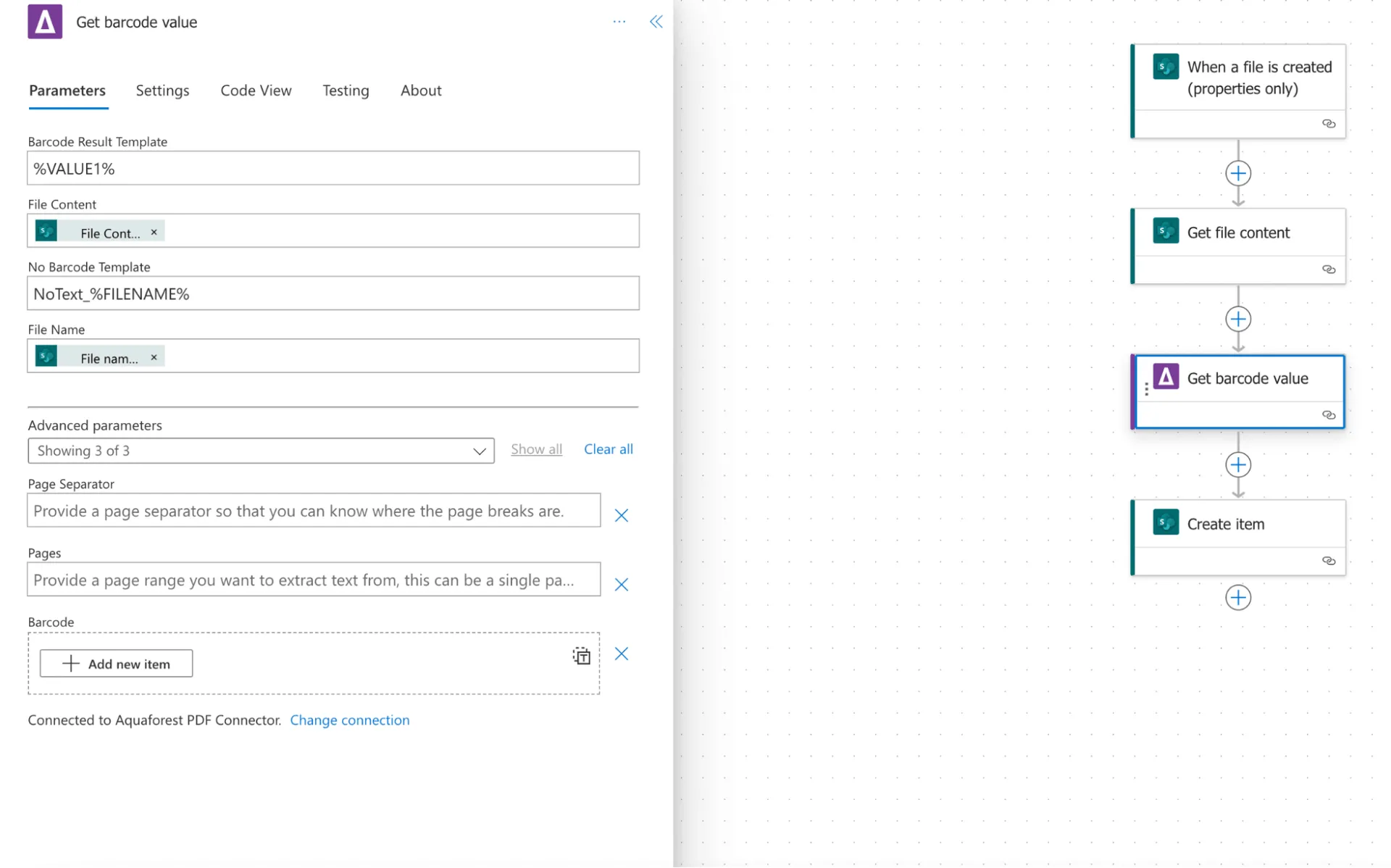
When you activate the connector and add an action, the next step is to fill in the parameters.
- Barcode Result Template: Define the output text template for found barcodes.
- File Content: Add “File content” from Dynamic list.
- File Name: Add “File name with extension” from Dynamic list.
- No Barcode Template: Set the output text template for cases where no barcode is found.
Step 3: Configure barcode zones and optional parameters.
Add a barcode zone and set its required Location value using the Aquaforest Zonal Extraction Tool referenced in the connector documentation(opens in a new tab). Choose the barcode types to detect in that zone. Repeat for other known regions; don’t assume an empty location scans the full page.
- Page Separator: Define a separator for page breaks.
- Pages: Specify the page range for extracting barcode values.
Step 4. Create item action.
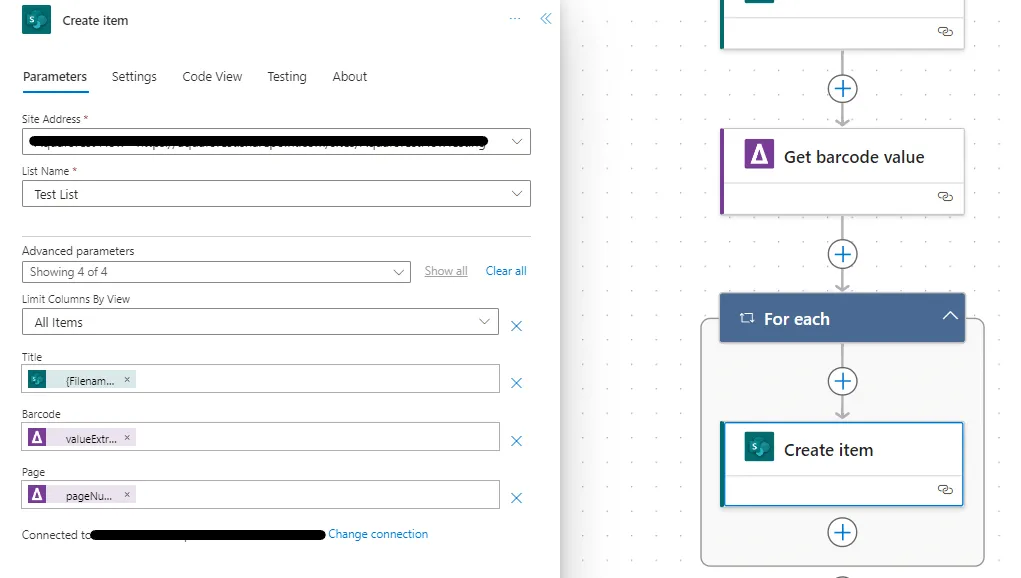
Add the create item action and configure it using the details below:
Site address: The URL of your SharePoint site.
List name: Select the destination SharePoint list where you want to save a record.
Create a text column such as Barcode value in that list, and map the connector’s Barcode output to it. Populate Title and any other required list fields. The Create item action(opens in a new tab) writes a list record; the source PDF was already read by Get file content and Get barcode value. It doesn’t take the source library’s folder path.
Check the connector’s Is Successful output before creating the item, and handle missing barcode results separately. If you need one record per result, iterate the Barcode Results array instead of saving the combined Barcode string.
The connector also returns these output parameters.
- Barcode: The generated string from the extracted text applied to the file template.
- Barcode Results: An array with pages and their corresponding extracted barcode values.
- Page Number: The page where the barcode was found.
- Page Barcode: The generated string from the extracted barcode value applied to the Barcode Result Template.
- Zone Values: An array containing the barcode extracted from each zone.
- Is Successful: A Boolean value indicating the success of the operation.
- License Info: Information about your API subscription key.
- Error: Contains the error message returned by the operation, if any.
Step 5: Execute the action.
Click on the Save button and run the Power Automate workflow to trigger the “Get Barcode Value” action.
Step 6: Review output.
Check the output for successfully extracted barcode values, along with detailed information about each page.
Conclusion
The Aquaforest PDF Connector(opens in a new tab) enables a Power Automate flow to read barcodes from PDF files, and the SharePoint Create item action saves the results to a list. Test the configured zones with representative PDFs, and then add checks for missing or unexpected values before relying on the records. Teams building the same workflow in code can follow the C# barcode scanner tutorial with Nutrient .NET SDK.