Agentic RAG, explained: Why retrieval is only as good as your documents

Table of contents
- Agentic RAG puts an AI agent in control of retrieval: It decides what to look up, when to look again, and when it has enough to answer, instead of running one fixed lookup.
- It can help with multistep questions, ambiguous queries, and answers spread across several documents; evaluate the benefit against added latency and cost.
- The agent’s reasoning is only as good as the documents it retrieves. If parsing drops a table or garbles a scan, the agent reasons over the wrong input and the extra autonomy just compounds the error.
- This guide covers how agentic RAG differs from traditional RAG, the retrieval loop, and how document extraction affects retrieval and answer quality.
A basic two-step retrieval-augmented generation (RAG) pipeline follows a fixed sequence: Take the question, retrieve the top matching chunks, and generate an answer from them. It works well when the answer sits in one place and the query is clear.
That baseline can struggle when the question needs several steps, when the first retrieval misses, or when the answer is spread across multiple documents. Agentic RAG addresses those cases by giving an AI agent control over the retrieval process itself.
What is agentic RAG?
Agentic RAG is a RAG architecture where an agent (a language model with tools and a decision loop) drives retrieval, rather than a single fixed lookup feeding the model once.
Instead of retrieve-then-generate, the agent can reformulate the query, retrieve more than once, choose between sources, decide whether what it found is sufficient, and only then answer. Retrieval becomes a decision the agent makes at each step.
Traditional RAG vs. agentic RAG
The comparison below uses a basic two-step baseline. Non-agentic pipelines can also rewrite queries, search multiple indexes, and validate results through predefined steps; agentic RAG lets a model choose the next action.
| Basic two-step RAG | Agentic RAG | |
|---|---|---|
| Retrieval | One fixed lookup | Agent decides what and when to retrieve |
| Queries | Uses the question as-is | Can reformulate and refine the query |
| Multistep questions | Struggles | Handles via multiple retrieval rounds |
| Sources | Single index | Can choose among several tools or indexes |
| Failure mode | Misses, then answers anyway | Can detect a miss and retry |
| Cost and latency | Low, predictable | Higher: more model calls and lookups |
Agentic RAG isn’t a free upgrade. The added retrieval rounds and reasoning cost latency and tokens, so it pays off on hard, multistep questions rather than simple lookups.
How the agentic RAG loop works
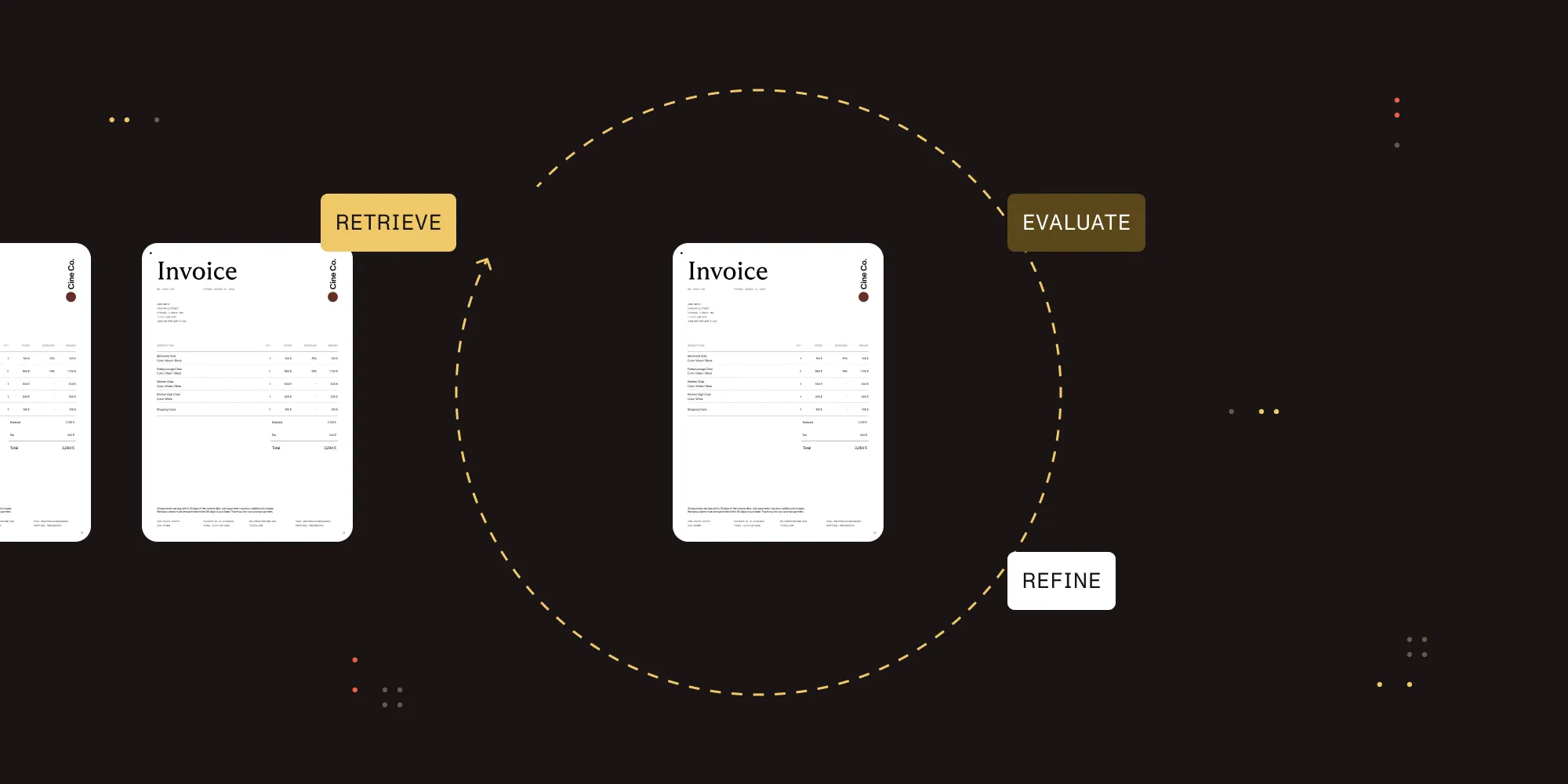
A typical agentic RAG loop runs roughly like what’s shown below.
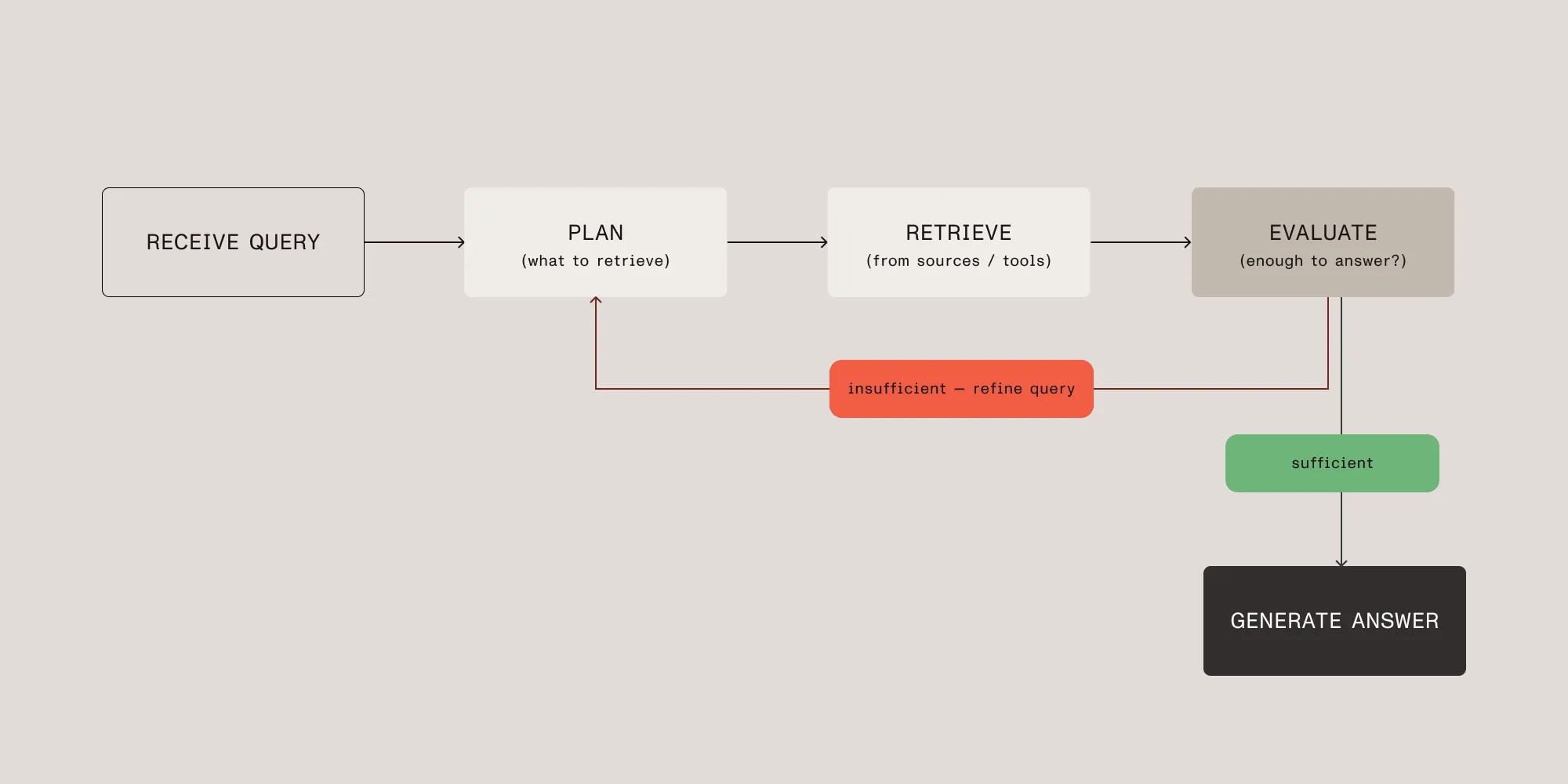
- Receive — Take in the query.
- Plan — Decide what to retrieve and how to phrase the lookup.
- Retrieve — Pull results from one or more sources.
- Evaluate — Is this enough to answer, or is something missing or ambiguous?
- Loop or answer — Retrieve again with a refined query if needed; otherwise, generate the answer.
The loop is what separates agentic RAG from a one-shot pipeline. It also means errors compound: A wrong retrieval early on can send the agent down a bad path for several steps.
Many implementations run this loop with the ReAct pattern: The agent alternates between reasoning (“Thought”), taking an action such as a retrieval (“Action”), and reading the result (“Observation”), repeating until it can answer.
Agentic RAG architectures
Agentic RAG systems generally fall into two patterns:
- Single-agent (router) — One agent sits in front of multiple knowledge sources (a vector index, a web search tool, a SQL database, and an API) and decides which to query for a given question. It’s the simplest agentic setup and fits cases where the main challenge is choosing the right source.
- Multi-agent — Several specialized agents, often one per source or task, are coordinated by an orchestrating agent. Each handles its own retrieval or reasoning, and the orchestrator combines the results. This suits workflows that span many sources or need division of labor, at the cost of more coordination and latency.
Whichever pattern you pick, the architecture governs only how the agent retrieves. The quality of what comes back depends on the documents.
Agentic retrieval in code
The loop is less code than it sounds. Give the agent a retrieval tool and a prompt that tells it to retrieve again when results fall short, and the agent framework runs the loop for you. With LangChain:
For a framework-level comparison of retrieval and orchestration choices, see LlamaIndex vs. LangChain for RAG.
from langchain.agents import create_agentfrom langchain.tools import toolfrom langchain.chat_models import init_chat_model
# `vector_store` holds your indexed documents (see the multimodal RAG post# for the ingestion side).@tool(response_format="content_and_artifact")def retrieve_context(query: str):    """Retrieve passages relevant to the query from the document index."""    docs = vector_store.similarity_search(query, k=4)    serialized = "\n\n".join(f"{d.metadata}\n{d.page_content}" for d in docs)    return serialized, docs
model = init_chat_model("gpt-4o-mini", model_provider="openai")agent = create_agent(    model,    tools=[retrieve_context],    system_prompt=(        "Use the retrieval tool to answer questions about the documents. "        "If the results are insufficient, retrieve again with a refined query. "        "If the context does not answer the question, say you don't know."    ),)
result = agent.invoke(    {"messages": [{"role": "user", "content": "What was Q2 revenue growth?"}]})
The agent decides when to call retrieve_context, can rerun it with a sharper query, and is instructed to abstain when context is insufficient. The prompt doesn’t enforce answer sufficiency: Add evaluation, a retrieval-round limit, and tests for missing evidence. What it can’t do is recover a figure that extraction dropped before indexing.
You can also expose document operations themselves as agent tools: Nutrient’s DWS MCP Server lets an agent call extraction, optical character recognition (OCR), and conversion as tool calls, so the same loop can parse a new document mid-task.
Why retrieval is only as good as your documents
An agent can reformulate queries and retrieve as many times as it likes, but it can only reason over what retrieval returns, and retrieval can only return what was extracted from the source documents in the first place.
Extraction is one source of agentic RAG failures. The agent looks capable in a demo on clean text, and then gives wrong answers on real documents because:
- A table was flattened into an unreadable run of numbers, so the figure the agent needs is gone.
- A scanned page had no text layer, so OCR was never run and the page returned nothing.
- Text came out in the wrong reading order, so retrieved chunks are scrambled and the agent misreads them.
The agent has no way to know the input is corrupted. It reasons over bad data, and the extra autonomy of agentic RAG amplifies the error across the loop.
A wrong answer can come from extraction, retrieval selection, question interpretation, or generation. Evaluate each stage separately. See why your AI agent hallucinates PDF table data for how a single parsing error turns into a confident wrong answer downstream.
Preparing documents for agentic RAG
The fix is upstream: Get clean, structured content out of the source documents before any of it reaches the index. For real-world documents (PDFs, scans, images), that means:
- Text extracted in correct reading order, with multicolumn layouts handled.
- Tables detected and serialized with structure intact, not flattened.
- Scanned and handwritten content run through OCR and intelligent character recognition (ICR) before indexing.
- Figures located and pulled out as discrete assets.
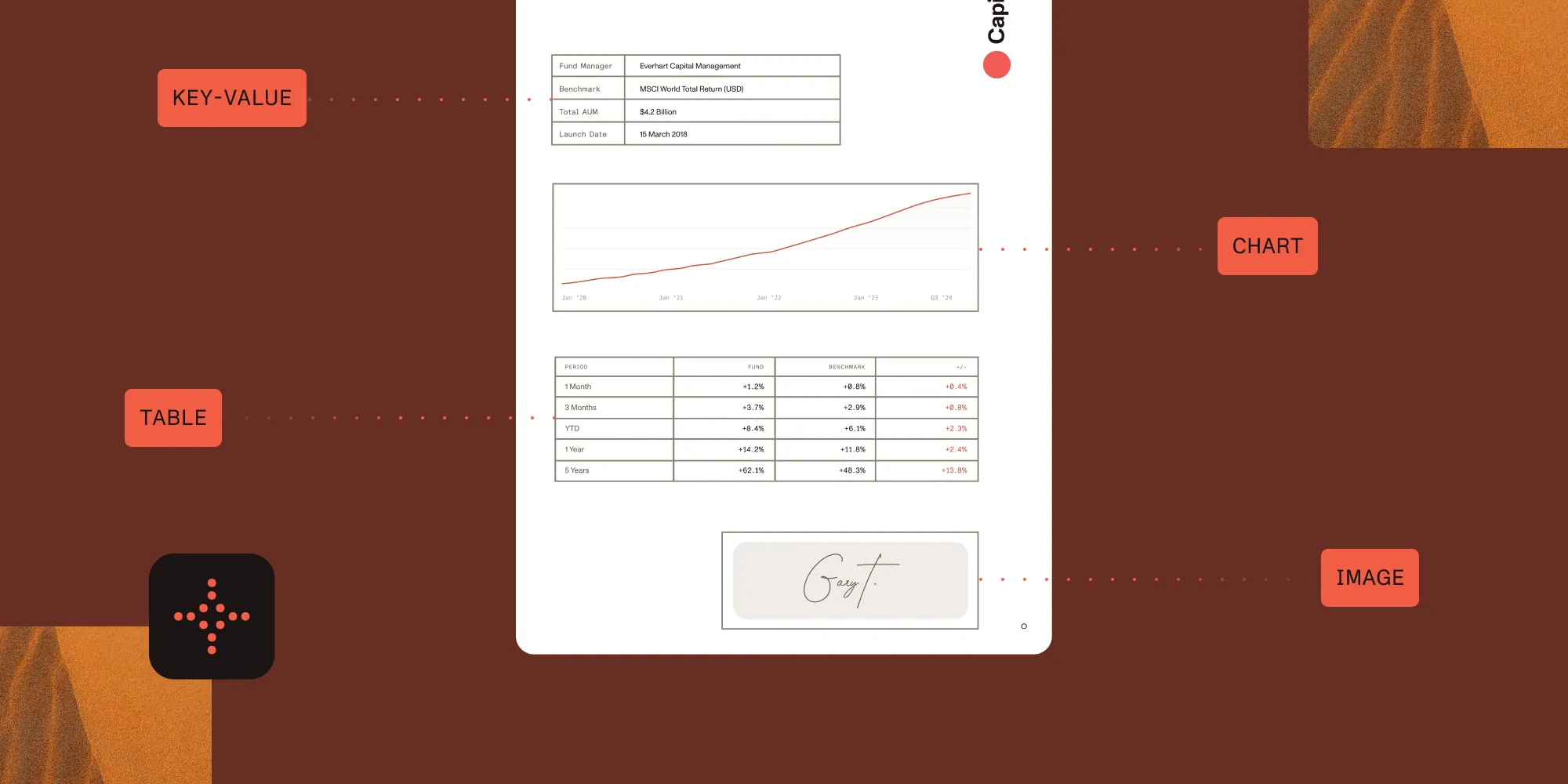
Nutrient’s AI document and data extraction SDK is built for this layer: OCR, ICR, and vision language model (VLM)-enhanced extraction handle scanned and handwritten content, detect and extract tables with cell-level coordinates, and pull key-value pairs from forms and invoices without templates. Output is structured JSON with reading order and confidence scores, and every engine, including the VLM, can run on your own infrastructure.
The DWS Data Extraction API turns those documents straight into RAG-ready Markdown, with four processing modes that trade cost for depth — from text for born-digital files, to agentic, a VLM-augmented mode for charts, handwriting, and degraded scans. Evaluate whether the preserved layout gives your agent more useful chunks than flat-text extraction on your own documents.
Beyond retrieval, Nutrient AI Assistant runs an agentic editing agent that plans and executes multistep document workflows (extraction, annotation, redaction, and form operations) under configurable policies.
For the retrieval side of the same problem, indexing text, tables, and images together, see multimodal RAG.
Common pitfalls
- Letting the agent loop indefinitely — Cap retrieval rounds; an agent with no stopping condition burns tokens and latency.
- Skipping retrieval evaluation — The “is this enough?” step is what makes the loop worthwhile. Without it, you have a slower traditional RAG.
- Trusting the input — Check parsed content against the source alongside retrieval relevance and answer groundedness.
- Using agentic RAG for everything — Simple lookups don’t need it; reserve the cost for multistep questions.
FAQ
Agentic RAG is a RAG architecture where an AI agent drives retrieval instead of a single fixed lookup feeding the model once. The agent can reformulate the query, retrieve more than once, choose between sources, and decide when it has enough before it answers.
A basic two-step RAG pipeline retrieves and then generates. Fixed pipelines can include query rewriting and validation; they don’t need an agent for those steps. Agentic RAG lets the agent decide what and when to retrieve, retry when results fall short, and choose among sources, which helps on multistep or ambiguous questions at the cost of more model calls and latency.
Use it for hard, multistep questions, ambiguous queries, or answers spread across several documents. For simple lookups, traditional RAG is cheaper and faster, so reserve the extra cost for cases that need it.
ReAct is a common loop where the agent alternates between reasoning (“thought”), taking an action such as a retrieval (“action”), and reading the result (“observation”), repeating until it can answer.
Extraction errors, irrelevant retrieval, misunderstood questions, and unsupported generation can all cause wrong answers. Compare the extracted content with the source, check retrieved passages, and evaluate whether the answer is supported. A flattened table or skipped scan is an ingestion issue to fix before tuning retrieval.
Conclusion
Agentic RAG hands the agent control over retrieval, which can help with hard, multistep questions, at the cost of more latency and tokens.
But that autonomy only helps when the retrieved content is correct. An agent reasoning over a flattened table or a skipped scan reaches a wrong answer faster, and with more confidence. Reliable extraction is the precondition.
If you’re building agentic RAG over real documents, start with reliable extraction. Nutrient’s AI document and data extraction SDK is built for that ingestion layer. Contact our team to talk through your document workflow, or explore the Data Extraction API guide to get started.