LlamaIndex vs. LangChain: Which should you use in 2026?

Table of contents
- LlamaIndex and LangChain focus on different parts of RAG — LlamaIndex emphasizes retrieval and indexing over private data; LangChain emphasizes orchestration and agents. Teams can use them together.
- Choose based on the hard part — Pick LlamaIndex when retrieval quality over private data is the challenge. Pick LangChain when the task requires orchestrating multistep agents and tools across many integrations.
- They’re not mutually exclusive — LangChain ships a retriever that wraps a LlamaIndex index.
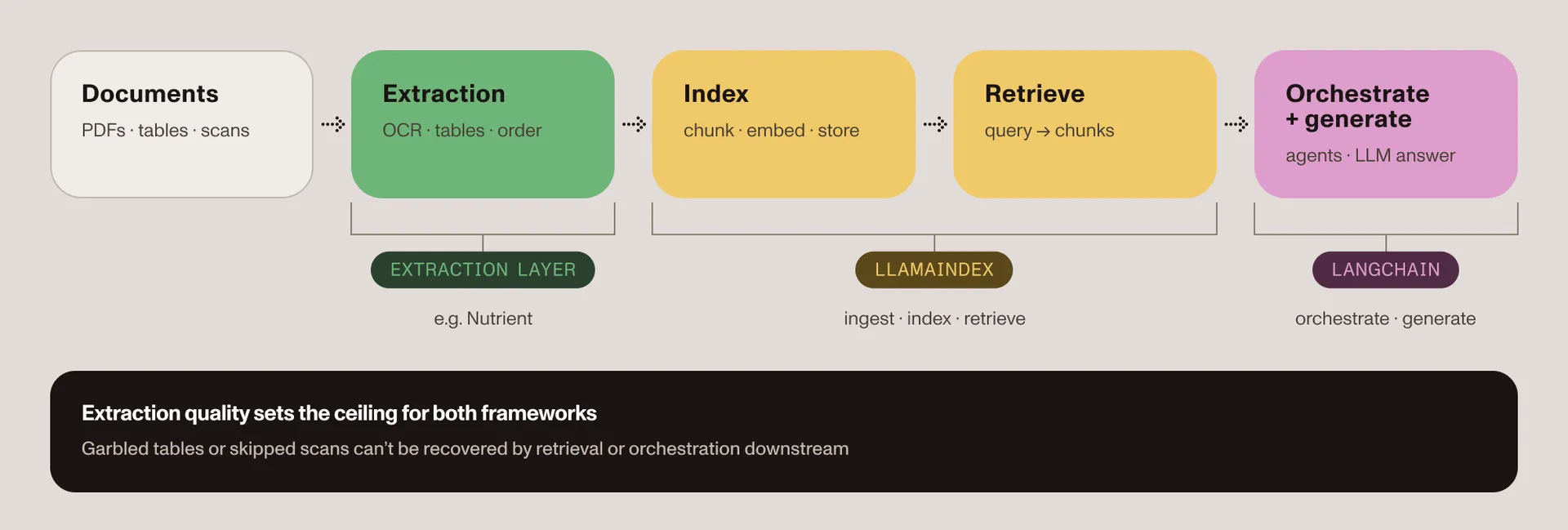
- Document extraction often decides the outcome — Basic loaders commonly used with either framework can lose PDF structure, so complex tables, layouts, and scans cap answer quality before retrieval starts. Nutrient fits here as the extraction layer that feeds either framework; it’s not a replacement for one.
For retrieval-augmented generation (RAG), LlamaIndex is usually the stronger starting point when retrieval over private data is the hard part. LangChain is usually better when a large language model (LLM) application needs multistep agents, tools, and durable orchestration. They can work together, and either framework still depends on the quality of the documents entering the pipeline.
LlamaIndex vs. LangChain at a glance
The table below summarizes each framework’s primary strengths. Their capabilities have converged over time: LlamaIndex added agents and workflows, while LangChain added retrieval, as the frameworks’ official comparison(opens in a new tab) explains. The details were verified against the LangChain 1.x documentation(opens in a new tab), LlamaIndex releases(opens in a new tab), and LangGraph 1.x in mid-2026; check the current releases before choosing a version. LlamaIndex staying on a 0.x version is a versioning convention, not a maturity signal.
| Dimension | LlamaIndex | LangChain |
|---|---|---|
| Primary focus | Data framework for retrieval and indexing (RAG over own data) | General LLM-app framework for orchestration and agents |
| Retrieval and indexing | Core strength: indices, query engines, retrievers | Supported, with a broad retriever ecosystem |
| Agents and orchestration | LlamaIndex Workflows (event-driven, step-based) | Agents built on LangGraph (stateful, multi-actor) |
| Integrations | LlamaHub connector marketplace | Very broad integration surface across providers |
| Observability | Available via integrations | LangSmith (tracing, evaluation) |
| Document ingestion | Built-in readers; LlamaParse is a separate managed parser | DocumentLoaders ecosystem (PyPDF, PDFPlumber, Unstructured, and others) |
| Use together? | Yes — both expose interfaces for the other | Yes — ships a retriever that wraps a LlamaIndex index |
| License (core) | MIT, open source | MIT, open source |
| Paid add-ons | LlamaParse/LlamaCloud (credit-based parsing) | LangSmith (observability, evaluation, deployment) |
| Learning curve | Fewer concepts for basic RAG | More building blocks; steeper but more flexible |
What LlamaIndex is for
LlamaIndex describes itself as a data framework for LLM apps, built around loading, indexing, storing, and querying private data — the classic RAG pipeline. Its strengths are retrieval and indexing: indices, query engines, and a large connector marketplace (LlamaHub) for getting data in. It has since expanded into agents via LlamaIndex Workflows (an event-driven, step-based execution model) and now positions itself around document agents, but retrieval over private data is still its core.
What LangChain is for
LangChain is a general framework for LLM applications, with a broad integration surface and a current emphasis on agents. Its documentation now leads with a configurable agent harness built on LangGraph. LangGraph is a separate, low-level runtime for building stateful, multi-actor agents, with durable execution and human-in-the-loop support. LangChain also offers LangSmith for tracing and evaluation. It supports retrieval and RAG too, but its primary focus remains orchestration rather than retrieval.
The same RAG pipeline in each framework
The clearest way to see the difference is a minimal RAG pipeline in each framework. LlamaIndex reaches a working query engine in a few lines, with sensible RAG defaults baked in:
from llama_index.core import VectorStoreIndex, SimpleDirectoryReader
# Uses OpenAI by default — set OPENAI_API_KEY.documents = SimpleDirectoryReader("data").load_data()index = VectorStoreIndex.from_documents(documents)query_engine = index.as_query_engine()print(query_engine.query("What changed in Q2 revenue?"))
LangChain expects each step to be assembled by hand — load, split, embed, retrieve, and wire the chain. That means more surface area, but more control over each stage. On LangChain 1.x, the legacy retrieval-chain helpers are maintained in the separate langchain-classic package, so install it along with the integration packages used below:
from langchain_community.document_loaders import TextLoaderfrom langchain_text_splitters import RecursiveCharacterTextSplitterfrom langchain_openai import OpenAIEmbeddings, ChatOpenAIfrom langchain_core.vectorstores import InMemoryVectorStorefrom langchain_core.prompts import ChatPromptTemplatefrom langchain_classic.chains import create_retrieval_chainfrom langchain_classic.chains.combine_documents import create_stuff_documents_chain
# Load > split > embed > retrieve > generate (set OPENAI_API_KEY).docs = TextLoader("data.txt").load()splits = RecursiveCharacterTextSplitter(chunk_size=1000, chunk_overlap=200).split_documents(docs)vectorstore = InMemoryVectorStore.from_documents(splits, OpenAIEmbeddings())retriever = vectorstore.as_retriever(search_kwargs={"k": 3})
prompt = ChatPromptTemplate.from_template(    "Answer using only the context:\n\n{context}\n\nQuestion: {input}")chain = create_retrieval_chain(retriever, create_stuff_documents_chain(ChatOpenAI(), prompt))print(chain.invoke({"input": "What changed in Q2 revenue?"})["answer"])
LlamaIndex supplies more RAG defaults, while LangChain exposes the pipeline stages for broader composition.
Retrieval, agents, and interoperability
The familiar shorthand — “LlamaIndex for retrieval, LangChain for orchestration” — still describes their main strengths, although both now cover more of the pipeline. LangChain also ships a LlamaIndexRetriever, which lets a LlamaIndex index serve as a retriever inside a LangChain chain. A pipeline can therefore use LlamaIndex for ingestion, indexing, and retrieval, and LangChain for orchestration and generation.
Which one to use (is LlamaIndex better than LangChain?)
Neither framework is better for every RAG system. Start with LlamaIndex when retrieval over private documents is the main challenge, and start with LangChain when the pipeline needs broad orchestration across tools and providers. Because they interoperate, a pipeline can also use both. Match the initial choice to the requirements below:
| If the priority is… | Start with | Why |
|---|---|---|
| Retrieval quality over private documents | LlamaIndex | Indices, query engines, and retrievers are its core |
| Fastest path to a working RAG query engine | LlamaIndex | Loading-to-querying is the default workflow |
| Multistep agents and tool orchestration | LangChain | Broad agent harness built on LangGraph |
| Stateful, multi-actor agents with durable execution | LangChain (LangGraph) | Purpose-built low-level runtime for exactly this |
| The broadest integration surface across providers | LangChain | Widest ecosystem of loaders, tools, and model providers |
| Production tracing and evaluation | LangChain (LangSmith) | First-party observability and evaluation tooling |
| Using both | LlamaIndex + LangChain | LlamaIndex to ingest/index/retrieve, LangChain to orchestrate |
Most teams can start with one framework and add the other when a specific requirement appears. Their interoperability makes that change less disruptive than replacing the pipeline.
Both core frameworks are free, but their defaults affect LLM token costs. Chunk size, retrieval depth, agent retries, and multistep chains determine how much context each query sends to the model. LlamaIndex handles more of these choices through retrieval defaults, while LangChain exposes them in the pipeline configuration. Measure token use per query before traffic grows.
Before tuning either framework, check the input. A parser that loses content or structure limits the retrieval quality of both.
Structured output and optional field citations through the Nutrient Data Extraction API — free tier included.
How document extraction affects both frameworks
A RAG pipeline can retrieve only what its parser preserves. LlamaIndex’s own team calls parsing “the silent bottleneck,”(opens in a new tab) noting that “if your parser destroys table structure, loses reading order, or flattens charts into garbage text, the rest of the stack does not matter.” Both frameworks support a range of document loaders(opens in a new tab) and parsing integrations. A basic loader such as LangChain’s PyPDFLoader isn’t designed to preserve every scanned page or complex layout, so high-fidelity tables and scans can require a dedicated parser such as LlamaParse, Unstructured, or a commercial extraction API. The Extract document elements guide shows how typed elements, bounding boxes, and reading order can be preserved across PDFs, images, and scans.
Here’s what that looks like. A basic loader on a financial table often returns a flat run of numbers, with the row and column relationships gone:
Revenue Q1 Q2 Q3 4.2 4.9 5.1 Growth 12% 17% 4%A structure-preserving extractor keeps the table intact, so a retrieved chunk still answers “Q2 growth”:
| Metric | Q1 | Q2 | Q3 || ------- | --- | --- | --- || Revenue | 4.2 | 4.9 | 5.1 || Growth | 12% | 17% | 4% |No embedding model or retriever can recover the association the parser threw away.
Why structure matters more than one score
An aggregate accuracy score can hide structural failures. If a parser loses row-to-column associations, retrieval tuning can’t reconstruct them. An evaluation should therefore check whether the system returns the correct value from the correct table location, not just whether an answer appears plausible.
No independent benchmark compares LangChain’s PyPDFLoader, LlamaParse, and Nutrient in one controlled test. However, a 2026 study of PDF parsing in RAG(opens in a new tab) evaluated PyPDFLoader alongside PDF-to-Markdown pipelines and found that preprocessing and structure-aware chunking materially affected downstream answer accuracy. For how extraction quality can be measured reproducibly, our benchmark methodology documents the corpus and harness in full.
Evaluate the ingestion paths on the documents the application will process:
- Pull 50–100 documents representative of the real distribution — the multicolumn, scanned, and table-heavy cases, not just the clean PDFs.
- Run each ingestion path and inspect the parsed output directly before embedding.
- Check whether table rows keep their column associations and whether reading order survives on multicolumn pages.
- Only then measure end-to-end answer quality. A retrieval problem and an extraction problem look identical from the answer alone.
Where Nutrient fits
Nutrient isn’t a RAG framework and doesn’t replace LangChain or LlamaIndex; it sits earlier in the pipeline. The Nutrient document extraction API and AI Document Processing turn tables, key-value pairs, multicolumn layouts, and scans into structured, source-grounded output, with optical character recognition (OCR) built in.
The parse endpoint returns document elements with spatial metadata. For schema-based fields, the extract endpoint can return optional citation metadata with match labels and confidence scores. Locations are available when a value is grounded in the source; a not_found result has no source location. Use these signals to route uncertain values for review before indexing. The platform can also be self-hosted. Its deterministic OCR and intelligent character recognition (ICR) modes run without an external model dependency. Some AI-augmented modes use a hosted LLM.
Nutrient is SOC 2 Type 2 audited. The platform serves more than 3,000 organizations, including 15 percent of Global 500 companies, and processes more than 1 billion document interactions annually. The Data Extraction API takes a few minutes to set up. For a direct comparison with LlamaIndex’s parser, see the Nutrient vs. LlamaIndex breakdown.
Try it on a document
The parse request below returns structured document elements with spatial metadata; it doesn’t request schema-field citation metadata:
import requests
response = requests.post(    "https://api.nutrient.io/extraction/parse",    headers={"Authorization": "Bearer YOUR_API_KEY"},    files={"file": open("document.pdf", "rb")},    data={"instructions": '{"mode":"understand","output":{"format":"spatial"}}'},)print(response.json())
Get a free API key(opens in a new tab) and follow the RAG ingestion guide to wire Nutrient into an existing pipeline.
Conclusion
LlamaIndex is a strong starting point for retrieval-heavy RAG, while LangChain suits pipelines that need broad orchestration. They can also run together. In either case, evaluate parsing before tuning retrieval because lost table structure, reading order, or scanned content can’t be recovered downstream. Start with Nutrient’s free tier(opens in a new tab) to test the extraction layer on representative documents.
FAQ
LlamaIndex focuses on retrieval and indexing over private data. LangChain provides broader orchestration and agent tooling. Both support RAG and can be used in the same pipeline.
Yes. LangChain’s LlamaIndexRetriever lets a LlamaIndex index act as a retriever inside a LangChain chain. This supports using LlamaIndex for retrieval and LangChain for orchestration.
Yes. Lost table structure, reading order, or scanned content reduces retrieval quality regardless of framework. The Nutrient Data Extraction API supports spatial elements and optional schema-field citations so teams can review extracted content before indexing it. A missing source location still requires review.
No. Nutrient prepares structured input from PDFs, scans, and complex tables. LlamaIndex or LangChain still handles retrieval, orchestration, and generation.
No. LlamaIndex can load, index, retrieve, and query data without LangChain. Add LangChain if the pipeline needs broader agent orchestration, more tool integrations, or stateful multistep workflows through LangGraph.
There’s no universal performance advantage. Latency depends on the index type, embedding model, vector store, and data, so benchmark both frameworks against a representative corpus.
Yes. Both core frameworks use the MIT license and are free to self-host. LlamaCloud, LlamaParse, and LangSmith provide optional managed services with separate pricing.