



How to build a Word (DOC/DOCX) viewer in JavaScript

Table of contents
Build a JavaScript Word viewer with Nutrient Web SDK: Install the SDK, copy assets to your project, and initialize the viewer with NutrientViewer.load(). View DOC/DOCX files directly in the browser with no server required.
Want to display Word documents directly in a browser without forcing users to download files or install software? This tutorial shows you how to build a JavaScript Word viewer using the Nutrient Web SDK. The viewer opens and displays DOC or DOCX files directly in the browser using client-side processing — no server required.
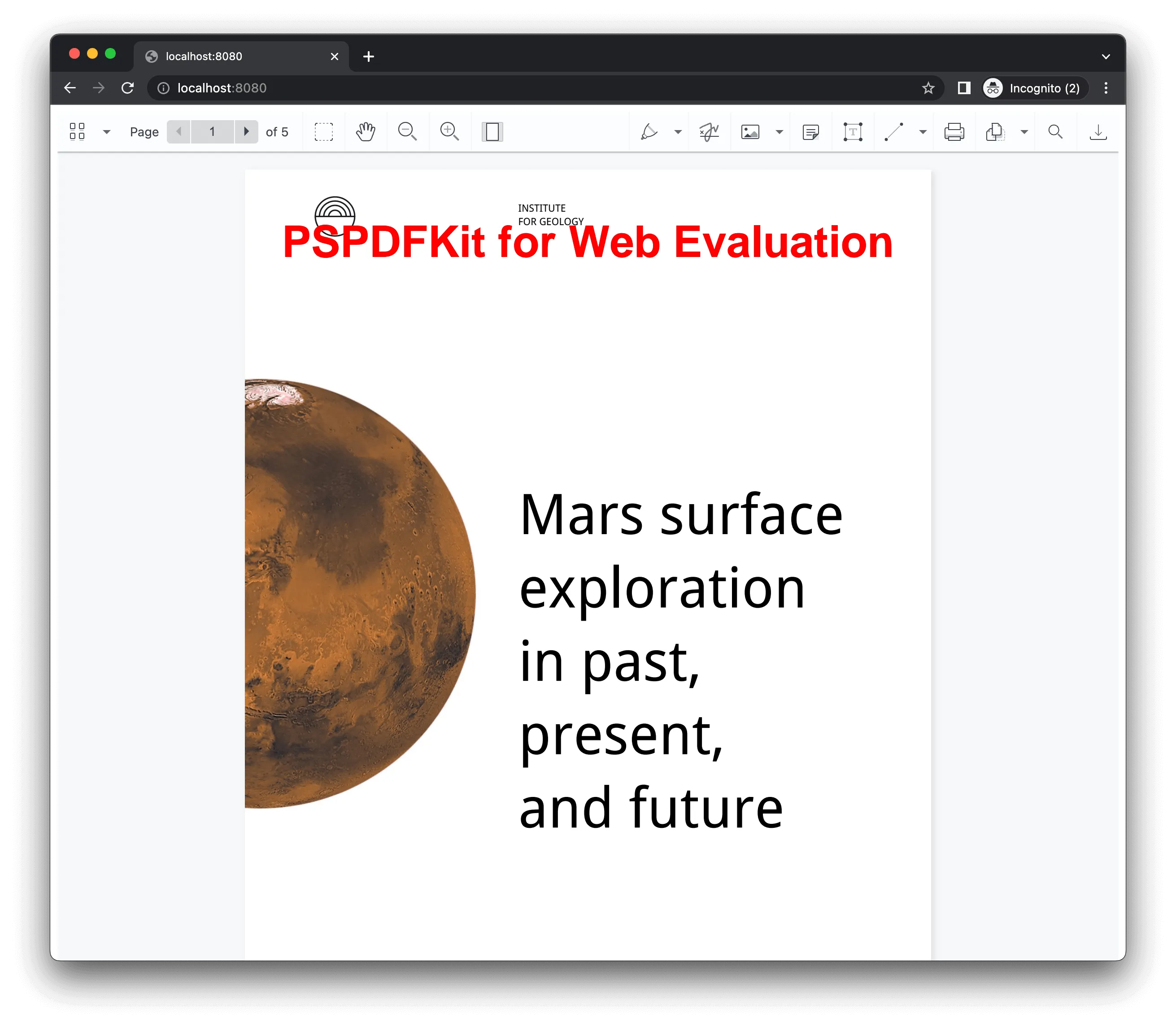
See the demo for a live example.
Opening and rendering Office documents in the browser
Nutrient Web SDK brings support for Word, Excel, and PowerPoint formats to your application, without you or your users needing any MS Office software, MS Office licenses, or third-party open source software. The technology works by converting an Office document to PDF directly in the browser, and the document is then rendered in our JavaScript viewer.
For both manual and npm installations, it’s important to note that the assets must be copied to a public folder. Make sure your server has the Content-Type: application/wasm MIME type set, as explained in our troubleshooting guide.
To serve the files, use an npm package like serve(opens in a new tab) as a simple HTTP server.
Unlocking more capabilities with Office-to-PDF conversion
Office-to-PDF conversion enables additional Office document functionality:
- Text editing — Edit text directly in the displayed Office document.
- Page manipulation — Organize documents by adding, removing, or rearranging pages.
- Annotations — Boost collaboration by adding text highlights, comments, or stamps.
- Adding signatures — Draw, type, or upload a signature directly to a Word document.
Requirements
This tutorial requires:
- The latest stable version of Node.js(opens in a new tab).
- A package manager compatible with npm(opens in a new tab). This post contains usage examples for the npm client(opens in a new tab) (installed with Node.js by default).
Adding Nutrient to your project
- Install the Nutrient Web SDK package from npm (or download it manually):
npm install @nutrient-sdk/viewer- Copy the directory containing all the required library files (artifacts) to the
assetsfolder:
cp -R ./node_modules/@nutrient-sdk/viewer/dist/ ./assets/Make sure your assets directory contains the nutrient-viewer.js file and a nutrient-viewer-lib directory with the library assets.
Integrating into your project
- Add a DOC or DOCX document to your project’s directory. Use this demo document as an example.
- Add an empty
<div>element with a defined width and height to where Nutrient will be mounted:
<div id="nutrient" style="width:100%; height: 100vh;"></div>- Include
nutrient-viewer.jsin your HTML page:
<script src="assets/nutrient-viewer.js"></script>- Initialize Nutrient Web SDK in JavaScript by calling the
load()method.
The configuration object specifies the container element, document path, and optional license key:
<script> NutrientViewer.load({ container: "#nutrient", document: "document.docx", // Add the path to your document here. licenseKey: "YOUR_LICENSE_KEY" // Remove this line for the free trial. })</script>This code loads document.docx into the element with the ID nutrient.
Full index.html file:
<!DOCTYPE html><html>  <head>    <title>My App</title>    <!-- Provide proper viewport information so that the layout works on mobile devices. -->    <meta      name="viewport"      content="width=device-width, initial-scale=1.0, minimum-scale=1.0, maximum-scale=1.0, user-scalable=no"    />  </head>  <body>    <!-- Element where Nutrient will be mounted. -->    <div id="nutrient" style="width:100%; height: 100vh"></div>
    <script src="assets/nutrient-viewer.js"></script>    <script>      NutrientViewer.load({        container: '#nutrient',        document: 'document.docx', // Add the path to your document here.      })        .then(function (instance) {          console.log('Nutrient loaded', instance);        })        .catch(function (error) {          console.error(error.message);        });    </script>  </body></html>
Serving your website
The npm serve package hosts the project locally.
- Install the
servepackage:
npm install --global serve- Serve the contents of the current directory:
serve -l 8080 .- Navigate to http://localhost:8080 to view the website.
A note about fonts
When converting an Office document with custom fonts to a PDF, Nutrient Web SDK might not have access to these fonts due to licensing constraints. Nutrient replaces unavailable fonts with equivalents — like Arial with Noto.
Adding more capabilities
Once deployed, customize the viewer to meet specific requirements or add more capabilities. These JavaScript guides cover common use cases:
- Instant synchronization
- Document assembly
- Page manipulation
- Editor
- Forms
- Signatures
- Redaction
- Document security
Conclusion
This tutorial covered building a Word viewer using JavaScript with the Nutrient SDK and the benefits of using Nutrient Web SDK to render Office documents in the browser.
The JavaScript Word viewer should now be running in your web application. For troubleshooting, contact the Support team.
The JavaScript Word viewer also integrates with web frameworks like Angular, Vue.js, and React.js. Start a free trial to see all web frameworks, or launch the demo to see the viewer in action.
Related reading
- How to build a React Word viewer — The same walkthrough in React
- How to build an Angular Word viewer — The same walkthrough in Angular
- How to build a Vue.js Word viewer — The same walkthrough in Vue.js
- How to build a PowerPoint viewer in JavaScript — Render PPT and PPTX with the same SDK
- Open Excel files in the browser using JavaScript — Handle XLS and XLSX without MS Office
FAQ
The Nutrient Web SDK loads and displays DOC/DOCX files directly in the browser.
No. No external software or MS Office licenses are required. Everything happens client-side using Nutrient.
Yes. Adjust the viewer layout and functionalities like annotations, page manipulation, and signatures.
Yes. Nutrient allows text editing directly in the document once loaded in the viewer.
Nutrient replaces unavailable custom fonts with similar system fonts like Noto.