Document Signing task configuration
The Document Signing task in Nutrient Workflow Automation Platform enables electronic signing of documents within workflows. This reduces reliance on physical paperwork and manual tracking while supporting security and legal compliance.
Use this task to:
- Configure documents for internal or external signing.
- Assign one or more recipients.
- Manage notifications and reminders.
- Enable sequential or parallel signing.
This task supports collaboration by enabling multiple users to sign a document either in a specific order or at the same time.
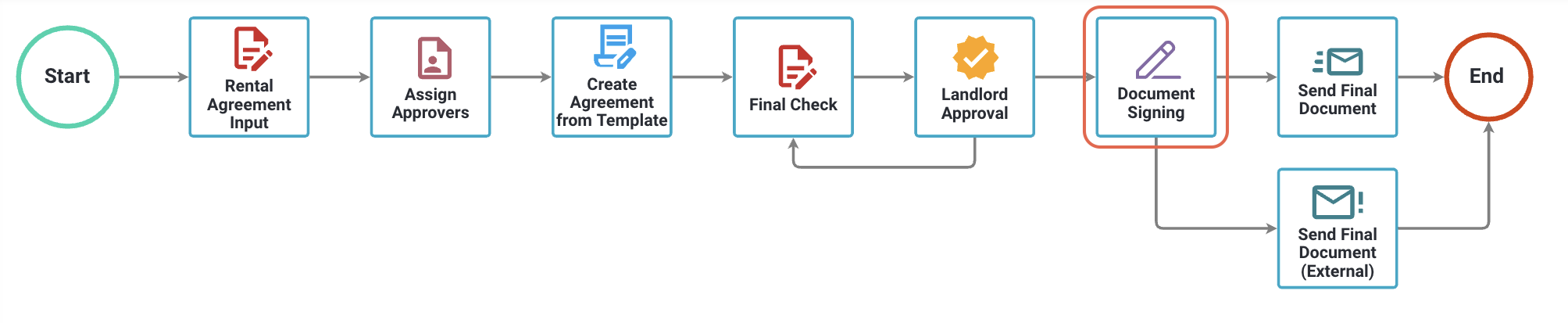
Watch the video below to learn more about the Document Signing task:
Use cases
Use the Document Signing task in workflows that require one or more recipients to sign documents. Common scenarios include:
- Contract approvals
- Legal agreements
- Policy acknowledgments
- Compliance documentation
- Other formal documents that require electronic signatures
This task works well for workflows in legal, financial, and administrative environments where timely execution and auditability are critical.
Task description
Use the Document Signing task to configure a document that one or more recipients must sign. You can assign the task to both internal users and external contacts. This task includes options to:
- Set up reminders and timeouts for pending signatures.
- Configure separate notifications for signers and the document admin.
- Define simultaneous or sequential signing flows.
- Support electronic signing for added security.
The document admin can drag and drop signature fields, create signer groups, and reorder signers as needed.
Unlike other workflow tasks, the Document Signing task includes two stages:
- Configuration — The document admin sets up the document for signing. This includes specifying signer details, signing order, groups, field placements, and notification settings. The system designates the document admin as the recipient of this task stage.
- Signing — Signers receive the task and complete the signing process. Signers can be internal or external to the platform. When you assign signers, they receive a secure link to access the document:
- Internal signers — authenticate using their Workflow Automation credentials.
- External signers — receive a one-time use 6-digit authentication code through email each time they access the document.
For details on how this task appears to end users, refer to the document admin and signer guides. This guide focuses on the process designer’s perspective, using the Process Builder interface to configure the Document Signing task.
Prerequisites
To configure the Document Signing task, you need:
- Administrative access to Nutrient Workflow Automation Platform.
- Permission to access the Process Builder.
- An existing workflow process where you want to add the task.
Task configuration
Configure the Document Signing task in the Process Builder tab using the steps below:
Configure document and signer settings:
- Source the document from an earlier task:
- Select a file that a previous task generated, such as PDF Merge, PDF Generator, an approval, or an attachment question from a form.
- If you don’t select a file, the document admin can upload a new file during runtime.
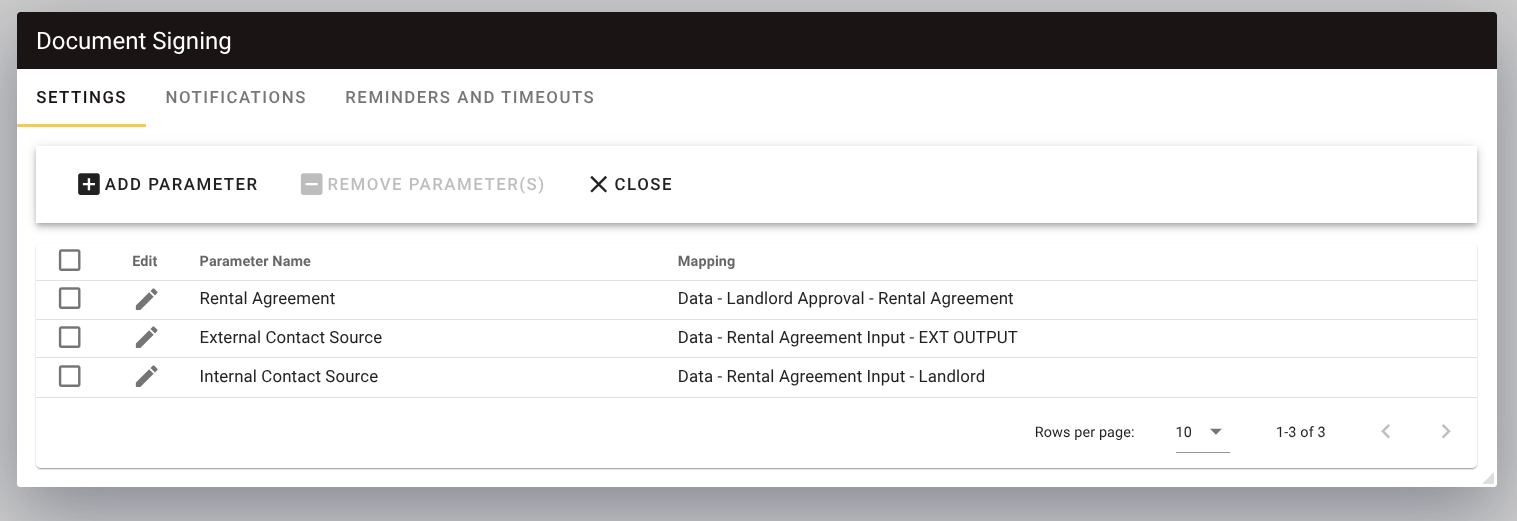
- Add parameters to prefill internal and external signers of the document:
- The document admin can add signers during runtime, but preconfigured signers streamline the process.
- Map internal contacts to a comma-separated list of contact guids similar to the output of a contact search question on a form.
- Map external contacts to a comma-separated list of name and email properties separated by a pipe (|) character, such as
John Doe|john@email.com,Jane Doe|jane.doe@email.com.
- Source the document from an earlier task:
Set up signer notification settings:
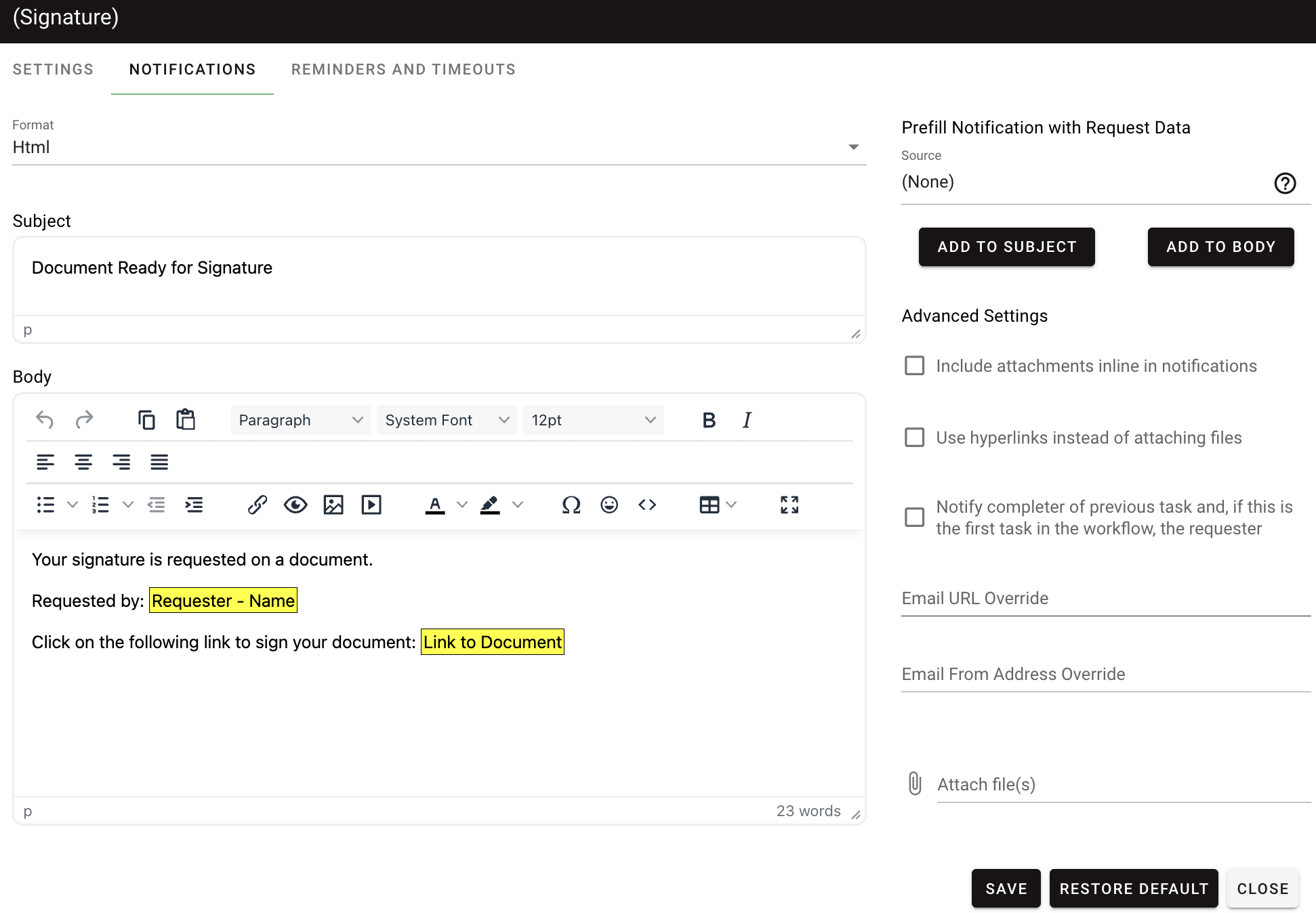
- Define default notification content for signers.
- Configure data mappings that control what information you can include in messages sent to signers. The document admin can modify these notifications at runtime, but only within the data mappings you configure.
Configure reminders and timeouts:
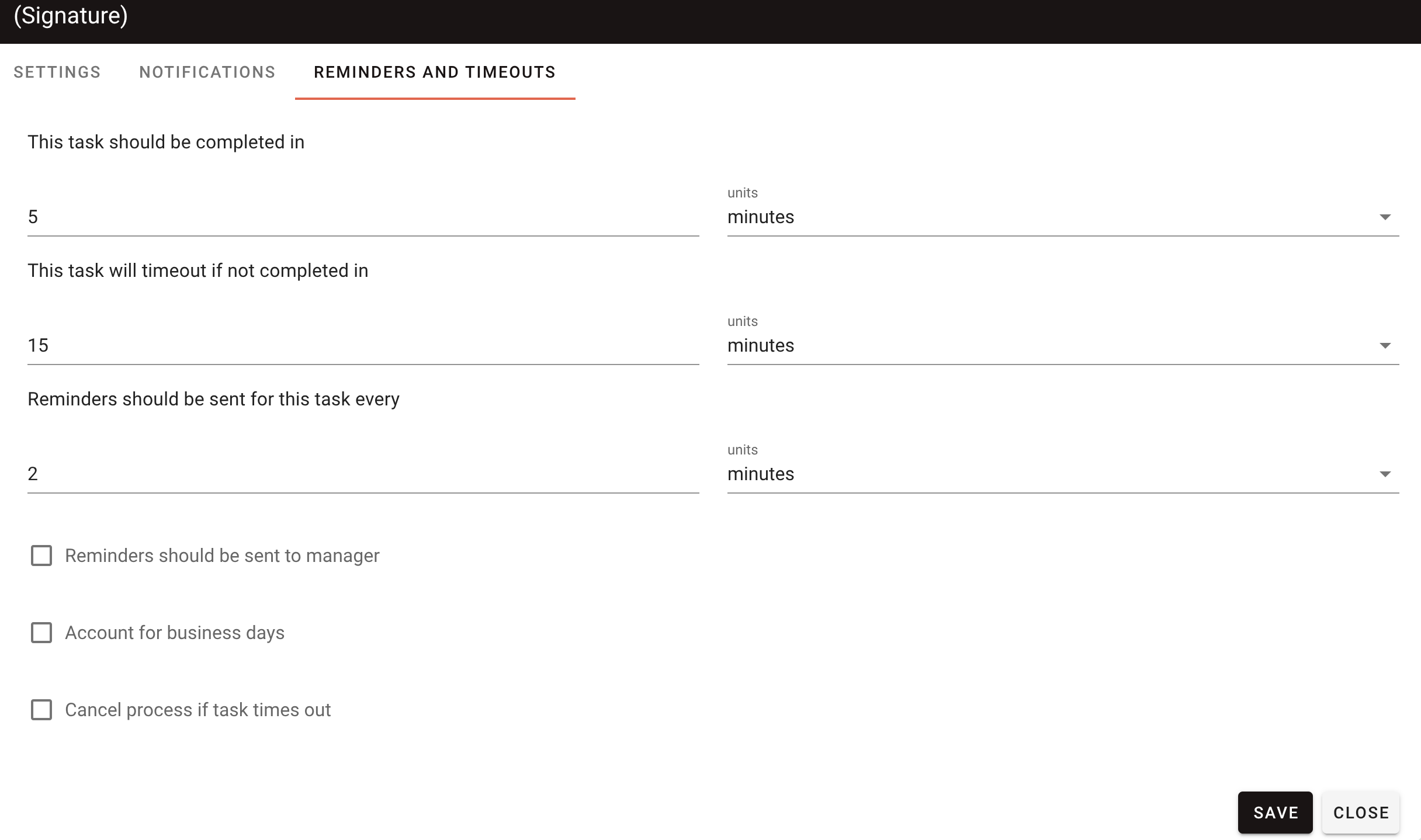
- Set default intervals for reminders and timeouts related to signer actions.
- Enable the document admin to adjust these settings at runtime if necessary.
Handling decline and revoke actions
The Document Signing task enables signers to decline signing and document administrators to revoke in-progress signing tasks. When either action occurs, the system cancels signing and the task finishes in a Declined or Revoked state. You can configure transitions to respond to these states.
Responding to declined tasks
When a signer declines, the task finishes in a Declined state. Configure a transition to respond to this state.
To set up a transition for declined signing:
- Open the Process Builder.
- After the Document Signing task, create a transition that checks the task state.
- Configure the transition to evaluate if the Document Signing task state equals Declined.
- Route the request to your desired next step:
- Route to an alternative approval chain
- Escalate to a supervisor
- Terminate the request
Example routing logic:
- If Declined — Route to an alternative approval chain
- If Declined — Send back to document configuration for reconfiguration
- If Declined — Make request to external service and cancel the request
Responding to revoked tasks
When a document administrator revokes signing, the task finishes in a Revoked state. Configure a transition to respond to this state.
To set up a transition for revoked signing:
- Open the Process Builder.
- After the Document Signing task, create a transition that checks the task state.
- Configure the transition to evaluate if the Document Signing task state equals Revoked.
- Route the request to your desired next step:
- Return to document configuration for correction
- Push data to a database and terminate the request
Example routing logic:
- If Revoked — Send back to document configuration for reconfiguration
- If Revoked — Cancel the entire request
Notifying participants of decline and revoke actions
When a signer declines or an administrator revokes, the system automatically notifies participants. You can optionally add additional notification tasks to customize messaging or notify additional stakeholders.
To set up additional decline notifications:
- After the Document Signing task, add a Notification task.
- Configure the notification to trigger when the Document Signing task state is Declined.
- Set recipients to include specific stakeholders such as:
- Managers or supervisors
- Alternative approval chains
- Customize the notification content to include context such as:
- Next steps or required actions
- Links to relevant request information
To set up additional revoke notifications:
- Add a Notification task after the Document Signing task.
- Configure the notification to trigger when the Document Signing task state is Revoked.
- Set recipients to include specific stakeholders such as:
- Management or oversight roles
- Customize the notification content to explain:
- When signing will restart or if the admin needs to reconfigure
- Contact information for questions
Example workflow: Document signing with decline and revoke paths
The following example shows a workflow that handles decline and revoke scenarios:
- Form submission — Request creator submits document request with metadata
- Document configuration — Document administrator configures document and adds signers
- Document Signing — One or more signers review and sign (or decline/revoke can occur)
- Transition Executes — Check task state:
- If Completed — All signers completed — Route to archive
- If Declined — Signer declined — Route to escalation
- If Revoked — Administrator revoked — Route to reconfiguration
- Escalation task — Send notification and route to supervisor or backup signer
- Reconfiguration task — Return back to document admin to fix and restart
Best practices
When configuring decline and revoke workflows:
- Set timeouts — Configure reminder and timeout settings in the Document Signing task to prevent long-running signing processes.
- Escalation limits — Set a maximum number of times you can revoke and/or decline a document before the system takes alternative actions.
- Audit logging — Use milestone or status tasks to mark when users decline or revoke documents for compliance tracking.
What’s next
For details on how signers decline, refer to the Decline document signing guide. For details on how admins revoke, refer to the Revoke document signing guide.
For information on configuring recipient rules and transitions, refer to the Optimize workflow with recipient rules guide.
To translate notification labels and other workflow text, refer to the Streamline workflow translations guide.