Configure system settings
System settings define instance-wide behavior in Nutrient Workflow Automation.
Access to System Settings and related Settings menu items is based on permissions. Administrators can view and manage system settings broadly, while non-administrator users may view only delegated settings they have permission to access, such as Database Sources. Each settings item honors its own permission.
Open and edit system settings
To view or update a setting:
In the Workflow portal, click the Settings icon in the upper-right corner.
Click System Settings.
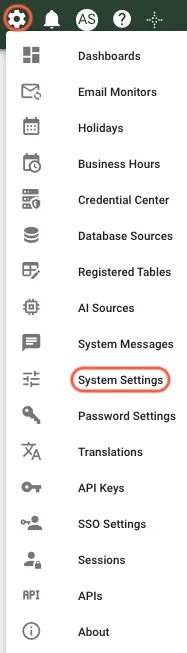
Find the setting you want to change.
Click the Edit (pencil) icon in that row.
Update the value.
Click Save.
System settings reference
The following table describes each setting.
| Setting | Value | Description |
|---|---|---|
AllowClient | Yes/No | Determines whether users can make requests on behalf of other users. |
AllowGuest | Yes/No | Enables or disables the built-in guest account. |
AllowIframeEmbedding | Yes/No | Determines whether users can embed the application in an iframe. When disabled, embedding is blocked. When enabled, use ContentSecurityPolicyHeader to control embedding behavior. |
AllowImpersonation | Yes/No | Web service only. Enables authentication with only a username, which means consumers can impersonate any account. Use this setting only in secure, access-controlled environments. |
AllowManageTaskReports | Yes/No | Enables administrator users to use report columns that provide request management actions similar to Manage Requests. For more information, refer to the manage task reports guide. |
Connection | Text | Connection string for the Nutrient Workflow Automation database. |
ContentSecurityPolicyHeader | Text | Custom Content Security Policy header value for iframe embedding scenarios. |
CredentialsEncryptionKey | System Identifier (SID) | Part of the encryption key that Credential Center uses. For more information, refer to the credential center guide. |
CustomTheme | Color Values | Custom theme color configuration. For more information, refer to the themes guide. |
DeveloperReassign | Yes/No | Enables developer reassignment for processes in development status. Yes reassigns all tasks to the requester. No keeps the normal assignment behavior. |
EmailLinkURL | URL | Base URL used in email notification links — for example, http://{EmailLinkURL}/. Users select this link to open Nutrient Workflow Automation. |
EmailPassword | Password | Simple Mail Transfer Protocol (SMTP) authentication password. |
EmailPort | Number | SMTP port override. |
EmailServer | IP/Host | SMTP server host that sends notifications. |
EmailUsername | Username | SMTP authentication username. |
EmailUseTLS | True/False | Requires STARTTLS for outbound email. |
EnableFileSecurity | Disabled/Enabled — allow legacy notification links/enabled | Enables file security features. |
EnhanceSubmissionProtection | Yes/No | Helps prevent users from selecting Submit or Save draft more than once on touch devices. This setting is temporary and will be removed in a future release. For best practices, refer to the form events section in the scripting reference guide. |
ErrorEmail | Email Address | Email address that receives system error messages. |
ExposeRequestRecords | Yes/No | Determines whether end users can view request records. |
GlobalDateFormat | Default: dd-MMM-yyyy h:mm:ss tt | Format string for date and time values. Examples are case-sensitive: MM-dd-yyyy h:mm:ss tt → 11-30-2021 5:30:01 AM; yyyy-MM-dd h:mm:ss tt → 2022-01-31 2:30:01 PM. |
GlobalDateOnlyFormat | Default: MMM-d-yyyy | Format string for date-only values without time, including calendar questions and report columns that use a short date. Examples: MM/dd/yy → 11/02/21; MMM d yyyy → Nov 2 2021. |
GuestLogoutHTML | Text | Message shown to guest users after a session times out because of inactivity. |
HelpEmail | Email Address | Legacy feature. Keep this value blank. |
HelpPhone | Phone # | Legacy feature. Keep this value blank. |
HelpURL | URL | Legacy feature. Keep this value blank. |
HostHeader | URL | Base URL of the site — for example, http://integrify.yourcompany.com. |
ID | Short Text | Instance name. This value must match the license name. |
InactivityLogoutMinutes | Number | Minutes of inactivity before the system logs users out automatically. Use a positive integer. For cloud deployments, wait overnight for the app reset. For on-premises deployments, restart the app in OnPremise Manager. This setting works only when single sign-on (SSO) isn’t implemented. |
InactivityLogoutMinutesGuest | Number | Maximum number of inactive minutes before the system logs guest users out. |
InactivityWarningMinutes | Number | Minutes of warning shown before automatic inactivity logout. The “Are you still here?” dialog opens at InactivityLogoutMinutes minus this value. Default is 2. |
KeepLoginHistoryDays | Number | Number of days to keep login history. -1 keeps all history. 0 keeps none. 1 keeps one day, and so on. |
LoginLockoutAttempts | Number | Number of failed login attempts before account lockout. |
LoginLockoutTimeout | Number | Lockout duration, in minutes, after too many failed login attempts. |
LoginMessage | Text | Message displayed on the login page. For more information, refer to the login screen customization FAQ. |
Logo | Image | Login and portal logo asset. |
PerformanceWarnings | Yes/No | Enables logging for operations that take longer than expected. |
PrivateComments | Yes/No | Determines whether private comments are available. |
PWD_HISTORY | Number | Number of previous passwords stored for password reuse checks. |
PWD_HISTORY_ACTIVE | 1 = On, 0 = Off | Turns password history enforcement on or off. |
RememberDeviceDays | Number | Number of days to keep an authenticated device in the known devices list. 0 requires multifactor authentication (MFA) at every login. |
RememberDeviceSpan | Select List | Determines when known device expiration starts: since last activity or since device registration. Expiration uses RememberDeviceDays. |
RequireMFA | Yes/No | Turns MFA on or off. |
RestrictedBrowsers | Short Text | List of restricted browsers(opens in a new tab). |
RestrictedBrowsersMessage | Short Text | HTML message shown to users on restricted browsers(opens in a new tab). |
ServiceURL | URL | Base URL for the service site. |
SystemEmail | Email Address | Sender address for system emails — for example, integrify@yourcompany.com. |
Theme | Select List | Portal color theme. Default: Nutrient Data Green. For more information, refer to the themes guide. |
UserRegistrationProcess | SID | SID of the custom self-registration process used for new users. |