Schedule recurring report deliveries
Report schedules render a report on a recurring cadence and deliver it by email or SFTP.
Manage report schedules from the Report tab on the Schedulers page. This guide covers the steps and detail page information that are specific to report schedules. For shared concepts — including permissions, the list view, the Schedule and History detail tabs, auto-disable behavior, and concurrency — refer to the schedulers overview guide.
Before you start
Before you create a report schedule, make sure you have the required credential for SFTP delivery.
For SFTP delivery, an SFTP server credential must already exist in the Credential Center. The schedule references the selected credential and doesn’t store SFTP usernames or passwords directly.
Create a report schedule
From the Report tab, select New Schedule in the page toolbar. The wizard includes five steps.
Step one — Basic information
Use this step to name the schedule and choose whether to send notifications.
| Attribute | Required | Description |
|---|---|---|
| Schedule Name | Yes | A descriptive name for this scheduled job. |
| Send notifications | No | When enabled, recipients receive a report job summary on completion. Failures are also routed to system administrators via the Notification Center. |
Step two — Select report
Use this step to select the report the schedule renders and delivers.
The report picker shows a folder tree of all reports visible to you. It opens in the Folders view by default. Switch to List view to search across all reports without folder navigation. Select a report with its radio button.
Each schedule can deliver one report. To deliver multiple reports on the same cadence, create one schedule for each report.
Step three — Delivery
Use this step to choose the output format and delivery method for the rendered report.
| Attribute | Required | Description |
|---|---|---|
| Output format | Yes | The format of the generated report, such as Excel. |
| Delivery method | Yes | Email to send the report as an email attachment, or SFTP to upload it to a remote file server. |
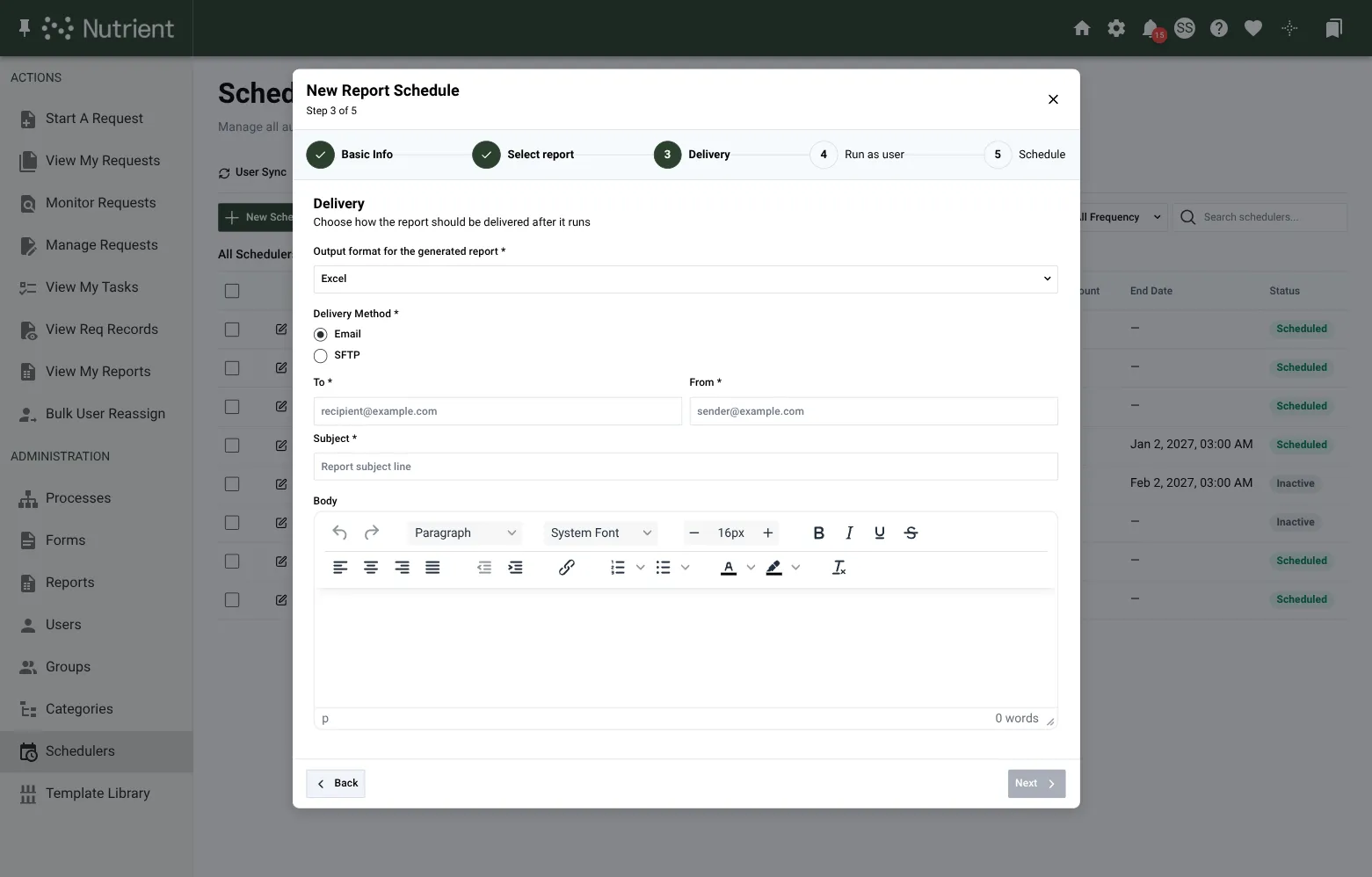
Email delivery
Use email delivery to send the rendered report as an attachment.
| Attribute | Required | Description |
|---|---|---|
| To | Yes | Recipient address. |
| From | Yes | Sender address. |
| Subject | Yes | Email subject line. |
| Body | No | Optional rich-text email body that accompanies the report. |
SFTP delivery
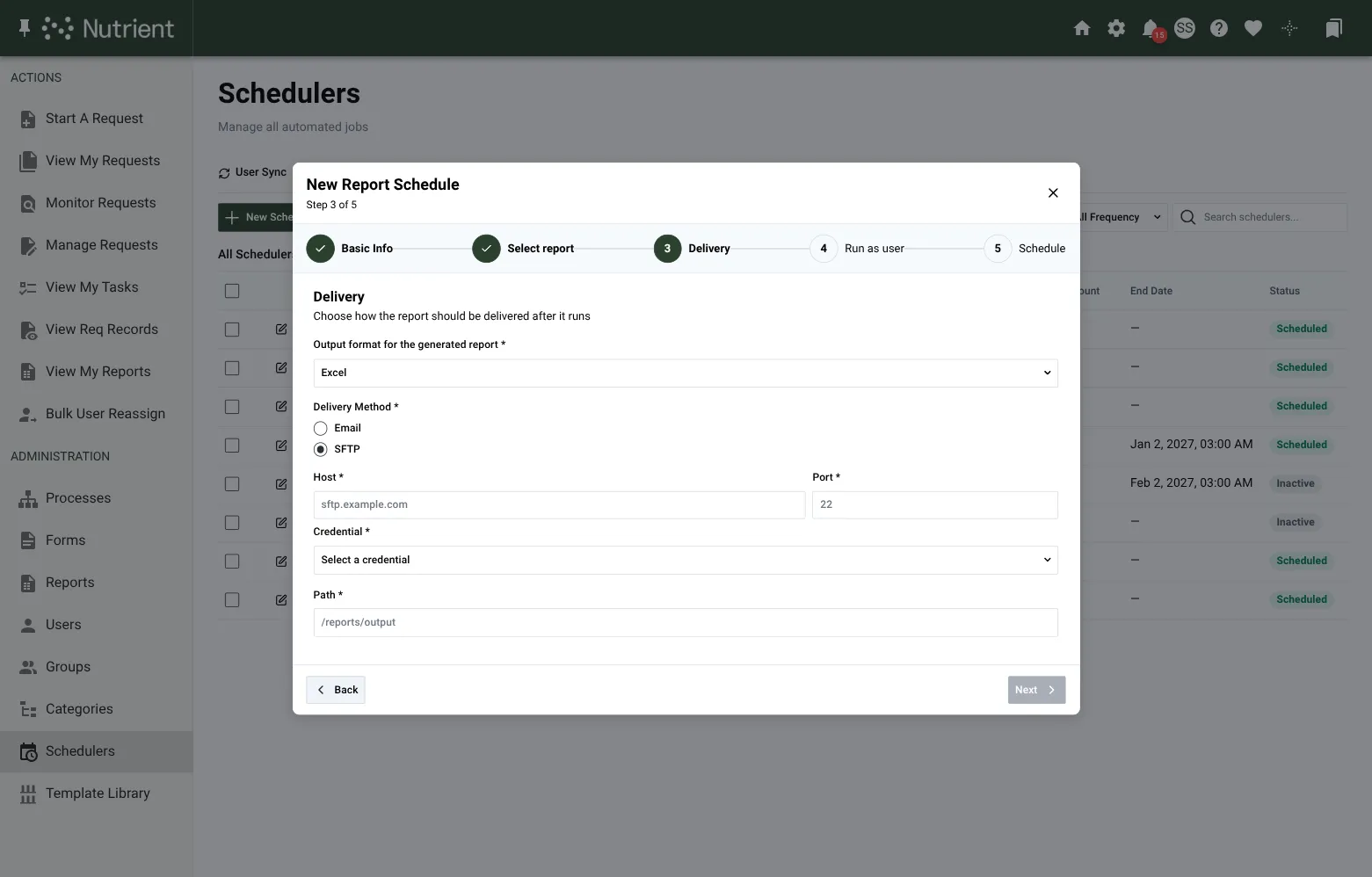
Use SFTP delivery to upload the rendered report to a remote file server.
| Attribute | Required | Description |
|---|---|---|
| Host | Yes | SFTP host name — for example, sftp.example.com. |
| Port | Yes | SFTP port, typically 22. |
| Credential | Yes | A credential from the Credential Center. The schedule never stores SFTP credentials directly. |
| Path | Yes | Remote directory where Nutrient Workflow Automation uploads the rendered report. |
Step four — Run as user
Use this step to select the user account the schedule runs as.
The schedule runs with the selected user’s permissions. Only reports that the Run As user can run will succeed.
The picker is a searchable table with Last Name, First Name, and Email columns. Select a row’s radio button to choose the Run As user.
Nutrient Workflow Automation captures the Run As user at create time. If that user is later deactivated or loses Run permission on the underlying report, the schedule’s runs fail and count toward the auto-disable threshold.
Step five — Schedule
Use this step to set the schedule cadence, start date and time, and optional end date.
You can choose One time or Recurring. For full field descriptions, refer to the schedule section in the Schedulers overview guide.
Detail page
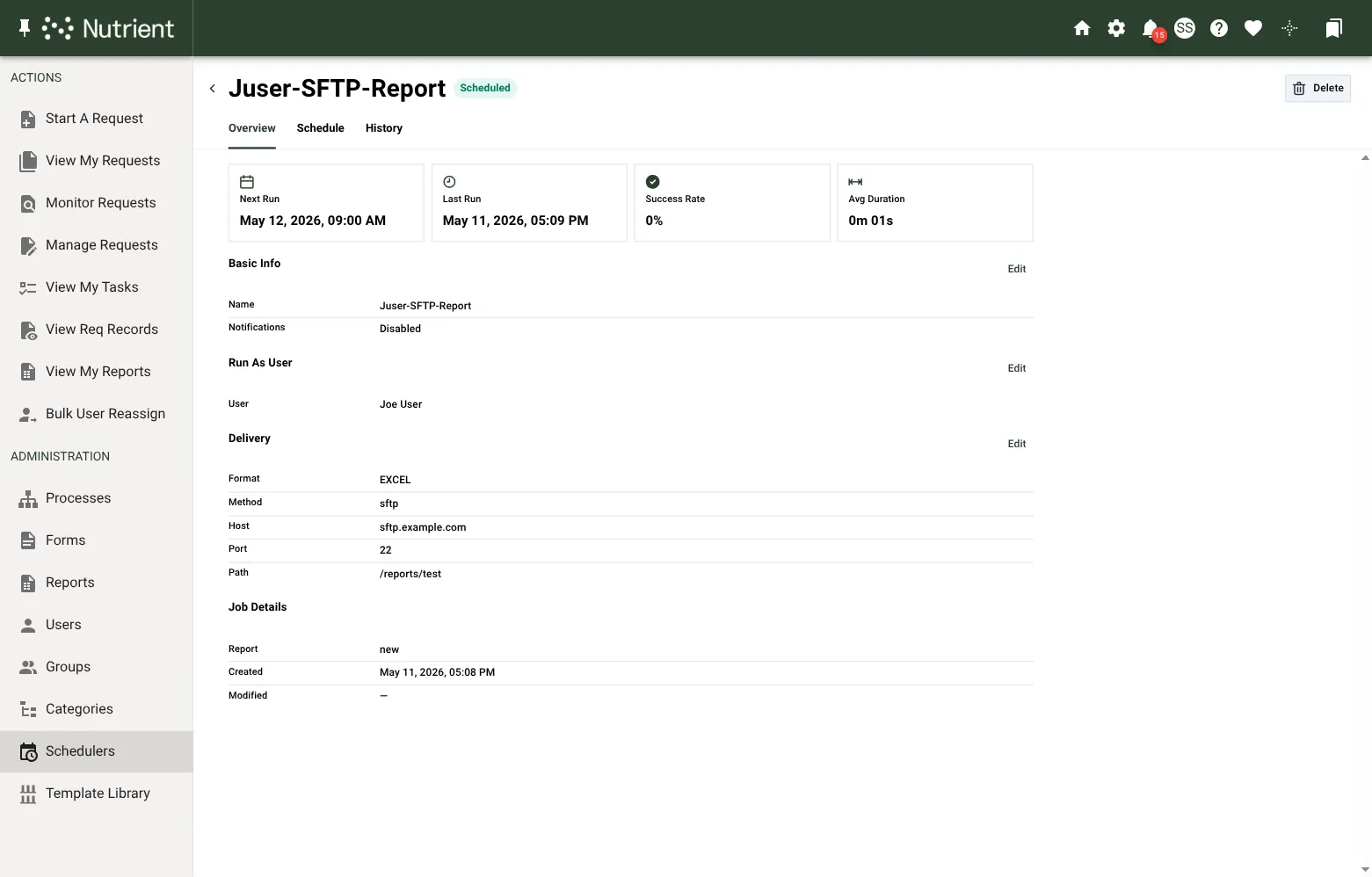
The report schedule detail page shows the standard four stat cards: Next Run, Last Run, Success Rate, and Avg Duration. It also shows four information cards specific to report schedules.
| Card | Contents |
|---|---|
| Basic Info | Schedule name and notifications setting. Edit action available. |
| Run As User | The user account the schedule runs as. Edit action available. |
| Delivery | Output format and delivery method, plus method-specific fields. Email shows To, From, and Subject. SFTP shows Host, Port, and Path. |
| Job Details | Report (the report name), Created, and Modified dates. |
The Schedule and History tabs are the same across all scheduler types. Refer to the schedule section and history section in the Schedulers overview guide.